
右下额叶回作为基底神经节-丘脑皮质反应抑制回路的关键节点和有效调节器。
The right inferior frontal gyrus as pivotal node and effective regulator of the basal ganglia-thalamocortical response inhibition circuit.
作者信息
Zhuang Qian, Qiao Lei, Xu Lei, Yao Shuxia, Chen Shuaiyu, Zheng Xiaoxiao, Li Jialin, Fu Meina, Li Keshuang, Vatansever Deniz, Ferraro Stefania, Kendrick Keith M, Becker Benjamin
机构信息
The Center of Psychosomatic Medicine, Sichuan Provincial Center for Mental Health, Sichuan Provincial People's Hospital, The University of Electronic Science and Technology of China, Chengdu, Sichuan Province 611731, China.
Center for Cognition and Brain Disorders, The Affiliated Hospital of Hangzhou Normal University, Hangzhou, Zhejiang Province 311121, China.
出版信息
Psychoradiology. 2023 Oct 13;3:kkad016. doi: 10.1093/psyrad/kkad016. eCollection 2023.
BACKGROUND
The involvement of specific basal ganglia-thalamocortical circuits in response inhibition has been extensively mapped in animal models. However, the pivotal nodes and directed causal regulation within this inhibitory circuit in humans remains controversial.
OBJECTIVE
The main aim of the present study was to determine the causal information flow and critical nodes in the basal ganglia-thalamocortical inhibitory circuits and also to examine whether these are modulated by biological factors (i.e. sex) and behavioral performance.
METHODS
Here, we capitalize on the recent progress in robust and biologically plausible directed causal modeling (DCM-PEB) and a large response inhibition dataset ( = 250) acquired with concomitant functional magnetic resonance imaging to determine key nodes, their causal regulation and modulation via biological variables (sex) and inhibitory performance in the inhibitory circuit encompassing the right inferior frontal gyrus (rIFG), caudate nucleus (rCau), globus pallidum (rGP), and thalamus (rThal).
RESULTS
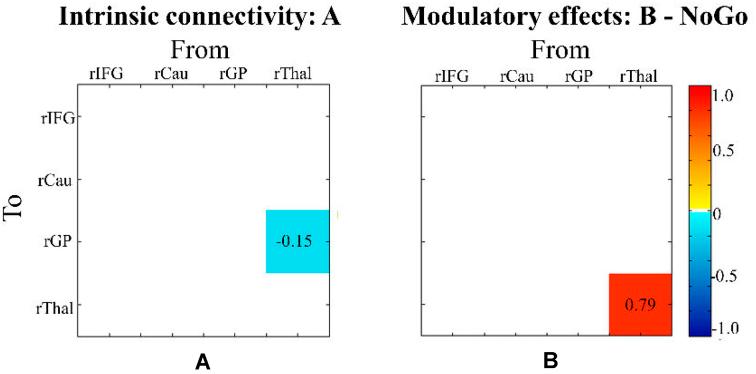
The entire neural circuit exhibited high intrinsic connectivity and response inhibition critically increased causal projections from the rIFG to both rCau and rThal. Direct comparison further demonstrated that response inhibition induced an increasing rIFG inflow and increased the causal regulation of this region over the rCau and rThal. In addition, sex and performance influenced the functional architecture of the regulatory circuits such that women displayed increased rThal self-inhibition and decreased rThal to GP modulation, while better inhibitory performance was associated with stronger rThal to rIFG communication. Furthermore, control analyses did not reveal a similar key communication in a left lateralized model.
CONCLUSIONS
Together, these findings indicate a pivotal role of the rIFG as input and causal regulator of subcortical response inhibition nodes.
背景
特定的基底神经节 - 丘脑皮质回路在反应抑制中的作用已在动物模型中得到广泛研究。然而,人类这种抑制性回路中的关键节点以及直接因果调节仍存在争议。
目的
本研究的主要目的是确定基底神经节 - 丘脑皮质抑制性回路中的因果信息流和关键节点,并检验这些是否受生物学因素(即性别)和行为表现的调节。
方法
在此,我们利用稳健且具有生物学合理性的定向因果建模(DCM - PEB)的最新进展以及通过功能磁共振成像同时获取的大型反应抑制数据集(n = 250),以确定关键节点、它们的因果调节以及在包含右侧额下回(rIFG)、尾状核(rCau)、苍白球(rGP)和丘脑(rThal)的抑制性回路中通过生物学变量(性别)和抑制表现的调节。
结果
整个神经回路表现出高度的内在连通性,反应抑制显著增加了从rIFG到rCau和rThal的因果投射。直接比较进一步表明,反应抑制诱导rIFG的流入增加,并增强了该区域对rCau和rThal的因果调节。此外,性别和表现影响调节回路的功能结构,女性表现出rThal自我抑制增加以及rThal对GP调节减少,而更好的抑制表现与更强的rThal到rIFG通信相关。此外,对照分析在左侧化模型中未发现类似的关键通信。
结论
总之,这些发现表明rIFG作为皮质下反应抑制节点的输入和因果调节器具有关键作用。


 Zotero 插件