Kellogg D R, Oegema K, Raff J, Schneider K, Alberts B M
Department of Biochemistry and Biophysics, University of California, San Francisco 94143-0448, USA.
Mol Biol Cell. 1995 Dec;6(12):1673-84. doi: 10.1091/mbc.6.12.1673.
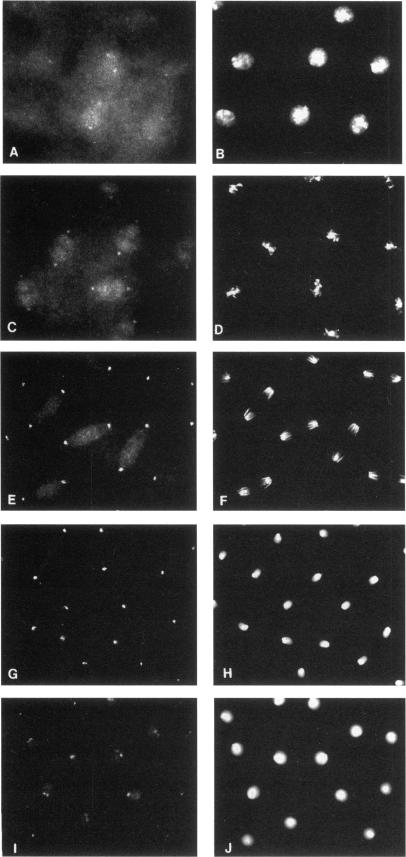
DMAP190 is a microtubule-associated protein from Drosophila that is localized to the centrosome. In a previous study, we used affinity chromatography to identify proteins that interact with DMAP190, and identified a 60-kDa protein that we named DMAP60 (Kellogg and Alberts, 1992). Like DMAP190, DMAP60 interacts with microtubules and is localized to the centrosome, and the two proteins associate as part of a multiprotein complex. We now report the cloning and sequencing of the cDNA encoding DMAP60. The amino acid sequence of DMAP60 is not homologous to any protein in the database, although it contains six consensus sites for phosphorylation by cyclin-dependent kinases. As judged by in situ hybridization, the gene for DMAP60 maps to chromosomal region 46A. In agreement with others working on Drosophila centrosomal proteins, we have changed the names for DMAP190 and DMAP60 to CP190 and CP60, respectively, to give these proteins a consistent nomenclature. Antibodies that recognize CP60 reveal that it is localized to the centrosome in a cell cycle-dependent manner. The amount of CP60 at the centrosome is maximal during anaphase and telophase, and then drops dramatically during late telophase or early interphase. This dramatic disappearance of CP60 may be due to specific proteolysis, because CP60 contains a sequence of amino acids similar to the "destruction box" that targets cyclins for proteolysis at the end of mitosis. Starting with nuclear cycle 12, CP60 and CP190 are both found in the nucleus during interphase. CP60 isolated from Drosophila embryos is highly phosphorylated, and dephosphorylated CP60 is a good substrate for cyclin B/p34cdc2 kinase complexes. A second kinase activity capable of phosphorylating CP60 is present in the CP60/CP190 multiprotein complex. We find that bacterially expressed CP60 binds to purified microtubules, and this binding is blocked by CP60 phosphorylation.
DMAP190是一种来自果蝇的微管相关蛋白,定位于中心体。在之前的一项研究中,我们使用亲和层析来鉴定与DMAP190相互作用的蛋白,并鉴定出一种60 kDa的蛋白,我们将其命名为DMAP60(凯洛格和阿尔伯茨,1992年)。与DMAP190一样,DMAP60与微管相互作用并定位于中心体,这两种蛋白作为多蛋白复合物的一部分相互关联。我们现在报告编码DMAP60的cDNA的克隆和测序。DMAP60的氨基酸序列与数据库中的任何蛋白都不同源,尽管它含有六个细胞周期蛋白依赖性激酶磷酸化的共有位点。通过原位杂交判断,DMAP60基因定位于染色体区域46A。与其他研究果蝇中心体蛋白的人员一致,我们已分别将DMAP190和DMAP60的名称更改为CP190和CP60,以使这些蛋白有一致的命名法。识别CP60的抗体显示它以细胞周期依赖性方式定位于中心体。中心体处CP60的量在后期和末期最大,然后在末期后期或间期早期急剧下降。CP60的这种急剧消失可能是由于特异性蛋白水解,因为CP60含有一段与“破坏框”相似的氨基酸序列,该序列在有丝分裂末期靶向细胞周期蛋白进行蛋白水解。从核周期12开始,CP60和CP190在间期都存在于细胞核中。从果蝇胚胎中分离出的CP60高度磷酸化,去磷酸化的CP60是细胞周期蛋白B/p34cdc2激酶复合物的良好底物。CP60/CP190多蛋白复合物中存在第二种能够磷酸化CP60的激酶活性。我们发现细菌表达的CP60与纯化的微管结合,并且这种结合被CP60磷酸化所阻断。