Woffendin C, Ranga U, Yang Z, Xu L, Nabel G J
Howard Hughes Medical Institute, University of Michigan Medical Center, Ann Arbor 48109-0650, USA.
Proc Natl Acad Sci U S A. 1996 Apr 2;93(7):2889-94. doi: 10.1073/pnas.93.7.2889.
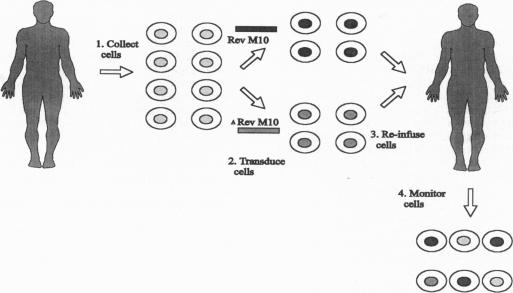
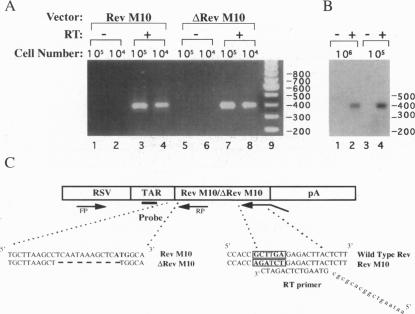
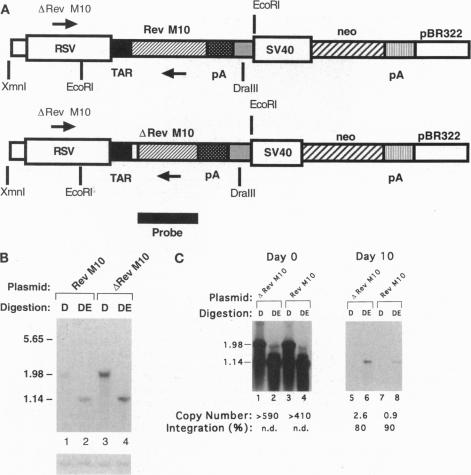
The resistance of acquired immunodeficiency syndrome (AIDS) to traditional drug therapy has prompted a search for alternative treatments for this disease. One potential approach is to provide genetic resistance to viral replication to prolong latency. This strategy requires the definition of effective antiviral genes that extend the survival of T cells in human immunodeficiency virus (HIV)-infected individuals. We report the results of a human study designed to determine whether a genetic intervention can prolong the survival of T cells in HIV-infected individuals. Gene transfer was performed in enriched CD4+ cells with plasmid expression vectors encoding an inhibitory Rev protein, Rev M10, or a deletion mutant control, deltaRev M10, delivered by gold microparticles. Autologous cells separately transfected with each of the vectors were returned to each patient, and toxicity, gene expression, and survival of genetically modified cells were assessed. Cells that expressed Rev M10 were more resistant to HIV infection than those with deltaRev M10 in vitro. In HIV-infected subjects, Rev M10-transduced cells showed preferential survival compared to deltaRev M10 controls. Rev M10 can therefore act as a specific intracellular inhibitor that can prolong T-cell survival in HIV-1-infected individuals and potentially serve as a molecular genetic intervention which can contribute to the treatment of AIDS.
获得性免疫缺陷综合征(艾滋病)对传统药物疗法产生的耐药性促使人们寻找针对该疾病的替代治疗方法。一种潜在的方法是提供对病毒复制的基因抗性以延长潜伏期。该策略需要确定有效的抗病毒基因,这些基因可延长人类免疫缺陷病毒(HIV)感染个体中T细胞的存活时间。我们报告了一项人体研究的结果,该研究旨在确定基因干预是否能够延长HIV感染个体中T细胞的存活时间。使用编码抑制性Rev蛋白Rev M10或缺失突变体对照deltaRev M10的质粒表达载体,通过金微粒将基因导入富集的CD4 +细胞中。将分别用每种载体转染的自体细胞回输到每位患者体内,并评估转基因细胞的毒性、基因表达和存活情况。在体外,表达Rev M10的细胞比表达deltaRev M10的细胞对HIV感染更具抗性。在HIV感染的受试者中,与deltaRev M10对照相比,转导Rev M10的细胞显示出优先存活。因此,Rev M10可作为一种特异性细胞内抑制剂,能够延长HIV-1感染个体中T细胞的存活时间,并有可能作为一种分子遗传学干预手段,为艾滋病的治疗做出贡献。