Ho S, Cheng P, Yuen J, Chan A, Leung N, Yeo W, Leung T, Lau W Y, Li A K, Johnson P J
Department of Clinical Oncology, Chinese University of Hong Kong, Prince of Wales Hospital, Shatin, New Territories.
Br J Cancer. 1996 Apr;73(8):985-8. doi: 10.1038/bjc.1996.192.
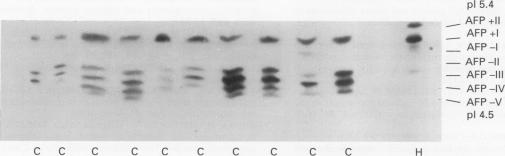
Serum levels of alphafetoprotein are raised in 60-80% of patients with hepatocellular carcinoma. Although widely used as a serum marker, frequent false-positive results in patients with benign liver disease, result in poor specificity. This occurs particularly when levels of alphafetoprotein fall between 50-500 ng ml-1, the so-called 'grey area'. Recent reports suggest that isoelectric focusing of alphafetoprotein demonstrates certain bands that are more specific for hepatocellular carcinoma. Our aim was to determine whether the apparent specificity of this new approach is gained at the expense of decreased sensitivity. Sera from 110 patients with a 'non-diagnostic' serum alphafetoprotein level (50-500 ng ml-1) were examined by isoelectric focusing and quantified by densitometric scanning. Ten patients with chronic liver disease and a raised serum alphafetoprotein level (50-500 ng ml-1), but with no evidence of hepatocellular carcinoma, were also studied. Isoelectric focusing revealed characteristic hepatocellular carcinoma bands (bands +II and +III) in 96% patients overall, and 100% of those with levels of total alphafetoprotein greater than 100 ng ml-1. No such bands were seen among ten subjects with cirrhosis but without hepatocellular carcinoma. Bands that are characteristic of hepatocellular carcinoma (bands +II or +III) are seen in the great majority of hepatocellular carcinoma patients; their absence makes a diagnosis of hepatocellular carcinoma extremely unlikely.
60% - 80%的肝细胞癌患者血清甲胎蛋白水平升高。尽管甲胎蛋白作为一种血清标志物被广泛应用,但在良性肝病患者中经常出现假阳性结果,导致其特异性较差。这种情况尤其发生在甲胎蛋白水平处于50 - 500 ng/ml之间时,即所谓的“灰色区域”。最近的报告表明,甲胎蛋白的等电聚焦显示出某些对肝细胞癌更具特异性的条带。我们的目的是确定这种新方法的明显特异性是否是以降低敏感性为代价获得的。通过等电聚焦检查了110例血清甲胎蛋白水平“无法诊断”(50 - 500 ng/ml)的患者的血清,并通过光密度扫描进行定量。还研究了10例慢性肝病且血清甲胎蛋白水平升高(50 - 500 ng/ml)但无肝细胞癌证据的患者。等电聚焦显示,总体上96%的患者出现了特征性的肝细胞癌条带(条带+II和+III),甲胎蛋白总水平大于100 ng/ml的患者中这一比例为100%。在10例有肝硬化但无肝细胞癌的患者中未观察到此类条带。绝大多数肝细胞癌患者可见肝细胞癌特征性条带(条带+II或+III);若没有这些条带,则肝细胞癌的诊断极不可能。