Szabo A, Korszun R, Hartl F U, Flanagan J
Howard Hughes Medical Institute, Memorial Sloan-Kettering Cancer Center, New York, 10021, USA.
EMBO J. 1996 Jan 15;15(2):408-17.
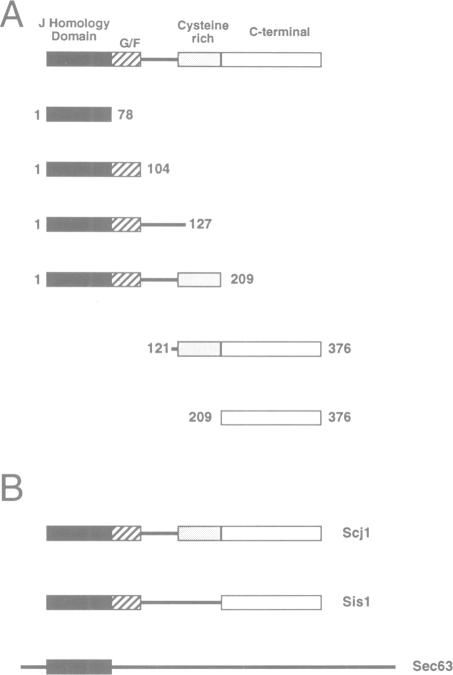
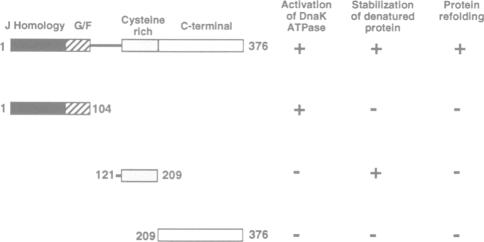
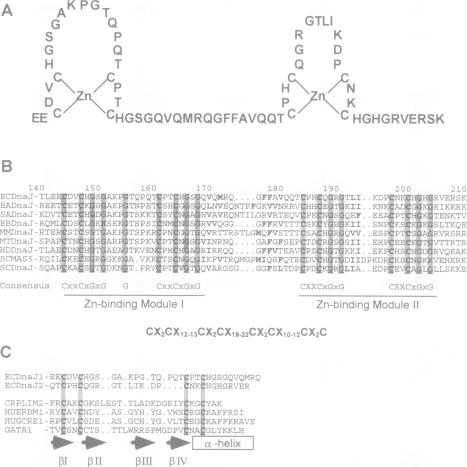
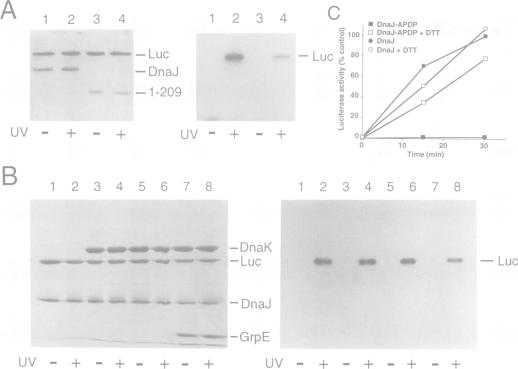
The Escherichia coli heat-shock protein DnaJ cooperates with the Hsp70 homolog DnaK in protein folding in vitro and in vivo. Little is known about the structural features of DnaJ that mediate its interaction with DnaK and unfolded polypeptide. DnaJ contains at least four blocks of sequence representing potential functional domains which have been conserved throughout evolution. In order to understand the role of each of these regions, we have analyzed DnaJ fragments in reactions corresponding to known functions of the intact protein. Both the N-terminal 70 amino acid 'J-domain' and a 35 amino acid glycine-phenylalanine region following it are required for interactions with DnaK. However, only complete DnaJ can cooperate with DnaK and a third protein, GrpE, in refolding denatured firefly luciferase. As demonstrated by atomic absorption and extended X-ray absorption fine structure spectroscopy (EXAFS), the 90 amino acid cysteine-rich region of DnaJ contains two Zn atoms tetrahedrally coordinated to four cysteine residues, resembling their arrangement in the C4 Zn binding domains of certain DNA binding proteins. Interestingly, binding experiments and cross-linking studies indicate that this Zn finger-like domain is required for the DnaJ molecular chaperone to specifically recognize and bind to proteins in their denatured state.
大肠杆菌热休克蛋白DnaJ在体外和体内的蛋白质折叠过程中与Hsp70同源物DnaK协同作用。关于介导其与DnaK和未折叠多肽相互作用的DnaJ的结构特征,人们了解甚少。DnaJ包含至少四个序列模块,代表在整个进化过程中保守的潜在功能域。为了了解这些区域各自的作用,我们分析了与完整蛋白已知功能相对应的反应中的DnaJ片段。与DnaK相互作用需要N端的70个氨基酸的“J结构域”及其后的35个氨基酸的甘氨酸-苯丙氨酸区域。然而,只有完整的DnaJ才能与DnaK和第三种蛋白GrpE协同作用,使变性的萤火虫荧光素酶重新折叠。如原子吸收和扩展X射线吸收精细结构光谱(EXAFS)所示,DnaJ的富含90个氨基酸的半胱氨酸区域包含两个锌原子,它们以四面体方式与四个半胱氨酸残基配位,类似于它们在某些DNA结合蛋白的C4锌结合结构域中的排列。有趣的是,结合实验和交联研究表明,这种锌指样结构域是DnaJ分子伴侣特异性识别并结合变性状态蛋白质所必需的。