Zlokovic B V, Martel C L, Matsubara E, McComb J G, Zheng G, McCluskey R T, Frangione B, Ghiso J
Department of Neurological Surgery, Childrens Hospital, Los Angeles, CA, USA.
Proc Natl Acad Sci U S A. 1996 Apr 30;93(9):4229-34. doi: 10.1073/pnas.93.9.4229.
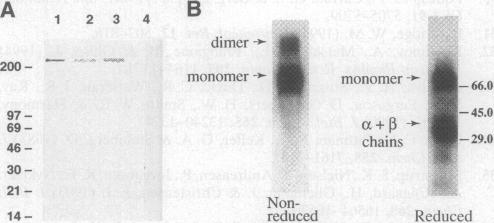
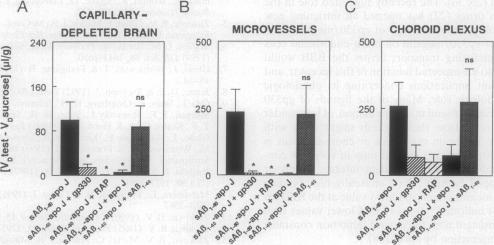
A soluble form of Alzheimer disease amyloid beta-protein (sA beta) is transported in the blood and cerebrospinal fluid mainly complexed with apolipoprotein J (apoJ). Using a well-characterized in situ perfused guinea pig brain model, we recently obtained preliminary evidence that apoJ facilitates transport of sA beta (1-40)-apoJ complexes across the blood-brain barrier and the blood-cerebrospinal fluid barrier, but the mechanisms remain poorly understood. In the present study, we examined the transport process in greater detail and investigated the possible role of glycoprotein 330 (gp330)/megalin, a receptor for multiple ligands, including apoJ. High-affinity transport systems with a Km of 0.2 and 0.5 nM were demonstrated for apoJ at the blood-brain barrier and the choroid epithelium in vivo, suggesting a specific receptor-mediated mechanism. The sA beta (1-40)-apoJ complex shared the same transport mechanism and exhibited 2.4- to 10.2-fold higher affinity than apoJ itself. Binding to microvessels, transport into brain parenchyma, and choroidal uptake of both apoJ and sA beta (1-40)-apoJ complexes were markedly inhibited (74-99%) in the presence of a monoclonal antibody to gp330/megalin and were virtually abolished by perfusion with the receptor-associated protein, which blocks binding of all known ligands to gp330. Western blot analysis of cerebral microvessels with the monoclonal antibody to gp330 revealed a protein with a mass identical to that in extracts of kidney membranes enriched with gp330/megalin, but in much lower concentration. The findings suggest that gp330/megalin mediates cellular uptake and transport of apoJ and sA beta (1-40)-apoJ complex at the cerebral vascular endothelium and choroid epithelium.
阿尔茨海默病β-淀粉样蛋白的可溶性形式(sAβ)在血液和脑脊液中运输,主要与载脂蛋白J(apoJ)形成复合物。利用特征明确的原位灌注豚鼠脑模型,我们最近获得了初步证据,表明apoJ促进sAβ(1-40)-apoJ复合物穿过血脑屏障和血脑脊液屏障,但具体机制仍知之甚少。在本研究中,我们更详细地研究了运输过程,并探讨了糖蛋白330(gp330)/巨膜蛋白(一种多种配体的受体,包括apoJ)的可能作用。在体内血脑屏障和脉络丛上皮中,apoJ表现出Km分别为0.2和0.5 nM的高亲和力转运系统,提示存在特异性受体介导的机制。sAβ(1-40)-apoJ复合物具有相同的转运机制,且亲和力比apoJ本身高2.4至10.2倍。在存在抗gp330/巨膜蛋白单克隆抗体的情况下,apoJ和sAβ(1-40)-apoJ复合物与微血管的结合、向脑实质的转运以及脉络丛摄取均受到显著抑制(74-99%),并且在用受体相关蛋白灌注后几乎完全消除,该蛋白可阻断所有已知配体与gp330的结合。用抗gp330单克隆抗体对脑微血管进行蛋白质印迹分析,发现一种蛋白质,其分子量与富含gp330/巨膜蛋白的肾膜提取物中的蛋白质相同,但浓度低得多。这些发现表明,gp330/巨膜蛋白在脑血管内皮和脉络丛上皮介导apoJ和sAβ(1-40)-apoJ复合物的细胞摄取和转运。