Rosenshine I, Ruschkowski S, Stein M, Reinscheid D J, Mills S D, Finlay B B
Department of Biotechnology and Molecular Genetics, The Hebrew University, Faculty of Medicine, Israel.
EMBO J. 1996 Jun 3;15(11):2613-24.
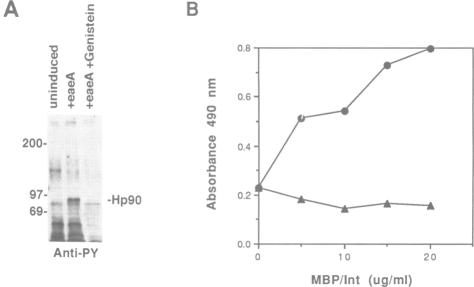
Enteropathogenic E. coli (EPEC) belongs to a group of bacterial pathogens that induce actin accumulation beneath adherent bacteria. We found that EPEC adherence to epithelial cells mediates the formation of fingerlike pseudopods (up to 10 microm) beneath bacteria. These actin-rich structures also contain tyrosine phosphorylated host proteins concentrated at the pseudopod tip beneath adherent EPEC. Intimate bacterial adherence (and pseudopod formation) occurred only after prior bacterial induction of tyrosine phosphorylation of an epithelial membrane protein, Hp90, which then associates directly with an EPEC adhesin, intimin. These interactions lead to cytoskeletal nucleation and pseudopod formation. This is the first example of a bacterial pathogen that triggers signals in epithelial cells which activates receptor binding activity to a specific bacterial ligand and subsequent cytoskeletal rearrangement.
肠道致病性大肠杆菌(EPEC)属于一类能在黏附细菌下方诱导肌动蛋白聚集的细菌病原体。我们发现,EPEC对上皮细胞的黏附介导了细菌下方指状伪足(长达10微米)的形成。这些富含肌动蛋白的结构还含有酪氨酸磷酸化的宿主蛋白,这些蛋白集中在黏附的EPEC下方的伪足尖端。紧密的细菌黏附(以及伪足形成)仅在细菌预先诱导上皮膜蛋白Hp90的酪氨酸磷酸化后发生,然后Hp90直接与EPEC黏附素intimin结合。这些相互作用导致细胞骨架成核和伪足形成。这是细菌病原体触发上皮细胞信号从而激活对特定细菌配体的受体结合活性以及随后细胞骨架重排的首个例子。