Ruiz-Echevarria M J, Peltz S W
Department of Molecular Genetics and Microbiology, University of Medicine and Dentistry of New Jersey, Robert Wood Johnson Medical School, NJ 08854, USA.
EMBO J. 1996 Jun 3;15(11):2810-9.
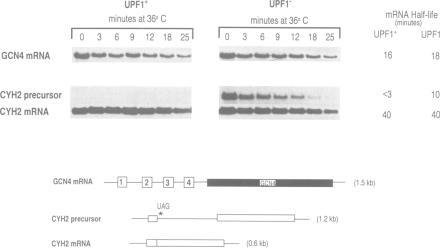
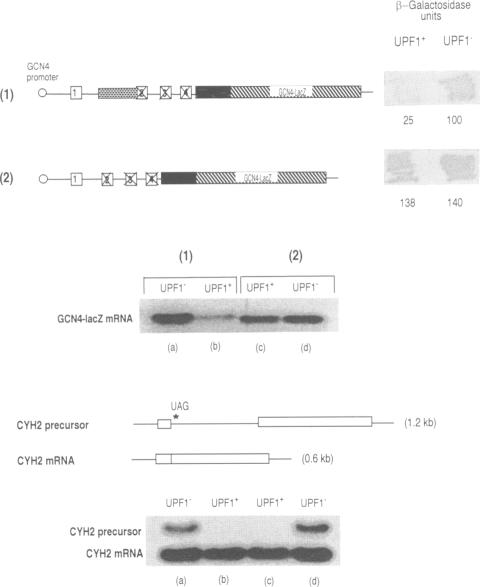
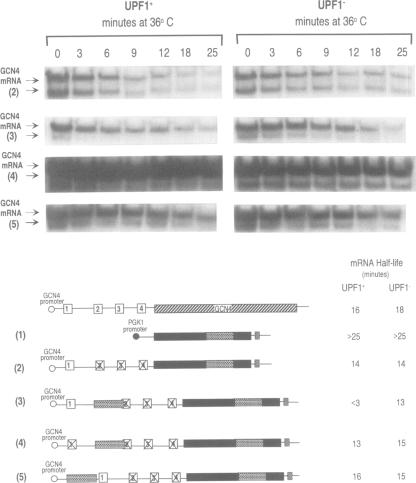
In the yeast Saccharomyces cerevisiae, premature translation termination promotes rapid degradation of mRNAs. Accelerated decay requires the presence of specific cis-acting sequences which have been defined as downstream elements. It has been proposed that the role of the downstream element may be to promote translational reinitiation or ribosomal pausing. The GCN4 gene produces an mRNA that contains four short upstream open reading frames (uORFs) preceding the GCN4 protein-coding region in which translational initiation and reinitiation events occur. It was anticipated that these uORFs would function in a manner analogous to nonsense codons, promoting rapid degradation of the mRNA. However, the GCN4 transcript was not degraded by the nonsense-mediated mRNA decay pathway. We have investigated the role of the leader region of the GCN4 transcript in an effort to identify possible sequence elements that inactivate this decay pathway. We show that the GCN4 leader region does not harbor a downstream element needed to promote mRNA decay. In addition, using hybrid GCN4-PGK1 transcripts, we demonstrate that if a translational reinitiation signal precedes a downstream element, the mRNA will no longer be sensitive to nonsense-mediated decay. Furthermore, we demonstrate that the downstream element is functional only after a translational initiation and termination cycle has been completed but is unable to promote nonsense-mediated mRNA decay if it is situated 5' of a translational initiation site. Based on these results, the role of the downstream element will be discussed.
在酿酒酵母中,过早的翻译终止会促进mRNA的快速降解。加速降解需要特定顺式作用序列的存在,这些序列已被定义为下游元件。有人提出,下游元件的作用可能是促进翻译重新起始或核糖体暂停。GCN4基因产生的mRNA在GCN4蛋白编码区之前包含四个短的上游开放阅读框(uORF),其中发生翻译起始和重新起始事件。预计这些uORF会以类似于无义密码子的方式发挥作用,促进mRNA的快速降解。然而,GCN4转录本并未通过无义介导的mRNA降解途径降解。我们研究了GCN4转录本前导区的作用,以确定可能使这种降解途径失活的序列元件。我们表明,GCN4前导区不包含促进mRNA降解所需的下游元件。此外,使用杂交的GCN4-PGK1转录本,我们证明如果翻译重新起始信号先于下游元件,mRNA将不再对无义介导的降解敏感。此外,我们证明下游元件仅在翻译起始和终止循环完成后才起作用,但如果它位于翻译起始位点的5'端,则无法促进无义介导的mRNA降解。基于这些结果,将讨论下游元件的作用。