Flavell D M, Wells T, Wells S E, Carmignac D F, Thomas G B, Robinson I C
Division of Neurophysiology, National Institute for Medical Research, The Ridgeway, Mill Hill, London NW7 1AA, UK.
EMBO J. 1996 Aug 1;15(15):3871-9.
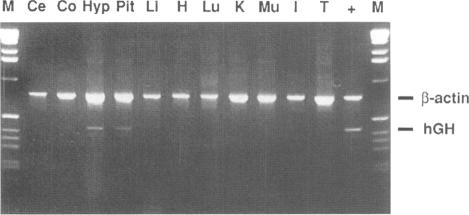
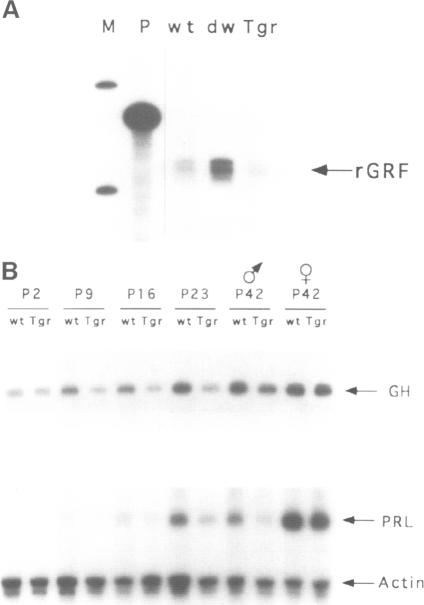
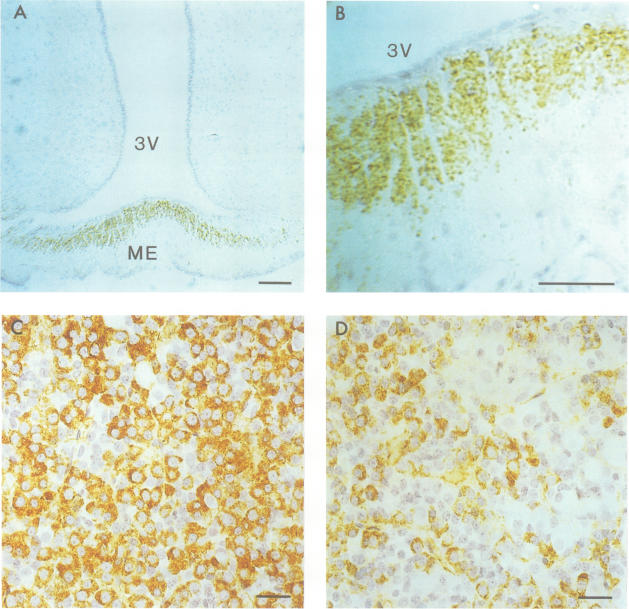
Expression of human growth hormone (hGH) was targeted to growth hormone-releasing (GRF) neurons in the hypothalamus of transgenic rats. This induced dominant dwarfism by local feedback inhibition of GRF. One line, bearing a single copy of a GRF-hGH transgene, has been characterized in detail, and has been termed Tgr (for Transgenic growth-retarded). hGH was detected by immunocytochemistry in the brain, restricted to the median eminence of the hypothalamus. Low levels were also detected in the anterior pituitary gland by radioimmunoassay. Transgene expression in these sites was confirmed by RT-PCR. Tgr rats had reduced hypothalamic GRF and mRNA, in contrast to the increased GRF expression which accompanies GH deficiency in other dwarf rats. Endogenous GH mRNA, GH content, pituitary size and somatotroph cell number were also reduced significantly in Tgr rats. Pituitary adrenocorticotrophic hormone (ACTH) and thyroid-stimulating hormone (TSH) levels were normal, but prolactin content, mRNA levels and lactotroph cell numbers were also slightly reduced, probably due to feedback inhibition of prolactin by the lactogenic properties of the hGH transgene. This is the first dominant dwarf rat strain to be reported and will provide a valuable model for evaluating the effects of transgene expression on endogenous GH secretion, as well as the use of GH secretagogues for the treatment of dwarfism.
人类生长激素(hGH)的表达被靶向到转基因大鼠下丘脑的生长激素释放(GRF)神经元。这通过GRF的局部反馈抑制诱导了显性侏儒症。其中一个携带GRF-hGH转基因单拷贝的品系已被详细表征,并被命名为Tgr(转基因生长迟缓)。通过免疫细胞化学在脑中检测到hGH,其仅限于下丘脑的正中隆起。通过放射免疫测定法在前垂体腺中也检测到低水平。通过RT-PCR证实了这些位点的转基因表达。与其他侏儒大鼠中伴随GH缺乏的GRF表达增加相反,Tgr大鼠的下丘脑GRF和mRNA减少。Tgr大鼠的内源性GH mRNA、GH含量、垂体大小和生长激素细胞数量也显著减少。垂体促肾上腺皮质激素(ACTH)和促甲状腺激素(TSH)水平正常,但催乳素含量、mRNA水平和催乳素细胞数量也略有减少,这可能是由于hGH转基因的催乳特性对催乳素的反馈抑制所致。这是首次报道的显性侏儒大鼠品系,将为评估转基因表达对内源性GH分泌的影响以及使用GH促分泌剂治疗侏儒症提供有价值的模型。