Tamimi Y, Bringuier P P, Smit F, van Bokhoven A, Debruyne F M, Schalken J A
Department of Urology/Urological Research Laboratory, University Hospital Nijmegen, The Netherlands.
Br J Cancer. 1996 Jul;74(1):120-2. doi: 10.1038/bjc.1996.325.
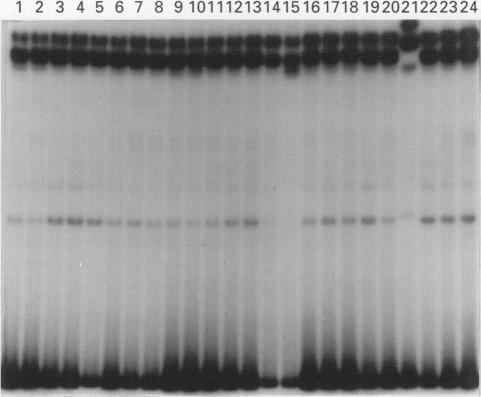
Cyclin-dependent kinase-4 inhibitor gene (p16INK4) has recently been mapped to chromosome 9p21. Homozygous deletions of this gene have been found at high frequency in cell lines derived from different types of tumours. These findings suggested therefore, that p16INK4 is a tumour-suppressor gene involved in a wide variety of human cancers. To investigate the frequency of p16INK mutations/deletions in prostate cancer, we screened 20 primary prostate tumours and four established cell lines by polymerase chain reaction (PCR) and single-strand conformation polymorphism (SSCP) analysis for exon 1 and exon 2. In contrast to most previous reports, no homozygous deletions were found in prostate cancer cell lines, but one cell line (DU145) has revealed to a mutation at codon 76. Only two SSCP shifts were detected in primary tumours: one of them corresponds to a mutation at codon 55 and the other one probably corresponds to a polymorphism. These data suggest that mutation of the p16INK4 gene is not a frequent genetic alteration implicated in prostate cancer development.
细胞周期蛋白依赖性激酶4抑制基因(p16INK4)最近被定位于9号染色体p21区域。在源自不同类型肿瘤的细胞系中,该基因的纯合缺失出现频率很高。因此,这些发现表明p16INK4是一种参与多种人类癌症的肿瘤抑制基因。为了研究前列腺癌中p16INK突变/缺失的频率,我们通过聚合酶链反应(PCR)和单链构象多态性(SSCP)分析,对20例原发性前列腺肿瘤和4个已建立的细胞系的外显子1和外显子2进行了筛查。与大多数先前的报道不同,在前列腺癌细胞系中未发现纯合缺失,但一个细胞系(DU145)在密码子76处发现了一个突变。在原发性肿瘤中仅检测到两个SSCP迁移:其中一个对应于密码子55处的突变,另一个可能对应于多态性。这些数据表明,p16INK4基因的突变不是前列腺癌发生过程中常见的基因改变。