Oldham S M, Clark G J, Gangarosa L M, Coffey R J, Der C J
Department of Pharmacology, University of North Carolina, Chapel Hill 27599, USA.
Proc Natl Acad Sci U S A. 1996 Jul 9;93(14):6924-8. doi: 10.1073/pnas.93.14.6924.
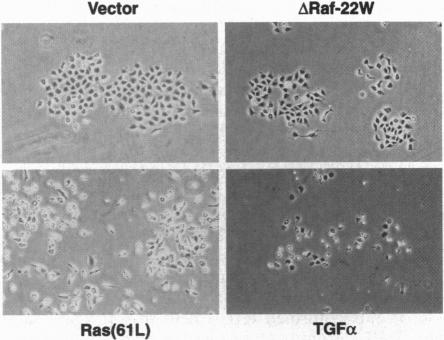
The potent transforming activity of membrane-targeted Raf-1 (Raf-CAAX) suggests that Ras transformation is triggered primarily by a Ras-mediated translocation of Raf-1 to the plasma membrane. However, whereas constitutively activated mutants of Ras [H-Ras(61L) and K-Ras4B(12V)] and Raf-1 (DeltaRaf-22W and Raf-CAAX) caused indistinguishable morphologic and growth (in soft agar and nude mice) transformation of NIH 3T3 fibroblasts, only mutant Ras caused morphologic transformation of RIE-1 rat intestinal cells. Furthermore, only mutant Ras-expressing RIE-1 cells formed colonies in soft agar and developed rapid and progressive tumors in nude mice. We also observed that activated Ras, but not Raf-1, caused transformation of IEC-6 rat intestinal and MCF-10A human mammary epithelial cells. Although both Ras- and DeltaRaf-22W-expressing RIE-1 cells showed elevated Raf-1 and mitogen-activated protein (MAP) kinase activities, only Ras-transformed cells produced secreted factors that promoted RIE-1 transformation. Incubation of untransformed RIE-1 cells in the presence of conditioned medium from Ras-expressing, but not DeltaRaf-22W-expressing, cells caused a rapid and stable morphologic transformation that was indistinguishable from the morphology of Ras-transformed RIE-1 cells. Thus, induction of an autocrine growth mechanism may distinguish the transforming actions of Ras and Raf. In summary, our observations demonstrate that oncogenic Ras activation of the Raf/MAP kinase pathway alone is not sufficient for full tumorigenic transformation of RIE-1 epithelial cells. Thus, Raf-independent signaling events are essential for oncogenic Ras transformation of epithelial cells, but not fibroblasts.
膜靶向Raf-1(Raf-CAAX)的强大转化活性表明,Ras转化主要是由Ras介导的Raf-1向质膜的易位触发的。然而,虽然Ras的组成型激活突变体[H-Ras(61L)和K-Ras4B(12V)]以及Raf-1(DeltaRaf-22W和Raf-CAAX)导致NIH 3T3成纤维细胞在形态和生长(在软琼脂中和裸鼠体内)方面发生难以区分的转化,但只有突变型Ras导致RIE-1大鼠肠细胞发生形态转化。此外,只有表达突变型Ras的RIE-1细胞在软琼脂中形成集落,并在裸鼠体内形成快速进展的肿瘤。我们还观察到,激活的Ras而非Raf-1导致IEC-6大鼠肠上皮细胞和MCF-10A人乳腺上皮细胞发生转化。虽然表达Ras和DeltaRaf-22W的RIE-1细胞均显示Raf-1和丝裂原活化蛋白(MAP)激酶活性升高,但只有Ras转化的细胞产生促进RIE-1转化的分泌因子。在来自表达Ras而非表达DeltaRaf-22W的细胞的条件培养基存在下培养未转化的RIE-1细胞,会导致快速且稳定的形态转化,这与Ras转化的RIE-1细胞的形态难以区分。因此,自分泌生长机制的诱导可能区分Ras和Raf的转化作用。总之,我们的观察结果表明,单独激活Raf/MAP激酶途径的致癌性Ras不足以使RIE-1上皮细胞发生完全的致瘤转化。因此,不依赖Raf的信号事件对于上皮细胞而非成纤维细胞的致癌性Ras转化至关重要。