
沙美特罗在体外与人中性粒细胞的抗炎、膜稳定相互作用。
Anti-inflammatory, membrane-stabilizing interactions of salmeterol with human neutrophils in vitro.
作者信息
Anderson R, Feldman C, Theron A J, Ramafi G, Cole P J, Wilson R
机构信息
Department of Immunology, University of Pretoria, South Africa.
出版信息
Br J Pharmacol. 1996 Apr;117(7):1387-94. doi: 10.1111/j.1476-5381.1996.tb15297.x.
Abstract
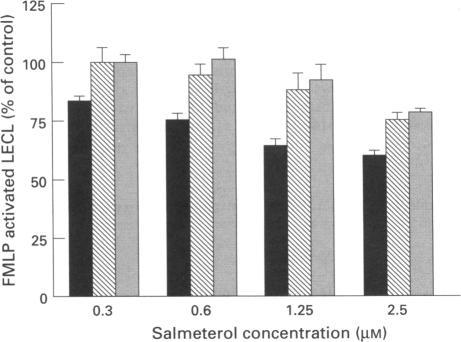
- We have investigated the effects of salmeterol (0.3-50 microM) on several pro-inflammatory activities of human neutrophils in vitro. 2. Oxidant production by FMLP- and calcium ionophore (A23187)-activated neutrophils was particularly sensitive to inhibition by low concentrations (0.3-3 microM) of salmeterol, while the responses of phorbol myristate acetate- and opsonised zymosan-stimulated cells were affected only by higher concentrations (3-50 microM) of the drug. At these concentrations salmeterol is not cytotoxic, nor does it act as a scavenger of superoxide. 3. These anti-oxidative interactions of salmeterol with neutrophils were insensitive to propranolol but could be eliminated by washing the cells, or by pretreatment with low concentrations (1-2 microM) of the pro-oxidative, membrane-destabilizing phospholipids, lysophosphatidylcholine (LPC), platelet activating factor (PAF) and lysoPAF (LPAF). 4. At concentrations of 6.25-50 microM salmeterol interfered with several other activities of stimulated neutrophils, including intracellular calcium fluxes, phospholipase A2 activity and synthesis of PAF. 5. In an assay of membrane-stabilizing activity, salmeterol (25 and 50 microM) neutralized the haemolytic action of LPC, PAF and LPAF. 6. Of the other commonly used beta 2-adrenoceptor agonists, fenoterol, and formoterol, but not salbutamol, caused moderate inhibition of neutrophil oxidant generation by a superoxide-scavenging mechanism. However, unlike salmeterol, these agents possessed only weak membrane stabilizing properties. 7. We conclude that salmeterol antagonizes the pro-inflammatory, pro-oxidative activity of several bioactive lipids implicated in the pathogenesis of bronchial asthma, by a mechanism related to the membrane-stabilizing, rather than to the beta 2-agonist properties of this agent.
摘要
- 我们在体外研究了沙美特罗(0.3 - 50微摩尔)对人中性粒细胞几种促炎活性的影响。2. 甲酰甲硫氨酸脑啡肽(FMLP)和钙离子载体(A23187)激活的中性粒细胞产生氧化剂的过程对低浓度(0.3 - 3微摩尔)的沙美特罗抑制作用尤为敏感,而佛波酯肉豆蔻酸酯和调理酵母聚糖刺激的细胞反应仅受较高浓度(3 - 50微摩尔)药物的影响。在这些浓度下,沙美特罗无细胞毒性,也不充当超氧化物清除剂。3. 沙美特罗与中性粒细胞的这些抗氧化相互作用对普萘洛尔不敏感,但可通过洗涤细胞或用低浓度(1 - 2微摩尔)的促氧化、膜不稳定磷脂(溶血磷脂酰胆碱(LPC)、血小板活化因子(PAF)和溶血PAF(LPAF))预处理来消除。4. 在6.25 - 50微摩尔浓度下,沙美特罗干扰了刺激的中性粒细胞的其他几种活性,包括细胞内钙通量、磷脂酶A2活性和PAF的合成。5. 在膜稳定活性测定中,沙美特罗(25和50微摩尔)中和了LPC、PAF和LPAF的溶血作用。6. 在其他常用的β2肾上腺素能受体激动剂中,非诺特罗和福莫特罗(而非沙丁胺醇)通过超氧化物清除机制对中性粒细胞氧化剂生成有中度抑制作用。然而,与沙美特罗不同,这些药物仅具有较弱的膜稳定特性。7. 我们得出结论,沙美特罗通过一种与该药物的膜稳定而非β2激动剂特性相关的机制,拮抗了几种与支气管哮喘发病机制有关的生物活性脂质的促炎、促氧化活性。

 Zotero 插件