Solez K, D'Agostini R J, Stawowy L, Freedman M T, Scott W W, Siegelman S S, Heptinstall R H
Am J Pathol. 1977 Jul;88(1):163-92.
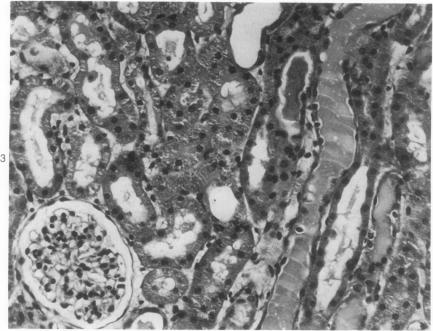
Acute renal failure caused in the rabbit by clamping one renal pedicle for 1 hour and removing the opposite kidney produced a histologic picture very similar to that observed in "hypotensive" acute renal failure in man. Intravenous infusion of propranolol, a drug which prevents renin release, at 1 mg/kg for 70 minutes beginning at time of pedicle clamping resulted in significantly lower serum creatinine in this model (2.8 +/- 0.2 mg% at 48 hours with propranolol versus 5.2 +/- 0.8 mg% without). Renin stimulation by dehydration or feeding a low-salt diet enhanced the difference between treated and untreated groups (2.6 +/- 0.4 mg% with propranolol versus 6.2 +/- 1.8 mg% without, after dehydration; 3.5 +/- 1.0 mg% with propranolol versus 7.6 +/- 1.4 mg% without, after low-salt diet).Suppression of renin production by saline feeding eliminated propranolol's beneficial effect (5.6 +/- 0.9 mg% with propranolol versus 4.0 +/- 0.6 mg% without). In rabbits with a normal food and water intake, renal denervation using phenol also eliminated propranolol's effect (creatinine 8.6 +/- 1.4 mg% with propranolol versus 8.6 +/- 1.8 mg% without). In rabbits with intact kidneys, flow probe recording of renal blood flow showed a significantly higher blood flow immediately after unclamping in the propranolol-treated animals, and renal angiograms showed less vasoconstriction in this group after unclamping. In this model of acute renal failure, renal vasoconstriction plays an important role following the initial ischemic insult. Propranolol lessens the severity of this vasoconstriction and the resulting acute renal failure. Its probable action is interference with neurogenically stimulated renin release.
通过夹闭兔一侧肾蒂1小时并切除对侧肾脏所引发的急性肾衰竭,其组织学表现与人类“低血压性”急性肾衰竭中观察到的情况非常相似。在夹闭肾蒂时开始以1mg/kg的剂量静脉输注普萘洛尔(一种可阻止肾素释放的药物),持续70分钟,结果该模型中的血清肌酐显著降低(48小时时,使用普萘洛尔组为2.8±0.2mg%,未使用组为5.2±0.8mg%)。脱水或给予低盐饮食刺激肾素分泌,增强了治疗组与未治疗组之间的差异(脱水后,使用普萘洛尔组为2.6±0.4mg%,未使用组为6.2±1.8mg%;低盐饮食后,使用普萘洛尔组为3.5±1.0mg%,未使用组为7.6±1.4mg%)。通过给予生理盐水抑制肾素生成消除了普萘洛尔的有益作用(使用普萘洛尔组为5.6±0.9mg%,未使用组为4.0±0.6mg%)。在正常进食和饮水的兔子中,使用苯酚进行肾去神经支配也消除了普萘洛尔的作用(使用普萘洛尔组肌酐为8.6±1.4mg%,未使用组为8.6±1.8mg%)。在肾脏完整的兔子中,用血流探头记录肾血流量显示,在普萘洛尔治疗的动物中,松开肾蒂后立即出现显著更高的血流量,并且肾血管造影显示该组在松开肾蒂后血管收缩程度较轻。在这个急性肾衰竭模型中,肾血管收缩在最初的缺血性损伤后起重要作用。普萘洛尔减轻了这种血管收缩的严重程度以及由此导致的急性肾衰竭。其可能的作用是干扰神经源性刺激的肾素释放。