Song H, Wang Y, Goetinck P F
Cutaneous Biology Research Center, Massachusetts General Hospital, Harvard Medical School, Charlestown 02129, USA.
Proc Natl Acad Sci U S A. 1996 Sep 17;93(19):10246-9. doi: 10.1073/pnas.93.19.10246.
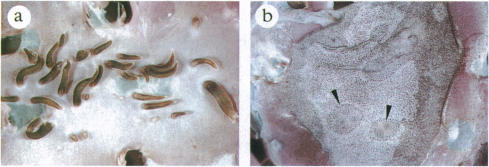
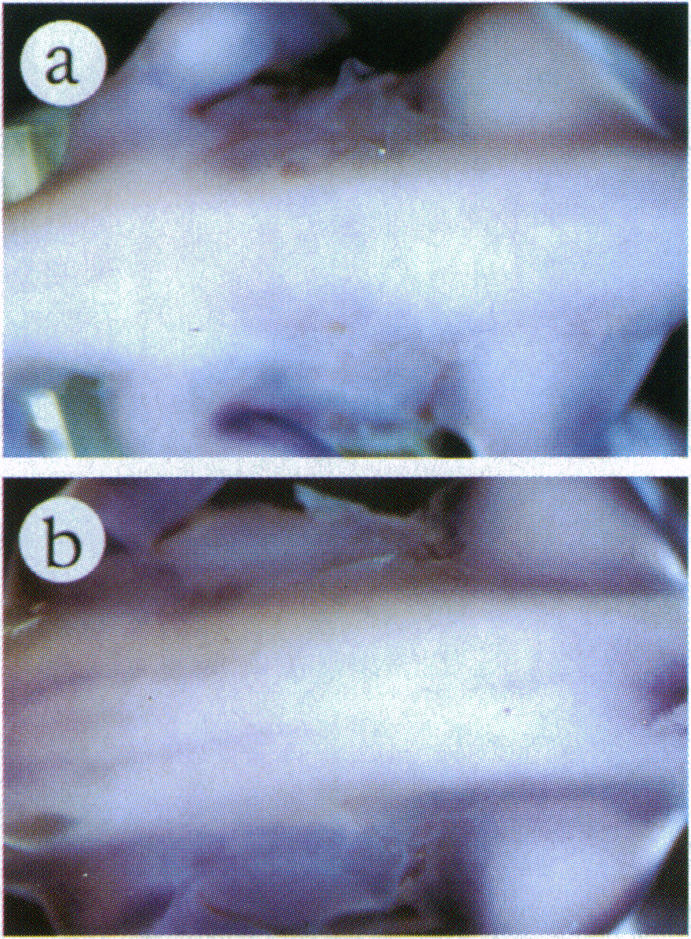
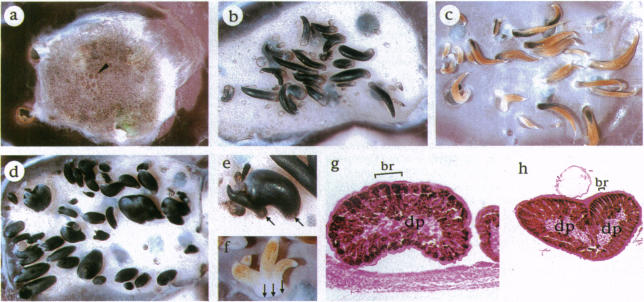
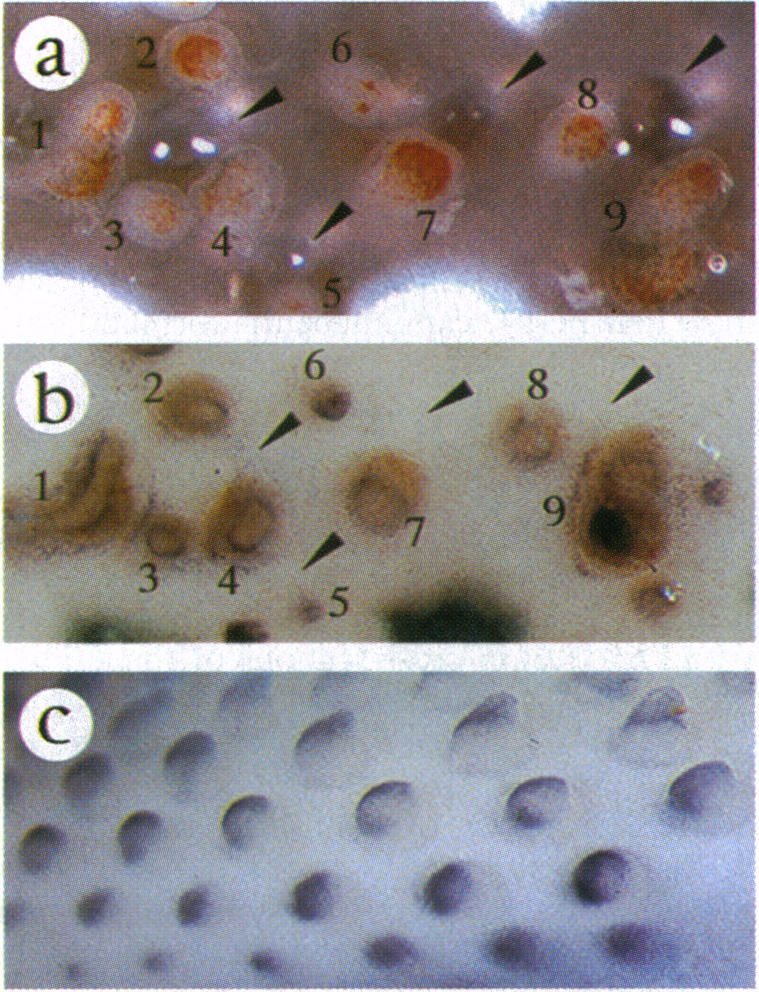
The initiation and morphogenesis of cutaneous appendages depend on a series of reciprocal signaling events between the epithelium and mesenchyme of the embryonic skin. In the development of feather germs, early dermal signals induce the formation of epidermal placodes that in turn signal the mesoderm to form dermal condensations immediately beneath them. We find a spatially and temporally restricted pattern of transcription for the genes that encode fibroblast growth factor (FGF) 2 and FGF receptor (FGFR) 1 in developing feather germs of the chicken embryo. FGF-2 expression is restricted to the epidermal placodes, whereas FGFR-1 expression is limited to the dermal condensations. Transcription of these genes could not be detected in skins of scaleless (sc/sc) embryos that fail to develop feathers as a result of an ectodermal defect. Treatment of sc/sc skins with FGF-2 results in the formation of feathers at the site of application of the growth factor and the induced feathers express FGFR-1 in their dermal condensations. Thus, we have established FGF-2 as an epidermal signal in early feather germ formation. The observation that FGF-2 can rescue the mutant phenotype of sc/sc embryos suggests that FGF-2 either is, or is downstream from, the signal that the sc/sc mutant ectoderm fails to generate.
皮肤附属器的起始和形态发生取决于胚胎皮肤上皮和间充质之间一系列相互的信号传导事件。在羽毛原基的发育过程中,早期真皮信号诱导表皮基板的形成,而表皮基板反过来又向中胚层发出信号,使其在其正下方形成真皮凝聚物。我们在鸡胚发育中的羽毛原基中发现了编码成纤维细胞生长因子(FGF)2和成纤维细胞生长因子受体(FGFR)1的基因在空间和时间上受限的转录模式。FGF-2的表达局限于表皮基板,而FGFR-1的表达则限于真皮凝聚物。在由于外胚层缺陷而无法发育羽毛的无鳞(sc/sc)胚胎的皮肤中检测不到这些基因的转录。用FGF-2处理sc/sc皮肤会导致在生长因子应用部位形成羽毛,并且诱导形成的羽毛在其真皮凝聚物中表达FGFR-1。因此,我们已确定FGF-2是早期羽毛原基形成中的一种表皮信号。FGF-2能够挽救sc/sc胚胎的突变表型这一观察结果表明,FGF- either是sc/sc突变外胚层未能产生的信号,或者是该信号的下游信号。