Schnell M J, Buonocore L, Kretzschmar E, Johnson E, Rose J K
Department of Pathology, Yale University School of Medicine, New Haven, CT 06510, USA.
Proc Natl Acad Sci U S A. 1996 Oct 15;93(21):11359-65. doi: 10.1073/pnas.93.21.11359.
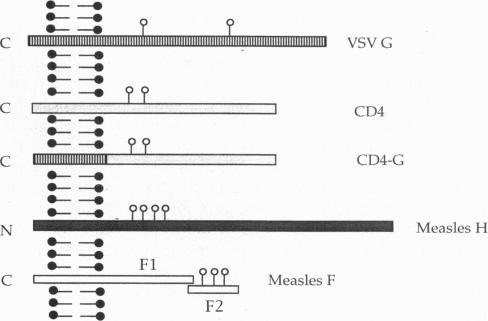
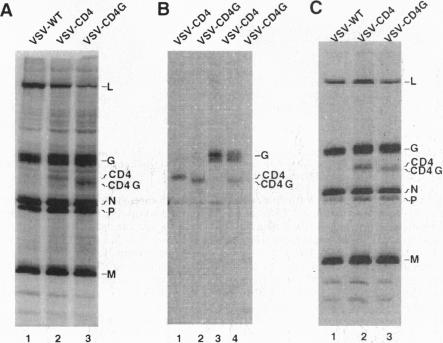
In a previous study we demonstrated that vesicular stomatitis virus (VSV) can be used as a vector to express a soluble protein in mammalian cells. Here we have generated VSV recombinants that express four different membrane proteins: the cellular CD4 protein, a CD4-G hybrid protein containing the ectodomain of CD4 and the transmembrane and cytoplasmic tail of the VSV glycoprotein (G), the measles virus hemagglutinin, or the measles virus fusion protein. The proteins were expressed at levels ranging from 23-62% that of VSV G protein and all were transported to the cell surface. In addition we found that all four proteins were incorporated into the membrane envelope of VSV along with the VSV G protein. The levels of incorporation of these proteins varied from 6-31% of that observed for VSV G. These results suggest that many different membrane proteins may be co-incorporated quite efficiently with VSV G protein into budding VSV virus particles and that specific signals are not required for this co-incorporation process. In fact, the CD4-G protein was incorporated with the same efficiency as wild type CD4. Electron microscopy of virions containing CD4 revealed that the CD4 molecules were dispersed throughout the virion envelope among the trimeric viral spike glycoproteins. The recombinant VSV-CD4 virus particles were about 18% longer than wild type virions, reflecting the additional length of the helical nucleocapsid containing the extra gene. Recombinant VSVs carrying foreign antigens on the surface of the virus particle may be useful for viral targeting, membrane protein purification, and for generation of immune responses.
在之前的一项研究中,我们证明水泡性口炎病毒(VSV)可作为载体在哺乳动物细胞中表达可溶性蛋白。在此,我们构建了表达四种不同膜蛋白的VSV重组体:细胞CD4蛋白、包含CD4胞外域以及VSV糖蛋白(G)跨膜区和胞质尾的CD4 - G杂合蛋白、麻疹病毒血凝素或麻疹病毒融合蛋白。这些蛋白的表达水平为VSV G蛋白表达水平的23% - 62%,且均转运至细胞表面。此外,我们发现所有这四种蛋白均与VSV G蛋白一起被整合到VSV的膜包膜中。这些蛋白的整合水平为VSV G蛋白整合水平的6% - 31%。这些结果表明,许多不同的膜蛋白可能相当高效地与VSV G蛋白共同整合到出芽的VSV病毒颗粒中,且该共同整合过程不需要特定信号。事实上,CD4 - G蛋白与野生型CD4的整合效率相同。对含有CD4的病毒粒子进行电子显微镜观察发现,CD4分子分散在病毒粒子包膜中三聚体病毒刺突糖蛋白之间。携带外源抗原的重组VSV - CD4病毒粒子比野生型病毒粒子长约18%,这反映了含有额外基因的螺旋核衣壳的额外长度。在病毒粒子表面携带外源抗原的重组VSV可能在病毒靶向、膜蛋白纯化以及免疫反应的产生方面具有应用价值。