Olave E, Prates J C, Gabrielli C, Pardi P
Faculty of Medicine, Universidad de la Frontera, Chile.
J Anat. 1996 Oct;189 ( Pt 2)(Pt 2):445-9.
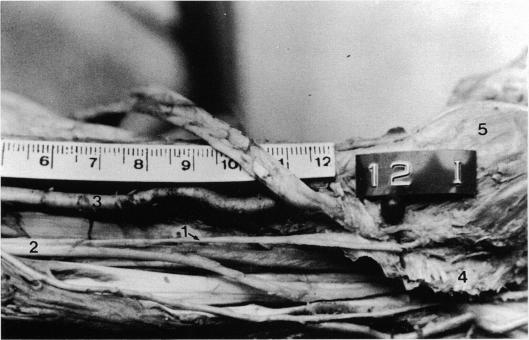
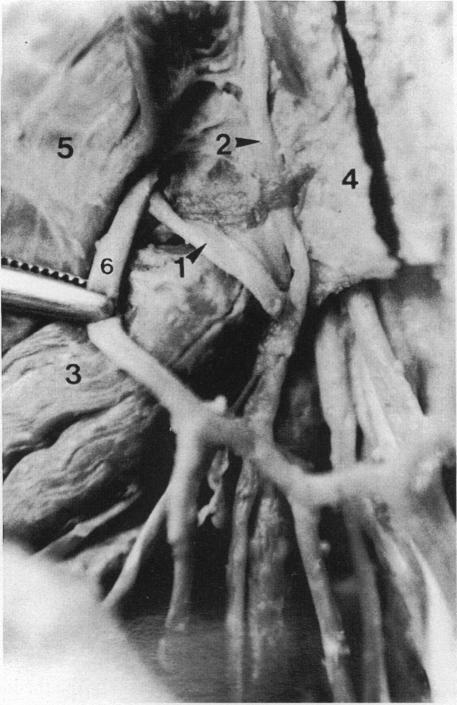
The branch from the median nerve to the thenar muscles has a proximal and lateral (recurrent) course and is vulnerable to lesions that affect these muscles. Because of its anatomical-clinical importance, this branch was studied in 60 palmar regions from 30 cadavers of adult individuals of both sexes, aged between 23 and 77 y. It arose from the lateral branch of the median nerve in 83.3% of the cases. Its origin was distal to the flexor retinaculum in 48.3%, at the distal margin of the retinaculum in 31.6%, in the carpal tunnel in 18.3% and proximal to the retinaculum in 1.7%; it pierced the retinaculum in 15%. The point of recurrence of the branch was localised topographically to 34.6 +/- 3.6 mm from the distal wrist crease; the angle between its recurrent course and the longitudinal axis of the hand averaged 66.8 degrees. In 50% of the cases the muscular branch innervated abductor pollicis brevis (APB), opponens pollicis (OP) and the superficial head of flexor pollicis brevis (FPB), in 40% it supplied only APB and OP, and in 10% a short muscular branch gave rise to independent branches in the palm and which supplied APB, OP and the superficial head of FPB. The so called "accessory thenar branch' was found in 38.3%.
正中神经至鱼际肌的分支走行于近端且偏向外侧(返支),易受影响这些肌肉的病变损伤。鉴于其解剖学 - 临床重要性,对30具年龄在23至77岁之间的成年男女尸体的60个手掌区域进行了该分支的研究。83.3%的病例中,该分支起自正中神经的外侧支。其起始位置在屈肌支持带远侧的占48.3%,在支持带远侧缘的占31.6%,在腕管内的占18.3%,在支持带近侧的占1.7%;15%的情况是该分支穿过支持带。该分支的折返点在距腕远侧横纹34.6±3.6毫米处定位;其返支走行与手部纵轴的夹角平均为66.8度。50%的病例中,肌支支配拇短展肌(APB)、拇对掌肌(OP)和拇短屈肌浅层头(FPB),40%的情况仅供应APB和OP,10%的情况是一条短肌支在手掌发出独立分支,供应APB、OP和FPB浅层头。38.3%的情况发现有所谓的“副鱼际支”。