Lindner R, Unanue E R
Department of Pathology, Washington University School of Medicine, St. Louis, MO 63110, USA.
EMBO J. 1996 Dec 16;15(24):6910-20.
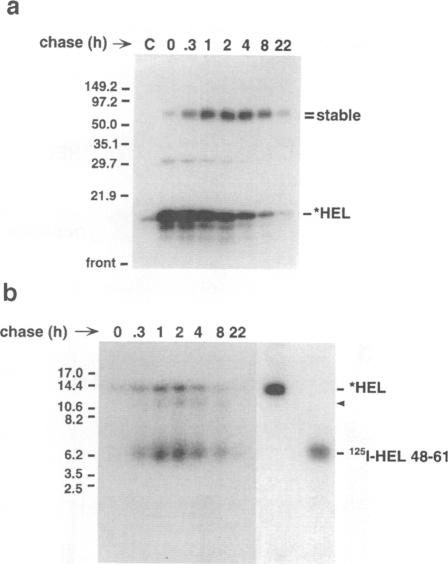
The peptide binding site of MHC class II molecules is open at both ends and, therefore, does not restrict the length of the bound ligand. Here we show that a partially folded protein antigen (*HEL) spontaneously formed SDS-unstable complexes with the purified MHC class II molecule I-Ak (Ak). These complexes were also detected on the surface of antigen-presenting cells (APCs) where they stimulated T cells. However, they rapidly disappeared after endocytosis. Intracellular processing of *HEL gave rise to SDS-stable, long-lived Ak complexes containing *HEL peptides and, unexpectedly, full-length *HEL. Both SDS-stable products were formed in low pH compartments and then transported to the plasma membrane. In contrast to *HEL peptides, the stable association of *HEL occurred in an alternative pathway that required mature class II molecules and did not involve HLA-DM or proteases. SDS-stable *HEL-Ak complexes were formed by a reaction of endosomal Ak with endocytosed *HEL, but not by direct conversion of SDS-unstable complexes derived from the plasma membrane. Our work establishes a fundamental difference between the two MHC class II loading pathways and for the first time demonstrates a full-length protein as a product of antigen processing.
MHC II类分子的肽结合位点两端开放,因此不限制结合配体的长度。我们在此表明,部分折叠的蛋白质抗原(HEL)与纯化的MHC II类分子I-Ak(Ak)自发形成SDS不稳定复合物。这些复合物也在抗原呈递细胞(APC)表面被检测到,在那里它们刺激T细胞。然而,它们在胞吞作用后迅速消失。HEL的细胞内加工产生了含有HEL肽且出乎意料地含有全长HEL的SDS稳定、寿命长的Ak复合物。两种SDS稳定产物均在低pH区室中形成,然后转运至质膜。与HEL肽不同,HEL的稳定结合发生在一条替代途径中,该途径需要成熟的II类分子,且不涉及HLA-DM或蛋白酶。SDS稳定的HEL-Ak复合物是由内体Ak与内吞的HEL反应形成的,而不是由源自质膜的SDS不稳定复合物直接转化形成的。我们的工作确立了两条MHC II类装载途径之间的根本差异,并首次证明全长蛋白质是抗原加工的产物。