Migita K, Eguchi K, Kawabe Y, Ichinose Y, Tsukada T, Aoyagi T, Nakamura H, Nagataki S
First Department of Internal Medicine, Nagasaki University School of Medicine, Japan.
Immunology. 1996 Dec;89(4):553-7. doi: 10.1046/j.1365-2567.1996.d01-789.x.
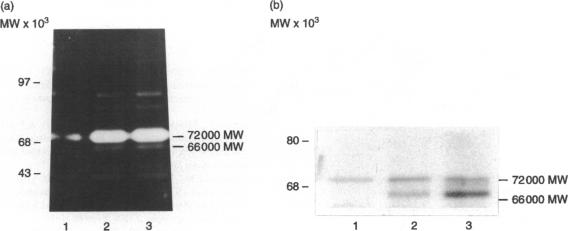
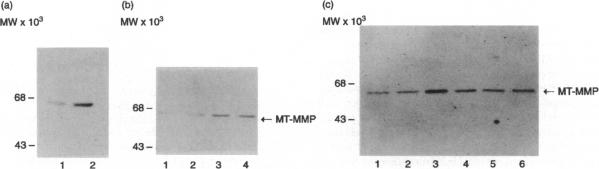
Degradation of the extracellular matrix plays an important role in rheumatoid articular destruction. Rheumatoid synovial fibroblasts secrete a large amount of matrix-degrading metalloproteinases (MMPs), which initiate tissue damage by proteolytic degradation of collagens and proteoglycans. Cytokines, such as interleukin-1 alpha, -1 beta or tumour necrosis factor (TNF)-alpha, are potent inducers of MMPs in rheumatoid synovial fibroblasts, MMPs are synthesized and secreted as latent pro-enzymes and their activation is achieved by proteolytic cleavage or the propeptide domain at the N-terminus of the molecule. Thus, the interaction of the pro-enzymes with specific activators determines the enzymatic activity in the extracellular space. In the present study, we identified a novel mechanism for the activation of pro-MMP-2, which can be achieved through the interaction of the inflammatory cytokine, TNF-alpha, with synovial fibroblasts. Although MMP-2 is constitutively secreted by synovial fibroblasts as a pro-enzyme, stimulation of fibroblasts by TNF-alpha-induced secretion of MMP-2 in an active form. In support of this result, TNF-alpha stimulation-induced membrane-type matrix metalloproteinase (MT-MMP), a newly identified MMP-2-specific activator on synovial fibroblasts. Cycloheximide analysis demonstrated that protein synthesis may be required for TNF-alpha-mediated MT-MMP expression on synovial fibroblasts. Our results suggest that TNF-alpha induces MMP-2 activation in part by up-regulating MT-MMP expression, thus representing a new mechanism for cytokine-mediated articular destruction in rheumatoid arthritis (RA).
细胞外基质的降解在类风湿性关节破坏中起重要作用。类风湿性滑膜成纤维细胞分泌大量基质降解金属蛋白酶(MMPs),这些酶通过对胶原蛋白和蛋白聚糖的蛋白水解降解引发组织损伤。细胞因子,如白细胞介素-1α、-1β或肿瘤坏死因子(TNF)-α,是类风湿性滑膜成纤维细胞中MMPs的强效诱导剂。MMPs以无活性的酶原形式合成并分泌,其激活是通过蛋白水解切割或分子N端前肽结构域的切割来实现的。因此,酶原与特定激活剂的相互作用决定了细胞外空间中的酶活性。在本研究中,我们确定了一种激活前MMP-2的新机制,该机制可通过炎性细胞因子TNF-α与滑膜成纤维细胞的相互作用来实现。虽然MMP-2作为一种酶原由滑膜成纤维细胞组成性分泌,但TNF-α刺激可诱导成纤维细胞分泌活性形式的MMP-2。支持这一结果的是,TNF-α刺激诱导滑膜成纤维细胞上一种新发现的MMP-2特异性激活剂——膜型基质金属蛋白酶(MT-MMP)的表达。放线菌酮分析表明,TNF-α介导的滑膜成纤维细胞上MT-MMP的表达可能需要蛋白质合成。我们的结果表明,TNF-α部分通过上调MT-MMP的表达诱导MMP-2激活,从而代表了类风湿性关节炎(RA)中细胞因子介导的关节破坏的一种新机制。