Bunce C, Bell E B
Immunology Research Group, Biological Sciences, University of Manchester, United Kingdom.
J Exp Med. 1997 Feb 17;185(4):767-76. doi: 10.1084/jem.185.4.767.
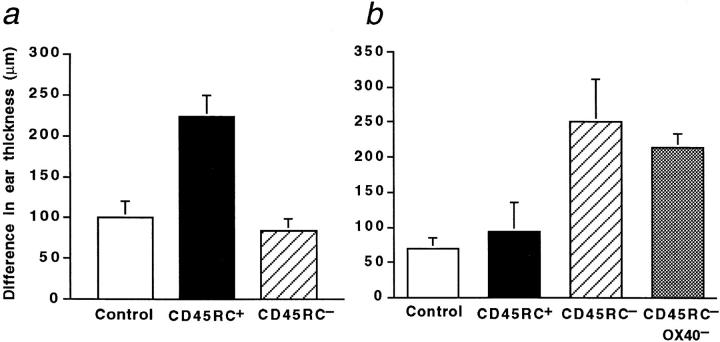
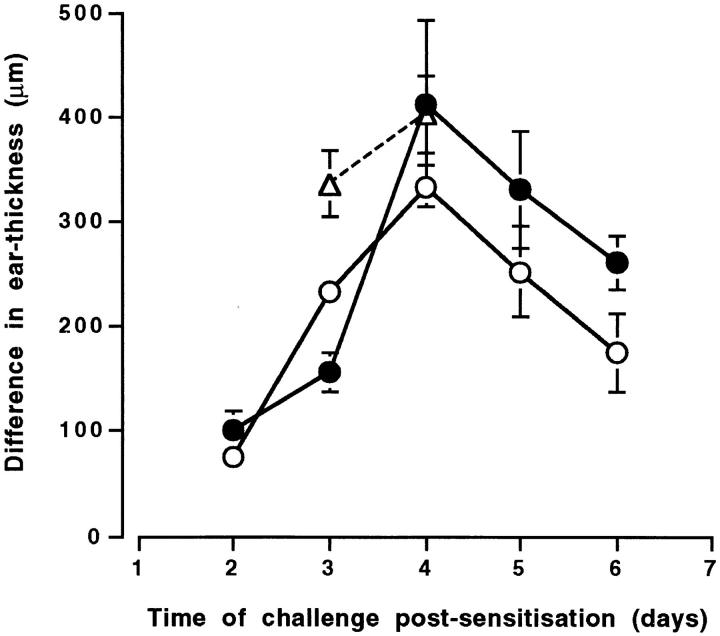
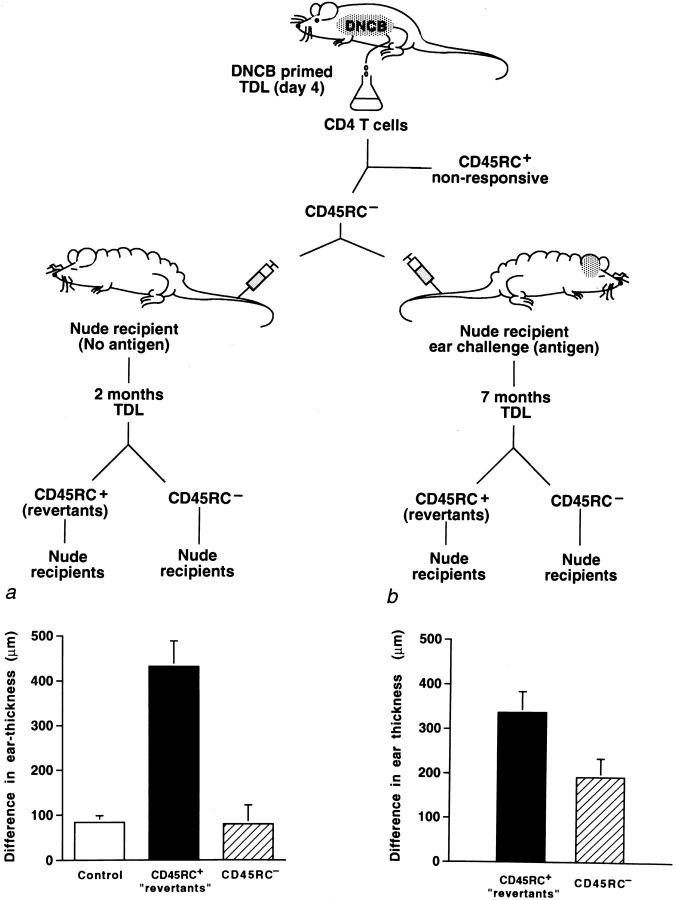
The cellular basis of immunological memory remains a controversial area with respect to the identity of memory T cells and the role of persisting antigen. CD4 T cells are phenotypically divided by the expression of high and low molecular weight isoforms of CD45, surface markers that are frequently used to identify "naive" (CD45Rhigh) and "memory" (CD45Rlow) subsets. The latter subset responds rapidly in antigen recall assays but paradoxically has a short life span, a property that is difficult to reconcile with long-term memory. The present study examines these issues using a DTH (delayed-type hypersensitivity) model in which contact sensitivity to dinitrochlorobenzene (DNCB) was transferred to athymic nude rats by recirculating CD4 T cell subsets defined in the rat by the anti-CD45RC mAb OX22. As expected, CD45RC+ (but not RC-) CD4 T cells from normal unprimed rats transferred a DNCB-specific DTH response, whereas, 4 d after sensitization the CD45RC- (memory) subset alone contained the DNCB reactivity. However, when donor cells were collected from thymectomized rats sensitized two mo earlier, DNCB-specific responses were transferred by both CD45RC- and RC+ subsets suggesting that many of the latter had developed from cells with a memory phenotype. This was confirmed when CD45RC CD4 T cells from 4-d primed rats were parked in intermediate nude recipients and recovered 2 mo later. DNCB-specific activity was now found wholly within the CD45RC+ "revertant" subset; the CD45RC-CD4 T cell population was devoid of activity. Importantly, we found that the total switch-back from CD45RC- to RC+ could be prevented, apparently by persisting antigen. The results indicate that there are two functionally distinct categories of memory T cells: one, a short-lived CD45Rlow type which orchestrates the rapid kinetics, the other, a longer-lived CD45Rhigh revertant which ensures that immunological memory endures.
就记忆性T细胞的身份以及持续存在的抗原的作用而言,免疫记忆的细胞基础仍是一个存在争议的领域。CD4 T细胞在表型上可根据CD45高分子量和低分子量同种型的表达进行区分,CD45是常用于识别“初始”(CD45Rhigh)和“记忆”(CD45Rlow)亚群的表面标志物。后一个亚群在抗原回忆试验中反应迅速,但矛盾的是其寿命较短,这一特性难以与长期记忆相协调。本研究使用迟发型超敏反应(DTH)模型来研究这些问题,在该模型中,通过抗CD45RC单克隆抗体OX22定义的循环CD4 T细胞亚群将对二硝基氯苯(DNCB)的接触敏感性转移给无胸腺裸鼠。正如预期的那样,来自正常未致敏大鼠的CD45RC +(而非RC -)CD4 T细胞转移了DNCB特异性DTH反应,而在致敏4天后,仅CD45RC -(记忆)亚群具有DNCB反应性。然而,当供体细胞从两个月前致敏的胸腺切除大鼠中收集时,DNCB特异性反应可由CD45RC -和RC +亚群转移,这表明后者中的许多细胞已从具有记忆表型的细胞发育而来。当来自致敏4天的大鼠的CD45RC CD4 T细胞被置于中间裸鼠受体中并在两个月后回收时,这一点得到了证实。现在发现DNCB特异性活性完全存在于CD45RC +“回复”亚群中;CD