López-Candales A, Holmes D R, Liao S, Scott M J, Wickline S A, Thompson R W
Division of Cardiology, Washington University School of Medicine, St. Louis, Missouri, USA.
Am J Pathol. 1997 Mar;150(3):993-1007.
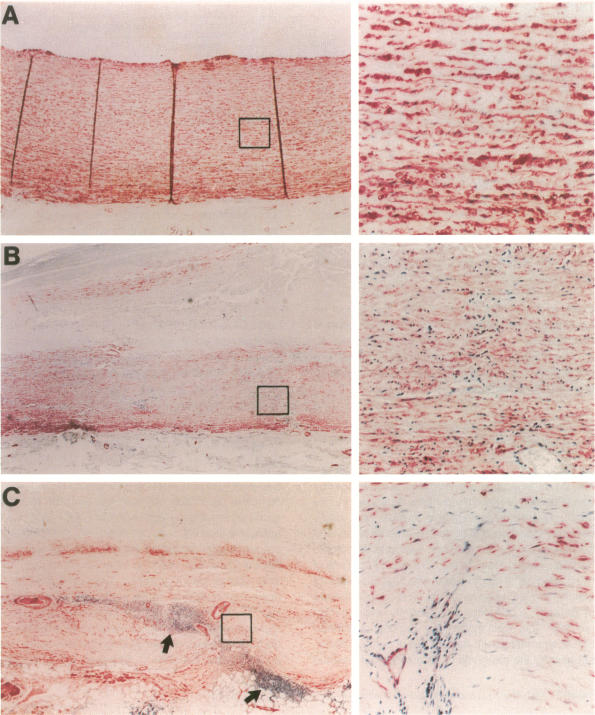
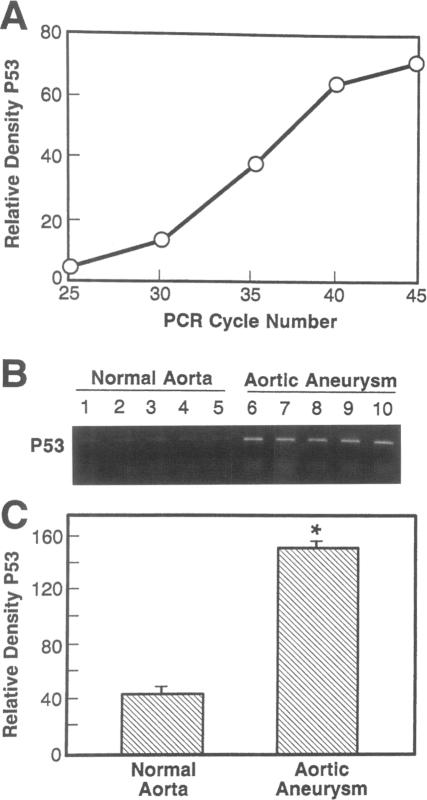
Abdominal aortic aneurysms (AAAs) are characterized by structural deterioration of the aortic wall leading to progressive aortic dilatation and eventual rupture. The histopathological changes in AAAs are particularly evident within the elastic media, which is normally dominated by vascular smooth muscle cells (SMCs). To determine whether a decrease in vascular SMCs contributes to medial degeneration, we measured SMC density in 21 normal and pathological human abdominal aortic tissue specimens using immunohistochemistry for alpha-SMC actin and direct cell counts (medial SMCs per high-power field (HPF)). Medial SMC density was not significantly different between normal aorta (n = 5; 199.5 +/- 14.9 SMCs/HPF) and atherosclerotic occlusive disease (n = 6; 176.4 +/- 13.9 SMCs/HPF), but it was reduced by 74% in AAA (n = 10; 50.9 +/- 6.1 SMCs/HPF; P < 0.01 versus normal aorta). Light and electron microscopy revealed no evidence of overt cellular necrosis, but SMCs in AAAs exhibited ultrastructural changes consistent with apoptosis. Using in situ end-labeling (ISEL) of fragmented DNA to detect apoptotic cells, up to 30% of aortic wall cells were ISEL positive in AAAs. By double-labeling techniques, many of these cells were alpha-actin-positive SMCs distributed throughout the degenerative media. In contrast, ISEL-positive cells were observed only within the intimal plaque in atherosclerotic occlusive disease. The amount of p53 protein detected by immunoblotting was increased nearly fourfold in AAA compared with normal aorta and atherosclerotic occlusive disease (P < 0.01), and immunoreactive p53 was localized to lymphocytes and residual SMCs in the aneurysm wall. Using reverse transcription polymerase chain reaction assays a substantial amount of p53 mRNA expression was observed in AAAs. These results demonstrate that medial SMC density is significantly decreased in human AAA tissues associated with evidence of SMC apoptosis and increased production of p53, a potential mediator of cell cycle arrest and programmed cell death. Given the role that SMCs normally play in maintaining medial architecture and in arterial wall matrix remodeling, the induction of SMC apoptosis likely makes an important contribution to the evolution of aneurysm degeneration.
腹主动脉瘤(AAA)的特征是主动脉壁结构退化,导致主动脉逐渐扩张并最终破裂。AAA的组织病理学变化在弹性中膜尤为明显,弹性中膜通常由血管平滑肌细胞(SMC)主导。为了确定血管SMC数量的减少是否导致中膜退变,我们使用α-SMC肌动蛋白免疫组织化学和直接细胞计数(每高倍视野(HPF)的中膜SMC数量)测量了21例正常和病理状态下的人类腹主动脉组织标本中的SMC密度。正常主动脉(n = 5;199.5±14.9个SMC/HPF)和动脉粥样硬化闭塞性疾病(n = 6;176.4±13.9个SMC/HPF)之间的中膜SMC密度无显著差异,但AAA组(n = 10;50.9±6.1个SMC/HPF;与正常主动脉相比,P < 0.01)降低了74%。光镜和电镜检查未发现明显的细胞坏死证据,但AAA中的SMC表现出与凋亡一致的超微结构变化。使用原位末端标记(ISEL)法检测断裂DNA以检测凋亡细胞,AAA中高达30%的主动脉壁细胞ISEL呈阳性。通过双重标记技术,这些细胞中有许多是分布在整个退变中膜的α-肌动蛋白阳性SMC。相比之下,在动脉粥样硬化闭塞性疾病中,仅在内膜斑块内观察到ISEL阳性细胞。免疫印迹法检测到的p53蛋白量在AAA中比正常主动脉和动脉粥样硬化闭塞性疾病增加了近四倍(P < 0.01),免疫反应性p53定位于动脉瘤壁中的淋巴细胞和残留的SMC。使用逆转录聚合酶链反应分析在AAA中观察到大量p53 mRNA表达。这些结果表明,在与SMC凋亡证据和p53产生增加相关的人类AAA组织中,中膜SMC密度显著降低,p53是细胞周期停滞和程序性细胞死亡的潜在介质。鉴于SMC通常在维持中膜结构和动脉壁基质重塑中所起的作用,SMC凋亡的诱导可能对动脉瘤退变的进展起重要作用。