Kupferman R, Mitra P P, Hohenberg P C, Wang S S
Bell Laboratories, Lucent Technologies, Murray Hill, New Jersey 07974, USA.
Biophys J. 1997 Jun;72(6):2430-44. doi: 10.1016/S0006-3495(97)78888-X.
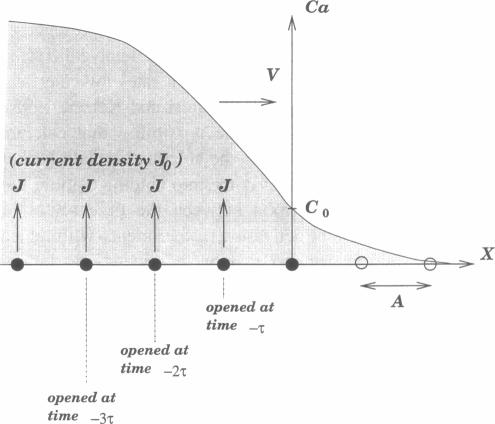
We present a theoretical analysis of intracellular calcium waves propagated by calcium feedback at the inositol 1,4,5-trisphosphate (IP3) receptor. The model includes essential features of calcium excitability, but is still analytically tractable. Formulas are derived for the wave speed, amplitude, and width. The calculations take into account cytoplasmic Ca buffering, the punctate nature of the Ca release channels, channel inactivation, and Ca pumping. For relatively fast buffers, the wave speed is well approximated by V(infinity) = (J(eff)D(eff)/C0)1/2, where J(eff) is an effective, buffered source strength; D(eff) is the effective, buffered diffusion constant of Ca; and C(0) is the Ca threshold for channel activation. It is found that the saturability and finite on-rate of buffers must be taken into account to accurately derive the wave speed and front width. The time scale governing Ca wave propagation is T(r), the time for Ca release to reach threshold to activate further release. Because IP3 receptor inactivation is slow on this time scale, channel inactivation does not affect the wave speed. However, inactivation competes with Ca removal to limit wave height and front length, and for biological parameter ranges, it is inactivation that determines these parameters. Channel discreteness introduces only small corrections to wave speed relative to a model in which Ca is released uniformly from the surface of the stores. These calculations successfully predict experimental results from basic channel and cell parameters and explain the slowing of waves by exogenous buffers.
我们对由肌醇1,4,5 -三磷酸(IP3)受体处的钙反馈所传播的细胞内钙波进行了理论分析。该模型包含了钙兴奋性的基本特征,但仍具有解析易处理性。推导了波速、振幅和宽度的公式。计算考虑了细胞质钙缓冲、钙释放通道的点状性质、通道失活以及钙泵浦。对于相对快速的缓冲剂,波速可很好地近似为(V(\infty) = (J_{eff}D_{eff}/C_0)^{1/2}),其中(J_{eff})是有效的、经缓冲的源强度;(D_{eff})是钙的有效、经缓冲的扩散常数;(C_0)是通道激活的钙阈值。研究发现,为了准确推导波速和前沿宽度,必须考虑缓冲剂的饱和性和有限的开启速率。控制钙波传播的时间尺度是(T_r),即钙释放达到阈值以激活进一步释放所需的时间。由于IP3受体失活在这个时间尺度上较慢,通道失活不影响波速。然而,失活与钙的去除相互竞争以限制波高和前沿长度,并且在生物学参数范围内,是失活决定了这些参数。相对于钙从储存库表面均匀释放的模型,通道离散性对波速仅引入了小的修正。这些计算成功地从基本通道和细胞参数预测了实验结果,并解释了外源性缓冲剂使波减速的现象。