Dupont G, Goldbeter A
Faculté des Sciences, Université Libre de Bruxelles, Belgium.
Biophys J. 1994 Dec;67(6):2191-204. doi: 10.1016/S0006-3495(94)80705-2.
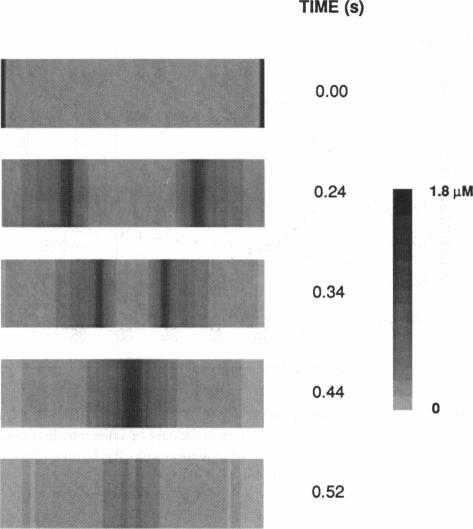
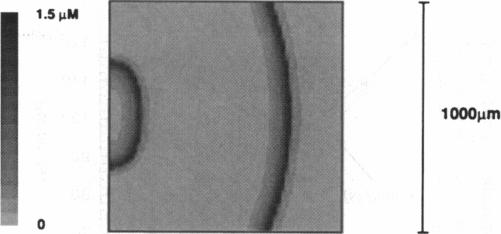
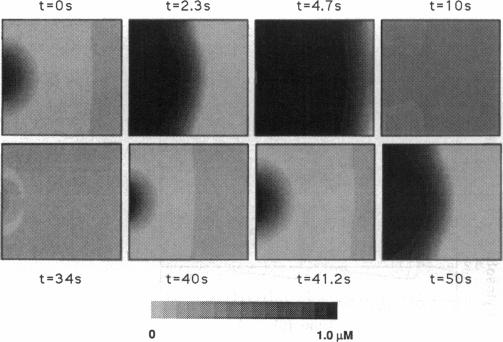
Cytosolic Ca2+ waves occur in a number of cell types either spontaneously or after stimulation by hormones, neurotransmitters, or treatments promoting Ca2+ influx into the cells. These waves can be broadly classified into two types. Waves of type 1, observed in cardiac myocytes or Xenopus oocytes, correspond to the propagation of sharp bands of Ca2+ throughout the cell at a rate that is high enough to permit the simultaneous propagation of several fronts in a given cells. Waves of type 2, observed in hepatocytes, endothelial cells, or various kinds of eggs, correspond to the progressive elevation of cytosolic Ca2+ throughout the cell, followed by its quasi-homogeneous return down to basal levels. Here we analyze the propagation of these different types of intracellular Ca2+ waves in a model based on Ca(2+)-induced Ca2+ release (CICR). The model accounts for transient or sustained waves of type 1 or 2, depending on the size of the cell and on the values of the kinetic parameters that measure Ca2+ exchange between the cytosol, the extracellular medium, and intracellular stores. Two versions of the model based on CICR are considered. The first version involves two distinct Ca2+ pools sensitive to inositol 1,4,5-trisphosphate (IP3) and Ca2+, respectively, whereas the second version involves a single pool sensitive both to Ca2+ and IP3 behaving as co-agonists for Ca2+ release. Intracellular Ca2+ waves occur in the two versions of the model based on CICR, but fail to propagate in the one-pool model at subthreshold levels of IP3. For waves of type 1, we investigate the effect of the spatial distribution of Ca(2+)-sensitive Ca2+ stores within the cytosol, and show that the wave fails to propagate when the distance between the stores exceeds a critical value on the order of a few microns. We also determine how the period and velocity of the waves are affected by changes in parameters measuring stimulation, Ca2+ influx into the cell, or Ca2+ pumping into the stores. For waves of type 2, the numerical analysis indicates that the best qualitative agreement with experimental observations is obtained for phase waves. Finally, conditions are obtained for the occurrence of "echo" waves that are sometimes observed in the experiments.
胞质Ca2+波在多种细胞类型中自发出现,或在激素、神经递质刺激后,或在促进Ca2+流入细胞的处理后出现。这些波大致可分为两类。在心肌细胞或非洲爪蟾卵母细胞中观察到的1型波,对应于Ca2+尖锐带在整个细胞中的传播,其传播速率足以使几个波前在给定细胞中同时传播。在肝细胞、内皮细胞或各种卵中观察到的2型波,对应于整个细胞中胞质Ca2+的逐渐升高,随后其几乎均匀地回落到基础水平。在此,我们基于Ca(2+)诱导的Ca2+释放(CICR)模型分析这些不同类型的细胞内Ca2+波的传播。该模型可解释1型或2型的瞬态或持续波,这取决于细胞大小以及测量胞质溶胶、细胞外介质和细胞内储存库之间Ca2+交换的动力学参数值。考虑了基于CICR的两种模型版本。第一个版本涉及两个分别对肌醇1,4,5 -三磷酸(IP3)和Ca2+敏感的不同Ca2+池,而第二个版本涉及一个对Ca2+和IP3都敏感的单一池,它们作为Ca2+释放的协同激动剂。基于CICR的两种模型版本中都会出现细胞内Ca2+波,但在IP3亚阈值水平下,单池模型中波无法传播。对于1型波,我们研究了胞质溶胶中Ca(2+)敏感的Ca2+储存库的空间分布的影响,并表明当储存库之间的距离超过几微米量级的临界值时,波无法传播。我们还确定了测量刺激、Ca2+流入细胞或Ca2+泵入储存库的参数变化如何影响波的周期和速度。对于2型波,数值分析表明,对于相位波,与实验观察结果的定性一致性最佳。最后,得出了实验中有时观察到的“回声”波出现的条件。