Kawahara M, Arispe N, Kuroda Y, Rojas E
Department of Molecular and Cellular Neurobiology, Tokyo Metropolitan Institute for Neuroscience, Japan.
Biophys J. 1997 Jul;73(1):67-75. doi: 10.1016/S0006-3495(97)78048-2.
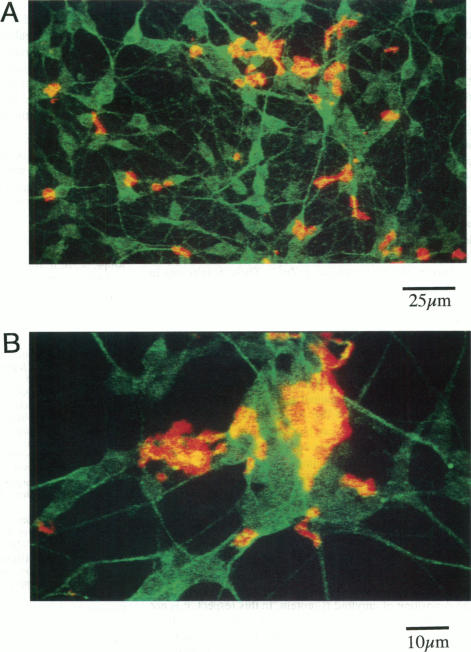
We have previously shown that the 40-residue peptide termed amyloid beta-protein (A beta P[1-40]) in solution forms cation-selective channels across artificial phospholipid bilayer membranes. To determine whether A beta P[1-40] also forms channels across natural membranes, we used electrically silent excised membrane patches from a cell line derived from hypothalamic gonadotrophin-releasing hormone GnRH neurons. We found that exposing either the internal or the external side of excised membrane patches to A beta P[1-40] leads to the spontaneous formation of cation-selective channels. With Cs+ as the main cation in both the external as well as the internal saline, the amplitude of the A beta P[1-40] channel currents was found to follow the Cs+ gradient and to exhibit spontaneous conductance changes over a wide range (50-500 pS). We also found that free zinc (Zn2+), reported to bind to amyloid beta-protein in solution, can block the flow of Cs+ through the A beta P[1-40] channel. Because the Zn2+ chelator o-phenanthroline can reverse this blockade, we conclude that the underlying mechanism involves a direct interaction between the transition element Zn2+ and sites in the A beta P[1-40] channel pore. These properties of the A beta P[1-40] channel are rather similar to those observed in the artificial bilayer system. We also show here, by immunocytochemical confocal microscopy, that amyloid beta-protein molecules form deposits closely associated with the plasma membrane of a substantial fraction of the GnRH neurons. Taken together, these results suggest that the interactions between amyloid beta-protein and neuronal membranes also occur in vivo, lending further support to the idea that A beta P[1-40] channel formation might be a mechanism of amyloid beta-protein neurotoxicity.