Tesch G H, Lan H Y, Atkins R C, Nikolic-Paterson D J
Department of Nephrology, Monash Medical Centre, Clayton Victoria, Australia.
Am J Pathol. 1997 Jul;151(1):141-50.
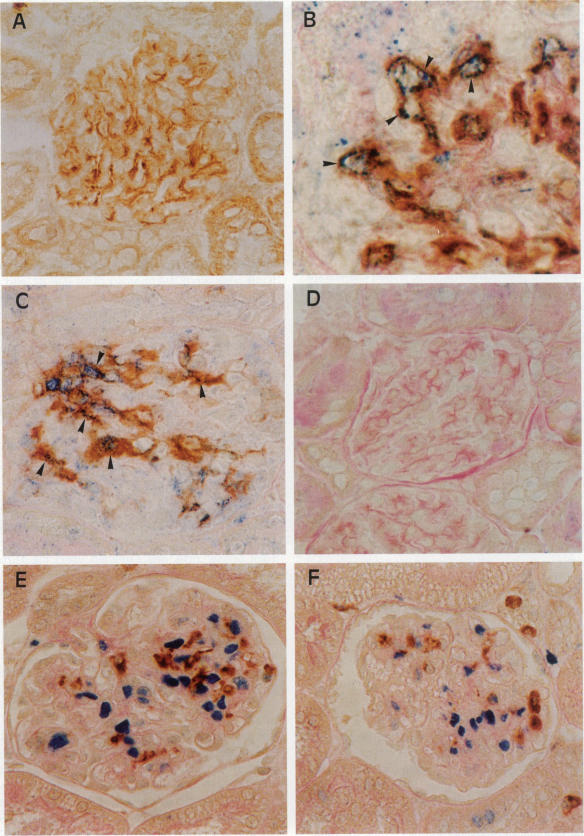
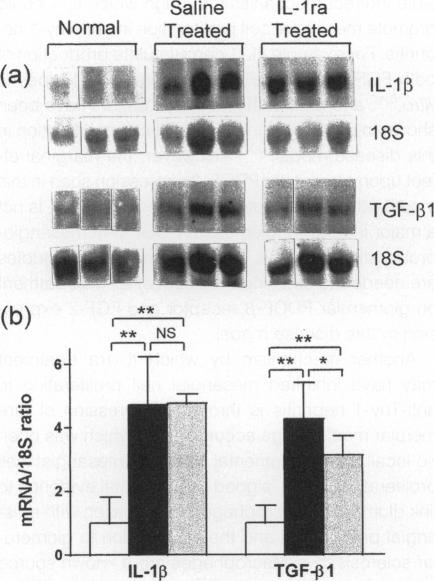
We examined the functional role of interleukin (IL)-1 in mesangial cell proliferation during rat anti-Thy-1 nephritis by blocking its action with IL-1 receptor antagonist (IL-1ra). Anti-Thy-1 nephritis was induced by intravenous injection of 5 mg/kg OX-7 IgG (day 0) into inbred Wistar rats. Groups of animals (n = 9) were implanted with a micro-osmotic pump on day -1, which delivered 25 micrograms/hour human recombinant IL-1ra or saline continuously until the rats were killed at day 6, the peak of mesangial cell proliferation. Immunostaining showed that IL-1 was expressed by mesangial cells during disease. IL-1ra treatment did not affect the mild, but significant, proteinuria seen after OX-7 injection. Compared with saline treatment, IL-1ra treatment reduced mesangial cell proliferation (decreases 24% P < 0.05), glomerular hypercellularity (decreases 29%; P < 0.05), and glomerular macrophage accumulation (decreases 20%; P < 0.05). However, IL-1ra treatment had no effect on glomerular IL-1 beta mRNA expression and caused only a small reduction in the high levels of glomerular expression of platelet-derived growth factor-beta protein (decreases 6%; P < 0.05). IL-1ra caused a modest reduction in the marked up-regulation of glomerular transforming growth factor-beta 1 mRNA expression on day 6 (decreases 26%; P < 0.05), although urinary excretion of this factor was unaffected. Interestingly, IL-1ra treatment had relatively little effect upon glomerular deposition of laminin, fibronectin, and collagen type IV seen in this acute disease. In conclusion, this study has 1) demonstrated that IL-1 is expressed by mesangial cells in vivo, 2) demonstrated that IL-1 is a mesangial cell growth factor in experimental mesangioproliferative nephritis, and 3) suggests that IL-1 has little or no fibrogenic activity in mesangial matrix deposition.
我们通过用白细胞介素-1受体拮抗剂(IL-1ra)阻断白细胞介素(IL)-1的作用,研究了其在大鼠抗Thy-1肾炎系膜细胞增殖中的功能作用。通过向近交系Wistar大鼠静脉注射5mg/kg OX-7 IgG(第0天)诱导抗Thy-1肾炎。在第-1天给动物组(n = 9)植入微渗透泵,持续输注25微克/小时的重组人IL-1ra或生理盐水,直至大鼠在第6天(系膜细胞增殖高峰期)处死。免疫染色显示疾病期间系膜细胞表达IL-1。IL-1ra治疗不影响OX-7注射后出现的轻度但显著的蛋白尿。与生理盐水治疗相比,IL-1ra治疗减少了系膜细胞增殖(降低24%;P < 0.05)、肾小球细胞增多(降低29%;P < 0.05)和肾小球巨噬细胞积聚(降低20%;P < 0.05)。然而,IL-1ra治疗对肾小球IL-1β mRNA表达无影响,仅使血小板衍生生长因子-β蛋白的高水平肾小球表达略有降低(降低6%;P < 0.05)。IL-1ra使第6天肾小球转化生长因子-β1 mRNA表达的显著上调适度降低(降低26%;P < 0.05),尽管该因子的尿排泄未受影响。有趣的是,IL-1ra治疗对该急性疾病中所见的层粘连蛋白、纤连蛋白和IV型胶原的肾小球沉积影响相对较小。总之,本研究1)证明IL-1在体内由系膜细胞表达,2)证明IL-1是实验性系膜增生性肾炎中的系膜细胞生长因子,3)提示IL-1在系膜基质沉积中几乎没有或没有促纤维化活性。