Moroda T, Iiai T, Suzuki S, Tsukahara A, Tada T, Nose M, Hatakeyama K, Seki S, Takeda K, Watanabe H, Abo T
Department of Immunology, Niigata University School of Medicine, Japan.
Immunology. 1997 Jun;91(2):219-26. doi: 10.1046/j.1365-2567.1997.00240.x.
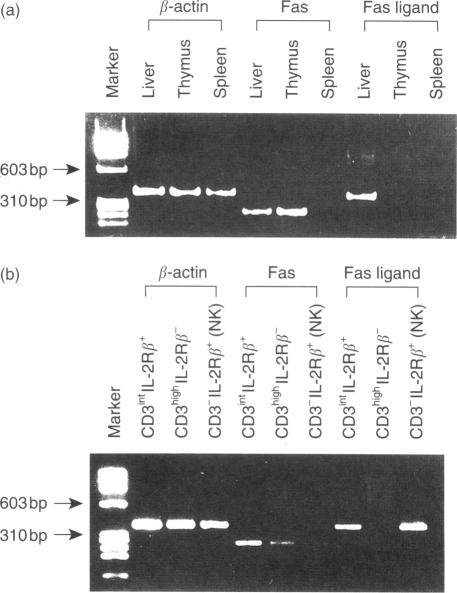
Self-reactive clones, estimated by anti-V beta monoclonal antibodies (mAb) in conjunction with the Mls system, are confined to a population of intermediate (int) T-cell receptor (TCR) (or CD3) cells (i.e. TCRint cells), but are not found among TCRhigh cells. The next questions to be answered are whether autologous killing is confined to TCRint cells and how such killing is mediated. In this study, 51Cr-labelled thymocytes of syngeneic or allogeneic origin were used as target cells (4-hr assay). When liver and splenic mononuclear cells (MNC) obtained from B6 mice were used as effector cells, prominent autologous killing was seen in liver MNC, but not splenic MNC. Such killing was not seen when thymocytes from B6-lpr/lpr mice (i.e. Fas-) were used as target cells, nor when liver MNC from MRL-gld/gld mice (i.e. Fas ligand-) were used as effector cells (target thymocytes of MRL(-)+/+ mice). Cell separation experiments using a cell sorter revealed that autologous killing was mediated for the most part by CD3int cells, while allogeneic killing was mediated entirely by natural killer (NK) cells, TCRint cells and TCRhigh cells. Among CD3int cells, the NK1.1+ subset (i.e. NK1.1+ T cells) manifested a higher level of autologous killing than did the NK1.1- subset. Consistent with the results of a functional assay, it was found by reverse-transcription-polymerase chain reaction (RT-PCR) assay that CD3int cells among liver MNC showed the expression of Fas ligand mRNA, while thymocytes expressed Fas mRNA. When class I major histocompatibility complex (MHC)- thymocytes (from beta 2-microglobulin-deficient mice) were used as target cells, NK cells, but not CD3int cells, showed potent cytotoxicity. These results suggest that autologous killing is a major function of TCRint cells with self-reactivity, and that such killing is mediated by means of Fas ligand/Fas molecules.
通过抗Vβ单克隆抗体(mAb)结合Mls系统估计的自身反应性克隆,局限于中等水平(int)T细胞受体(TCR)(或CD3)细胞群体(即TCRint细胞),但在TCRhigh细胞中未发现。接下来要回答的问题是自体杀伤是否局限于TCRint细胞以及这种杀伤是如何介导的。在本研究中,使用同基因或异基因来源的51Cr标记胸腺细胞作为靶细胞(4小时测定)。当使用从B6小鼠获得的肝脏和脾脏单核细胞(MNC)作为效应细胞时,在肝脏MNC中观察到显著的自体杀伤,但在脾脏MNC中未观察到。当使用来自B6-lpr/lpr小鼠(即Fas-)的胸腺细胞作为靶细胞时,或者当使用来自MRL-gld/gld小鼠(即Fas配体-)的肝脏MNC作为效应细胞(MRL(-)+ / +小鼠的靶胸腺细胞)时,未观察到这种杀伤。使用细胞分选仪进行的细胞分离实验表明,自体杀伤大部分由CD3int细胞介导,而异体杀伤完全由自然杀伤(NK)细胞、TCRint细胞和TCRhigh细胞介导。在CD3int细胞中,NK1.1 +亚群(即NK1.1 + T细胞)表现出比NK1.1-亚群更高水平的自体杀伤。与功能测定结果一致,通过逆转录-聚合酶链反应(RT-PCR)测定发现,肝脏MNC中的CD3int细胞显示Fas配体mRNA的表达,而胸腺细胞表达Fas mRNA。当使用I类主要组织相容性复合体(MHC)-胸腺细胞(来自β2-微球蛋白缺陷小鼠)作为靶细胞时,NK细胞而非CD3int细胞显示出强大的细胞毒性。这些结果表明,自体杀伤是具有自身反应性的TCRint细胞的主要功能,并且这种杀伤是通过Fas配体/Fas分子介导的。