Chen F S, Steele D, Fedida D
Department of Physiology, Botterell Hall, Queen's University, Kingston, Ontario K7L 3N6, Canada.
J Gen Physiol. 1997 Aug;110(2):87-100. doi: 10.1085/jgp.110.2.87.
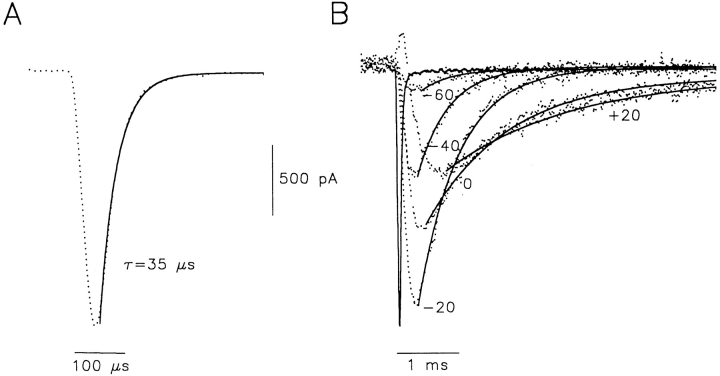
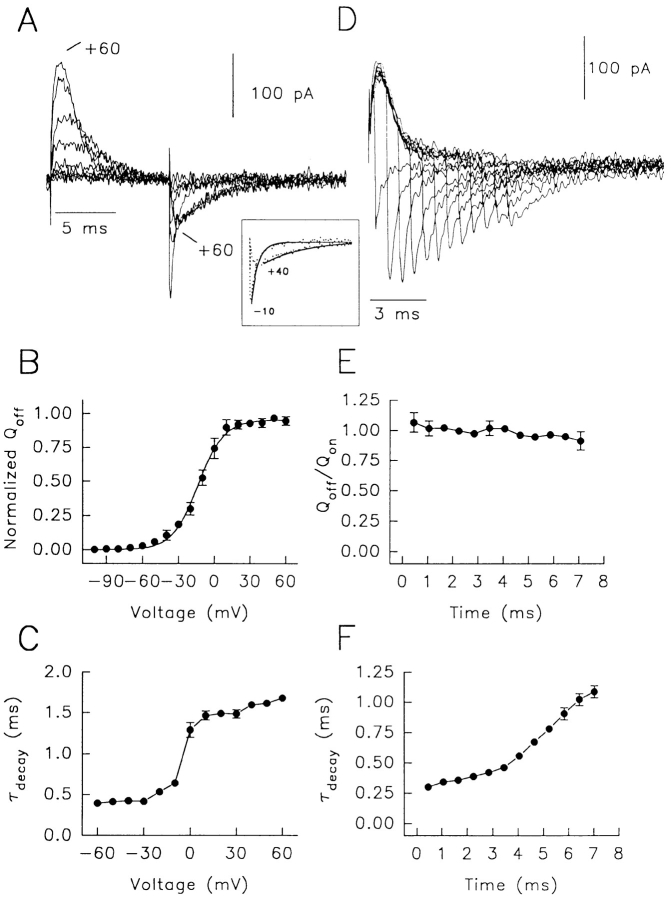
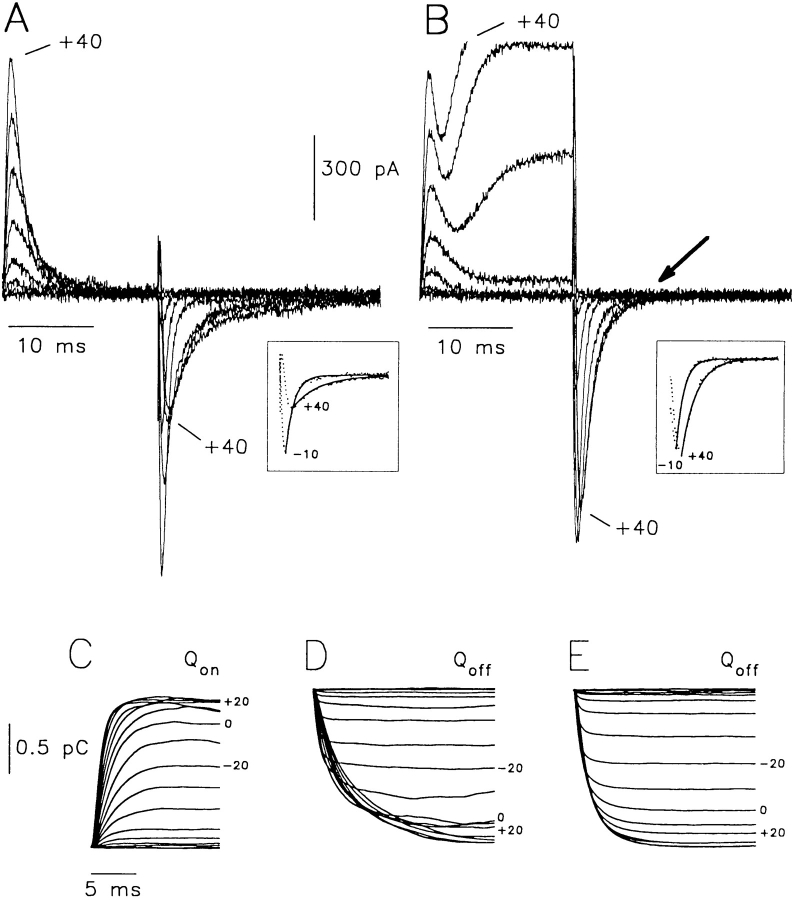
K+ channel gating currents are usually measured in the absence of permeating ions, when a common feature of channel closing is a rising phase of off-gating current and slow subsequent decay. Current models of gating invoke a concerted rearrangement of subunits just before the open state to explain this very slow charge return from opening potentials. We have measured gating currents from the voltage-gated K+ channel, Kv1.5, highly overexpressed in human embryonic kidney cells. In the presence of permeating K+ or Cs+, we show, by comparison with data obtained in the absence of permeant ions, that there is a rapid return of charge after depolarizations. Measurement of off-gating currents on repolarization before and after K+ dialysis from cells allowed a comparison of off-gating current amplitudes and time course in the same cells. Parallel experiments utilizing the low permeability of Cs+ through Kv1.5 revealed similar rapid charge return during measurements of off-gating currents at ECs. Such effects could not be reproduced in a nonconducting mutant (W472F) of Kv1.5, in which, by definition, ion permeation was macroscopically absent. This preservation of a fast kinetic structure of off-gating currents on return from potentials at which channels open suggests an allosteric modulation by permeant cations. This may arise from a direct action on a slow step late in the activation pathway, or via a retardation in the rate of C-type inactivation. The activation energy barrier for K+ channel closing is reduced, which may be important during repetitive action potential spiking where ion channels characteristically undergo continuous cyclical activation and deactivation.
钾离子通道门控电流通常在没有通透离子的情况下测量,此时通道关闭的一个共同特征是关闸电流的上升阶段以及随后缓慢的衰减。当前的门控模型认为,在通道开放状态之前亚基会发生协同重排,以解释从开放电位返回时电荷返回非常缓慢的现象。我们测量了在人胚肾细胞中高度过表达的电压门控钾离子通道Kv1.5的门控电流。在存在通透钾离子或铯离子的情况下,通过与在没有通透离子时获得的数据进行比较,我们发现去极化后电荷会快速返回。通过对细胞进行钾离子透析前后复极化时的关闸电流进行测量,可以比较同一细胞中关闸电流的幅度和时间进程。利用铯离子通过Kv1.5的低通透性进行的平行实验显示,在测量关闸电流时,在胞外液(ECs)中也有类似的快速电荷返回。在Kv1.5的非导电突变体(W472F)中无法重现这种效应,根据定义,该突变体在宏观上不存在离子通透现象。通道从开放电位返回时关闸电流快速动力学结构的保留表明,通透阳离子存在变构调节作用。这可能源于对激活途径后期缓慢步骤的直接作用,或者是通过减慢C型失活的速率。钾离子通道关闭的活化能垒降低,这在重复动作电位发放期间可能很重要,此时离子通道通常会经历连续的周期性激活和失活。