Department of Anesthesiology, Pharmacology, and Therapeutics, Life Sciences Institute, University of British Columbia, Vancouver, British Columbia V6T 1Z3, Canada.
J Gen Physiol. 2012 Nov;140(5):495-511. doi: 10.1085/jgp.201210823. Epub 2012 Oct 15.
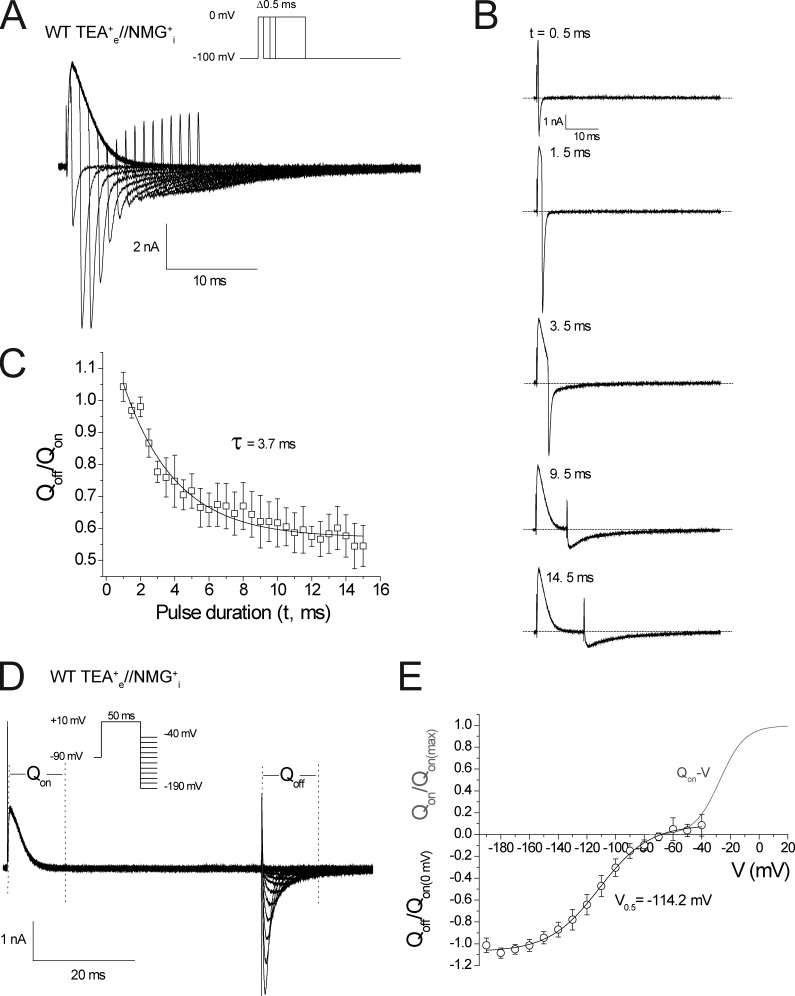
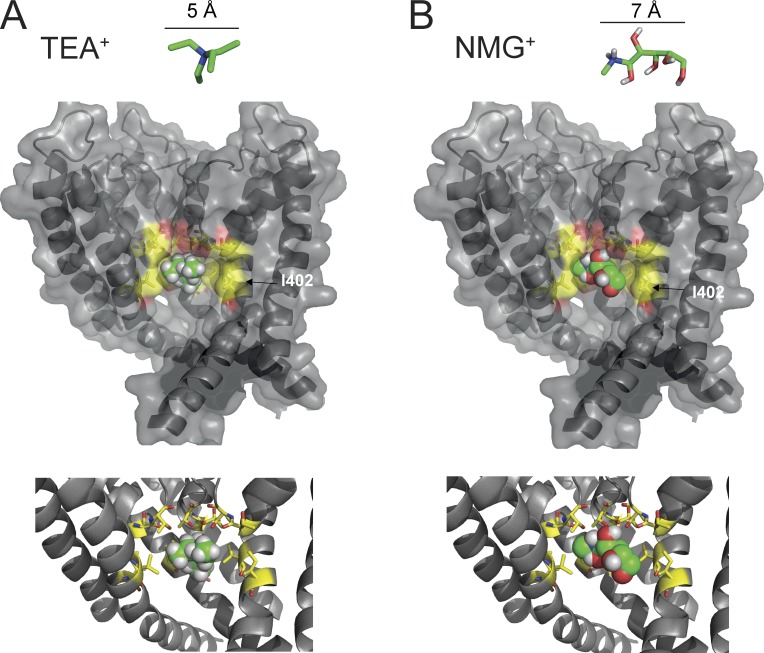
The open state of voltage-gated potassium (Kv) channels is associated with an increased stability relative to the pre-open closed states and is reflected by a slowing of OFF gating currents after channel opening. The basis for this stabilization is usually assigned to intrinsic structural features of the open pore. We have studied the gating currents of Kv1.2 channels and found that the stabilization of the open state is instead conferred largely by the presence of cations occupying the inner cavity of the channel. Large impermeant intracellular cations such as N-methyl-d-glucamine (NMG(+)) and tetraethylammonium cause severe slowing of channel closure and gating currents, whereas the smaller cation, Cs(+), displays a more moderate effect on voltage sensor return. A nonconducting mutant also displays significant open state stabilization in the presence of intracellular K(+), suggesting that K(+) ions in the intracellular cavity also slow pore closure. A mutation in the S6 segment used previously to enlarge the inner cavity (Kv1.2-I402C) relieves the slowing of OFF gating currents in the presence of the large NMG(+) ion, suggesting that the interaction site for stabilizing ions resides within the inner cavity and creates an energetic barrier to pore closure. The physiological significance of ionic occupation of the inner cavity is underscored by the threefold slowing of ionic current deactivation in the wild-type channel compared with Kv1.2-I402C. The data suggest that internal ions, including physiological concentrations of K(+), allosterically regulate the deactivation kinetics of the Kv1.2 channel by impairing pore closure and limiting the return of voltage sensors. This may represent a primary mechanism by which Kv channel deactivation kinetics is linked to ion permeation and reveals a novel role for channel inner cavity residues to indirectly regulate voltage sensor dynamics.
电压门控钾 (Kv) 通道的开放状态与预开放关闭状态相比具有更高的稳定性,这反映在通道开放后关闭门控电流的减慢。这种稳定性的基础通常归因于开放孔道的固有结构特征。我们研究了 Kv1.2 通道的门控电流,发现开放状态的稳定性主要归因于占据通道内腔的阳离子的存在。大的不可渗透的细胞内阳离子,如 N-甲基-D-葡萄糖胺 (NMG(+)) 和四乙铵,会严重减缓通道关闭和门控电流,而较小的阳离子 Cs(+) 对电压传感器返回的影响则更为温和。非传导性突变体在存在细胞内 K(+) 时也表现出明显的开放状态稳定化,这表明细胞内腔中的 K(+) 离子也会减缓孔道关闭。以前用于扩大内腔的 S6 片段中的突变 (Kv1.2-I402C) 缓解了大 NMG(+) 离子存在时关闭门控电流的减慢,这表明稳定离子的相互作用位点位于内腔中,并为孔道关闭创造了能量障碍。离子占据内腔的生理意义通过与 Kv1.2-I402C 相比,野生型通道中离子电流失活的三倍减缓得到强调。数据表明,包括生理浓度 K(+) 在内的内部离子通过损害孔道关闭和限制电压传感器的返回,变构调节 Kv1.2 通道的失活动力学。这可能代表 Kv 通道失活动力学与离子渗透相关的主要机制,并揭示了通道内腔残基间接调节电压传感器动力学的新作用。