Granzier H, Kellermayer M, Helmes M, Trombitás K
Department of Veterinary and Comparative Anatomy, Pharmacology, and Physiology, Washington State University, Pullman 99164-6520, USA.
Biophys J. 1997 Oct;73(4):2043-53. doi: 10.1016/S0006-3495(97)78234-1.
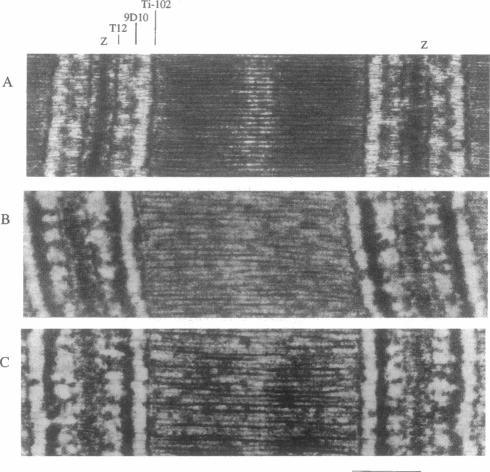
Titin (also known as connectin) is a giant filamentous protein whose elastic properties greatly contribute to the passive force in muscle. In the sarcomere, the elastic I-band segment of titin may interact with the thin filaments, possibly affecting the molecule's elastic behavior. Indeed, several studies have indicated that interactions between titin and actin occur in vitro and may occur in the sarcomere as well. To explore the properties of titin alone, one must first eliminate the modulating effect of the thin filaments by selectively removing them. In the present work, thin filaments were selectively removed from the cardiac myocyte by using a gelsolin fragment. Partial extraction left behind approximately 100-nm-long thin filaments protruding from the Z-line, whereas the rest of the I-band became devoid of thin filaments, exposing titin. By applying a much more extensive gelsolin treatment, we also removed the remaining short thin filaments near the Z-line. After extraction, the extensibility of titin was studied by using immunoelectron microscopy, and the passive force-sarcomere length relation was determined by using mechanical techniques. Titin's regional extensibility was not detectably affected by partial thin-filament extraction. Passive force, on the other hand, was reduced at sarcomere lengths longer than approximately 2.1 microm, with a 33 +/- 9% reduction at 2.6 microm. After a complete extraction, the slack sarcomere length was reduced to approximately 1.7 microm. The segment of titin near the Z-line, which is otherwise inextensible, collapsed toward the Z-line in sarcomeres shorter than approximately 2.0 microm, but it was extended in sarcomeres longer than approximately 2.3 microm. Passive force became elevated at sarcomere lengths between approximately 1.7 and approximately 2.1 microm, but was reduced at sarcomere lengths of >2.3 microm. These changes can be accounted for by modeling titin as two wormlike chains in series, one of which increases its contour length by recruitment of the titin segment near the Z-line into the elastic pool.
肌联蛋白(也称为连接蛋白)是一种巨大的丝状蛋白,其弹性特性对肌肉中的被动力有很大贡献。在肌节中,肌联蛋白的弹性I带片段可能与细肌丝相互作用,这可能会影响该分子的弹性行为。实际上,多项研究表明,肌联蛋白与肌动蛋白之间的相互作用在体外会发生,在肌节中也可能发生。为了单独探究肌联蛋白的特性,必须首先通过选择性去除细肌丝来消除其调节作用。在本研究中,通过使用凝溶胶蛋白片段从心肌细胞中选择性去除细肌丝。部分提取后,留下了从Z线伸出的约100纳米长的细肌丝,而I带的其余部分则没有细肌丝,从而暴露出肌联蛋白。通过进行更广泛的凝溶胶蛋白处理,我们还去除了Z线附近剩余的短细肌丝。提取后,通过免疫电子显微镜研究肌联蛋白的可伸展性,并使用机械技术确定被动力与肌节长度的关系。部分细肌丝提取对肌联蛋白的区域可伸展性没有明显影响。另一方面,在肌节长度大于约2.1微米时,被动力降低,在2.6微米时降低了33±9%。完全提取后,松弛肌节长度减少到约1.7微米。Z线附近的肌联蛋白片段在其他情况下是不可伸展的,在短于约2.0微米的肌节中向Z线塌陷,但在长于约2.3微米的肌节中则伸展。在肌节长度约为1.7至约2.1微米之间时,被动力升高,但在肌节长度大于2.3微米时降低。这些变化可以通过将肌联蛋白建模为两个串联的类蠕虫链来解释,其中一个通过将Z线附近的肌联蛋白片段募集到弹性池中增加其轮廓长度。