Couffinhal T, Silver M, Zheng L P, Kearney M, Witzenbichler B, Isner J M
Department of Medicine (Cardiology), St. Elizabeth's Medical Center, Tufts University School of Medicine, Boston Massachusetts 02135, USA.
Am J Pathol. 1998 Jun;152(6):1667-79.
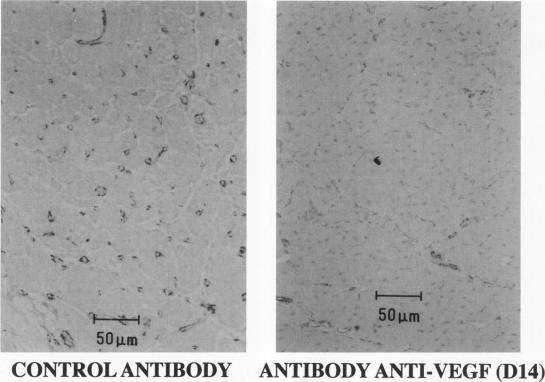
Neovascularization of ischemic muscle may be sufficient to preserve tissue integrity and/or function and may thus be considered to be therapeutic. The regulatory role of vascular endothelial growth factor (VEGF) in therapeutic angiogenesis was suggested by experiments in which exogenously administered VEGF was shown to augment collateral blood flow in animals and patients with experimentally induced hindlimb or myocardial ischemia. To address the possible contribution of postnatal endogenous VEGF expression to collateral vessel development in ischemia tissues, we developed a mouse model of hindlimb ischemia. The femoral artery of one hindlimb was ligated and excised. Laser Doppler perfusion imaging (LDPI) was employed to document the consequent reduction in hindlimb blood flow, which typically persisted for up to 7 days. Serial in vivo examinations by LDPI disclosed that hindlimb blood flow was progressively augmented over the course of 14 days, ultimately reaching a plateau between 21 and 28 days. Morphometric analysis of capillary density performed at the same time points selected for in vivo analysis of blood flow by LDPI confirmed that the histological sequence of neovascularization corresponded temporally to blood flow recovery detected in vivo. Endothelial cell proliferation was documented by immunostaining for bromodeoxyuridine injected 24 hours before each of these time points, providing additional evidence that angiogenesis constitutes the basis for improved collateral-dependent flow in this animal model. Neovascularization was shown to develop in association with augmented expression of VEGF mRNA and protein from skeletal myocytes as well as endothelial cells in the ischemic hindlimb; that such reparative angiogenesis is indeed dependent upon VEGF up-regulation was confirmed by impaired neovascularization after administration of a neutralizing VEGF antibody. Sequential characterization of the in vivo, histological, and molecular findings in this novel animal model thus document the role of VEGF as endogenous regulator of angiogenesis in the setting of tissue ischemia. Moreover, this murine model represents a potential means for studying the effects of gene targeting on nutrient angiogenesis in vivo.
缺血肌肉的新生血管形成可能足以维持组织完整性和/或功能,因此可被视为具有治疗作用。血管内皮生长因子(VEGF)在治疗性血管生成中的调节作用已通过实验得到证实,这些实验表明,外源性给予的VEGF可增加实验性诱导后肢或心肌缺血的动物和患者的侧支血流。为了探讨出生后内源性VEGF表达对缺血组织中侧支血管发育的可能作用,我们建立了一个后肢缺血的小鼠模型。结扎并切除一侧后肢的股动脉。采用激光多普勒灌注成像(LDPI)记录随之而来的后肢血流减少情况,这种减少通常会持续长达7天。通过LDPI进行的系列体内检查显示,后肢血流在14天内逐渐增加,最终在21至28天之间达到平稳状态。在与通过LDPI进行体内血流分析所选择的相同时间点进行的毛细血管密度形态计量分析证实,新生血管形成的组织学顺序在时间上与体内检测到的血流恢复情况相对应。在每个时间点前24小时注射溴脱氧尿苷进行免疫染色,记录内皮细胞增殖情况,这进一步证明血管生成是该动物模型中侧支依赖性血流改善的基础。结果表明,缺血后肢的骨骼肌细胞和内皮细胞中VEGF mRNA和蛋白表达增加,新生血管形成与之相关;给予中和性VEGF抗体后新生血管形成受损,证实这种修复性血管生成确实依赖于VEGF上调。因此,在这个新的动物模型中对体内、组织学和分子学结果进行的顺序性表征记录了VEGF在组织缺血情况下作为血管生成内源性调节因子的作用。此外,这个小鼠模型代表了一种在体内研究基因靶向对营养性血管生成影响的潜在手段。