Kaplan M H, Wurster A L, Grusby M J
Department of Immunology and Infectious Diseases, Harvard School of Public Health, Boston, Massachusetts 02115, USA.
J Exp Med. 1998 Sep 21;188(6):1191-6. doi: 10.1084/jem.188.6.1191.
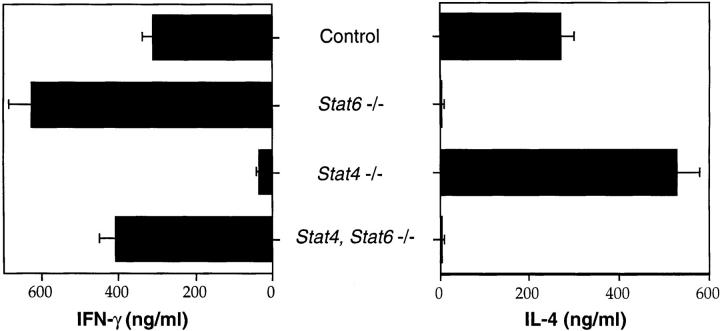
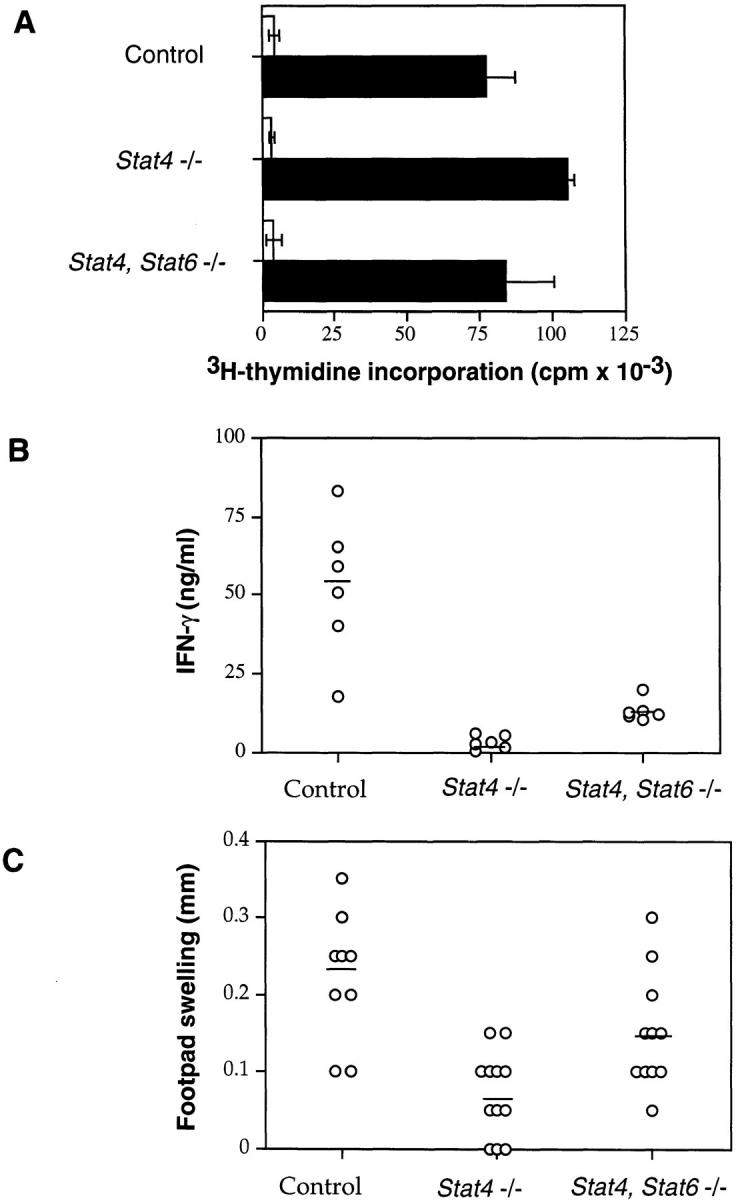
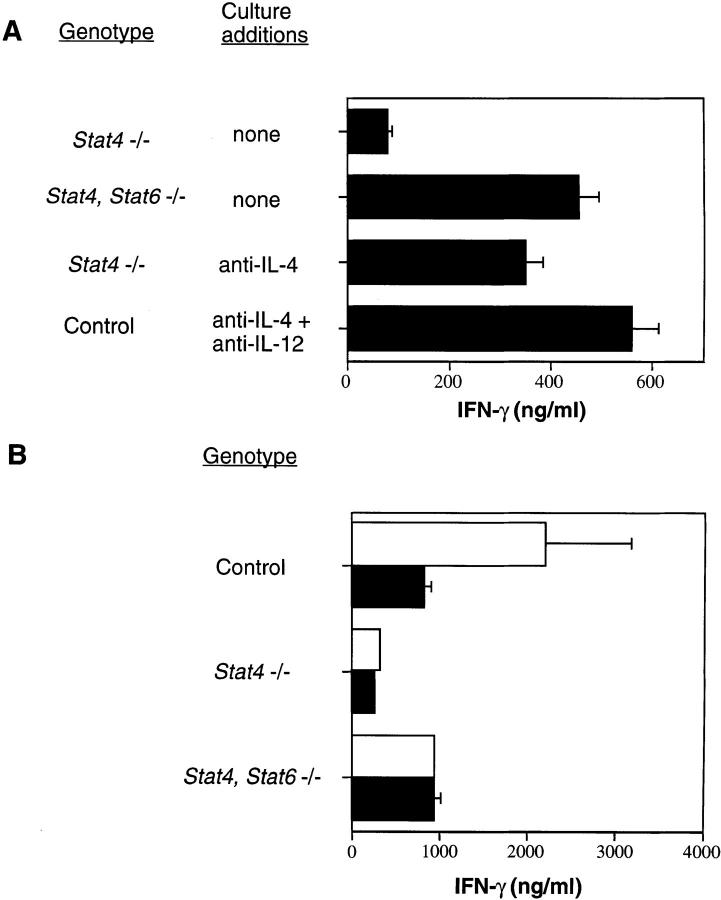
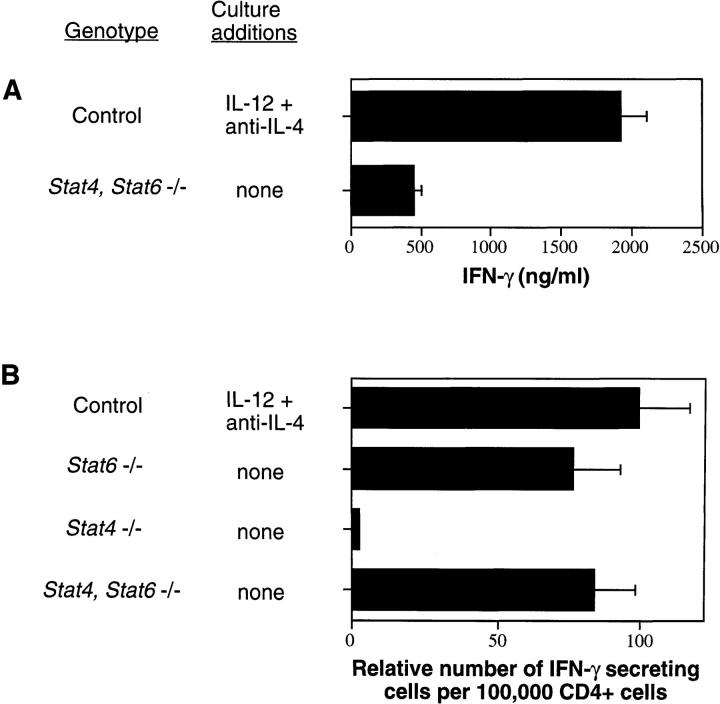
The differentiation of T helper (Th) cells is regulated by members of the signal transducer and activator of transcription (STAT) family of signaling molecules. We have generated mice lacking both Stat4 and Stat6 to examine the ability of Th cells to develop in the absence of these two transcription factors. Stat4, Stat6(-/-) lymphocytes fail to differentiate into interleukin (IL)-4-secreting Th2 cells. However, in contrast to Stat4(-/-) lymphocytes, T cells from Stat4, Stat6(-/-) mice produce significant amounts of interferon (IFN)-gamma when activated in vitro. Although Stat4, Stat6(-/-) lymphocytes produce less IFN-gamma than IL-12-stimulated control lymphocytes, equivalent numbers of IFN-gamma-secreting cells can be generated from cultures of Stat4, Stat6(-/-) lymphocytes activated under neutral conditions and control lymphocytes activated under Th1 cell-promoting conditions. Moreover, Stat4, Stat6(-/-) mice are able to mount an in vivo Th1 cell-mediated delayed-type hypersensitivity response. These results support a model of Th cell differentiation in which the generation of Th2 cells requires Stat6, whereas a Stat4-independent pathway exists for the development of Th1 cells.
辅助性T(Th)细胞的分化受信号转导及转录激活蛋白(STAT)信号分子家族成员的调控。我们构建了同时缺失Stat4和Stat6的小鼠,以研究在缺乏这两种转录因子的情况下Th细胞的发育能力。Stat4、Stat6(-/-)淋巴细胞无法分化为分泌白细胞介素(IL)-4的Th2细胞。然而,与Stat4(-/-)淋巴细胞不同,来自Stat4、Stat6(-/-)小鼠的T细胞在体外激活时会产生大量干扰素(IFN)-γ。虽然Stat4、Stat6(-/-)淋巴细胞产生的IFN-γ比IL-12刺激的对照淋巴细胞少,但在中性条件下激活的Stat4、Stat6(-/-)淋巴细胞培养物和在Th1细胞促进条件下激活的对照淋巴细胞培养物能产生等量的分泌IFN-γ的细胞。此外,Stat4、Stat6(-/-)小鼠能够产生体内Th1细胞介导的迟发型超敏反应。这些结果支持了一种Th细胞分化模型,即Th2细胞的产生需要Stat6,而Th1细胞的发育存在一条不依赖Stat4的途径。