Hock R, Scheer U, Bustin M
Protein Section, Laboratory of Molecular Carcinogenesis, Division of Basic Sciences, National Cancer Institute, National Institutes of Health, Bethesda, Maryland 20892, USA.
J Cell Biol. 1998 Dec 14;143(6):1427-36. doi: 10.1083/jcb.143.6.1427.
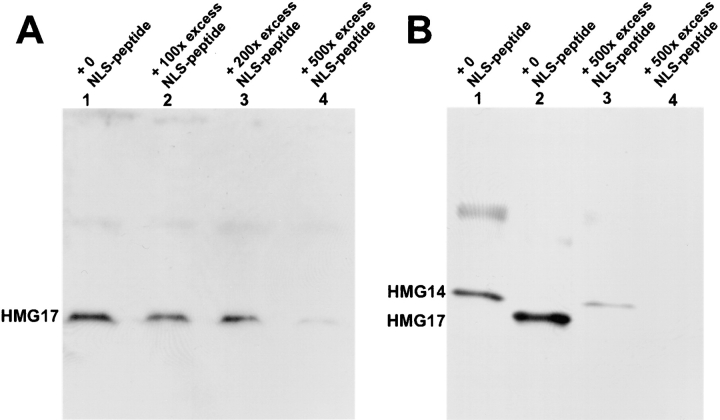
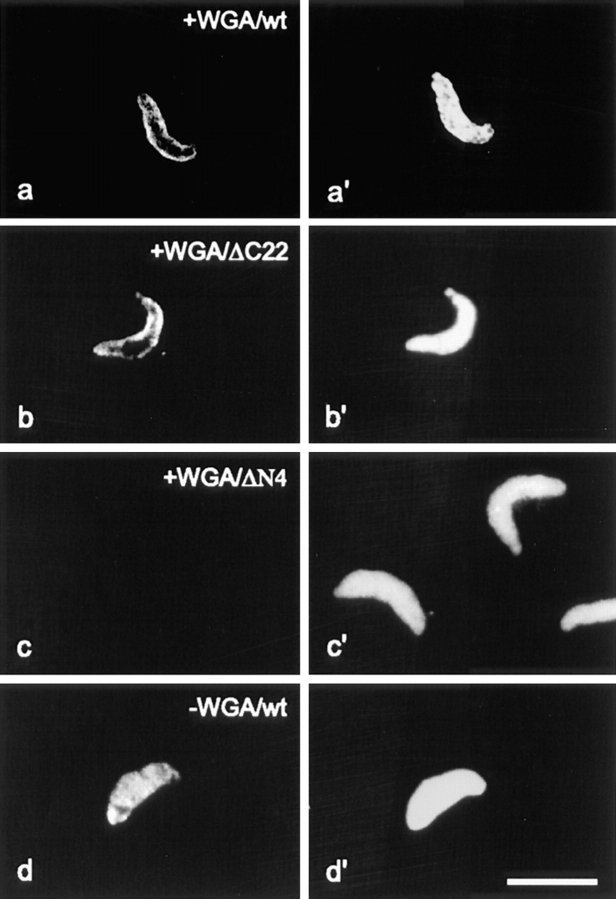
The high mobility group 14/17 (HMG-14/-17) proteins form specific complexes with nucleosome core particles and produce distinct footprints on nucleosomal DNA. Therefore, they could be an integral part of the chromatin fiber. Here we show that during the cell cycle these proteins are transiently dissociated from chromatin. They colocalize with the nuclear DNA in interphase and prophase but not in metaphase and anaphase. They relocate into the nucleus and colocalize again with the DNA in late telophase, concomitantly with the appearance of the nuclear envelope. Thus, these nucleosomal binding proteins are not always associated with chromatin. Using reconstituted nuclei and permeabilized cells, we demonstrate that these two small proteins, with a molecular mass <10 kD, are actively imported into the nucleus. We identify the major elements involved in the nuclear import of these chromosomal proteins: HMG-14/-17 proteins contain an intrinsic bipartite nuclear localization signal, and their entry into the nucleus through nuclear pores requires energy and the participation of importin alpha. These findings suggest that the cell cycle-related association of HMG-14/-17 with chromatin is dependent on, and perhaps regulated by, nuclear import processes.
高迁移率族蛋白14/17(HMG - 14/-17)与核小体核心颗粒形成特定复合物,并在核小体DNA上产生独特的足迹。因此,它们可能是染色质纤维的一个组成部分。在此我们表明,在细胞周期中,这些蛋白质会暂时与染色质解离。它们在间期和前期与核DNA共定位,但在中期和后期则不然。它们在末期后期重新进入细胞核并再次与DNA共定位,同时伴随着核膜的出现。因此,这些核小体结合蛋白并非总是与染色质相关联。利用重构细胞核和通透细胞,我们证明这两种分子量小于10 kD的小蛋白质能够被主动转运到细胞核中。我们确定了这些染色体蛋白核输入过程中的主要元件:HMG - 14/-17蛋白含有一个内在的双分型核定位信号,它们通过核孔进入细胞核需要能量以及输入蛋白α的参与。这些发现表明,HMG - 14/-17与染色质的细胞周期相关联依赖于核输入过程,并且可能受其调控。