Dearden N M, Holmes R L
J Anat. 1976 Jul;121(Pt 3):551-69.
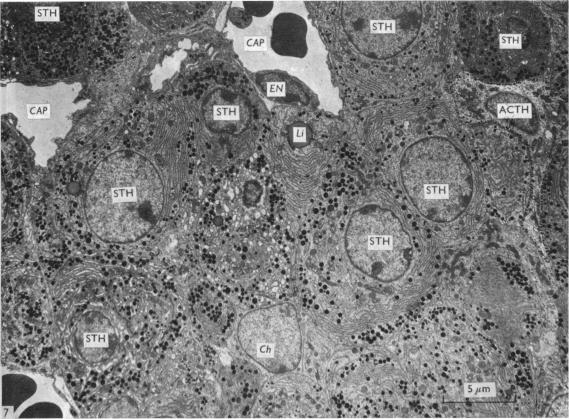
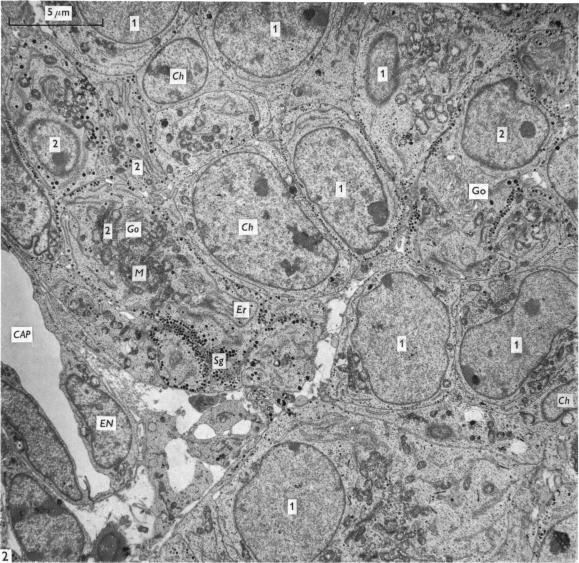
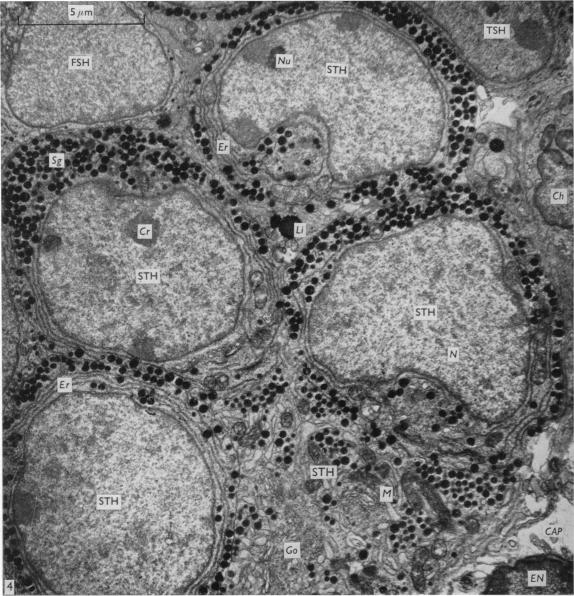
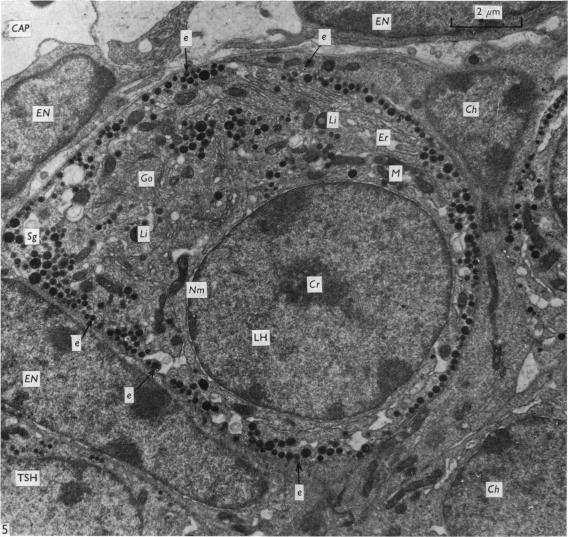
Pituitaries of fetal and postnatal (15 days p.c.-28 days p.n.) and adult (male) mice were studied by light and electron microscopy to correlate the developmental pattern of the hypothalamo-hypophysial vascular system with the time of onset of function of the adenohypophysis. The superior and anterior regions of the adenohypophysis become vascularized at 17 days p.c., when portal vessels extend from oral primary plexus to the pars distalis for the first time. Adenohypophysial vascularity and the number of portal vessels steadily increase to reach the adult pattern at 5 days p.n. At 1 day p.n. deep capillary loops appear in the caudal regions of the oral primary plexus; a capillary (tangential) plexus underlies the ependymal lining of the third ventricle by 6 days p.n. Superficial capillary loops were not observed until the third postnatal week. Granulation of secretory cells commences at 16 days p.c., predominantly in the upper and anterior adenohypophysis; at 17 days thyrotropes, gonadotropes and corticotropes are recognizable and by morphological criteria appear actively secretory on days 17-18 p.c., although few appear active at 19 days p.c. and 1 day p.n. Somatotropes are first seen at 18 days p.c., predominantly in the central and lateral regions of the pars distalis. Active secretory cells increase in number over the period 2-10 days p.n., but after 11 days p.n. thyrotropes and corticotropes seem to become progressively less active; fewer gonadotropes are seen after 15 days p.n., and these apparently become progressively less active from day 19. Most somatotropes appear active until 28 days p.n. The observations suggest that hypothalamic control of adenohypophysial function may exist in the mouse from 17 days p.c.
运用光镜和电镜技术,对胎鼠、出生后(妊娠15天至出生后28天)及成年(雄性)小鼠的垂体进行了研究,以探寻下丘脑 - 垂体血管系统的发育模式与腺垂体功能起始时间之间的关联。在妊娠17天时,腺垂体的上部和前部开始血管化,此时门静脉首次从口腔初级丛延伸至远侧部。腺垂体的血管化程度和门静脉数量持续稳定增加,至出生后5天时达到成年模式。出生后1天,口腔初级丛的尾部区域出现深部毛细血管袢;到出生后6天,第三脑室室管膜下衬有毛细血管(切线状)丛。直到出生后第三周才观察到浅表毛细血管袢。分泌细胞的颗粒化在妊娠16天时开始,主要发生在腺垂体的上部和前部;17天时,促甲状腺激素细胞、促性腺激素细胞和促肾上腺皮质激素细胞可被识别,从形态学标准来看,在妊娠17 - 18天时这些细胞表现为活跃分泌状态,不过在妊娠19天和出生后1天时仅有少数细胞呈活跃状态。生长激素细胞在妊娠18天时首次出现,主要位于远侧部的中央和外侧区域。在出生后2 - 10天期间,活跃分泌细胞的数量增加,但出生后11天之后,促甲状腺激素细胞和促肾上腺皮质激素细胞的活性似乎逐渐降低;出生后15天之后,促性腺激素细胞数量减少,且从第19天起其活性明显逐渐降低。大多数生长激素细胞在出生后28天前都保持活跃状态。这些观察结果表明,在小鼠中,从妊娠17天起可能就存在下丘脑对腺垂体功能的控制。