Weinreich F, Riordan J R, Nagel G
Max-Planck-Institut für Biophysik, 60596 Frankfurt/M., Germany.
J Gen Physiol. 1999 Jul;114(1):55-70. doi: 10.1085/jgp.114.1.55.
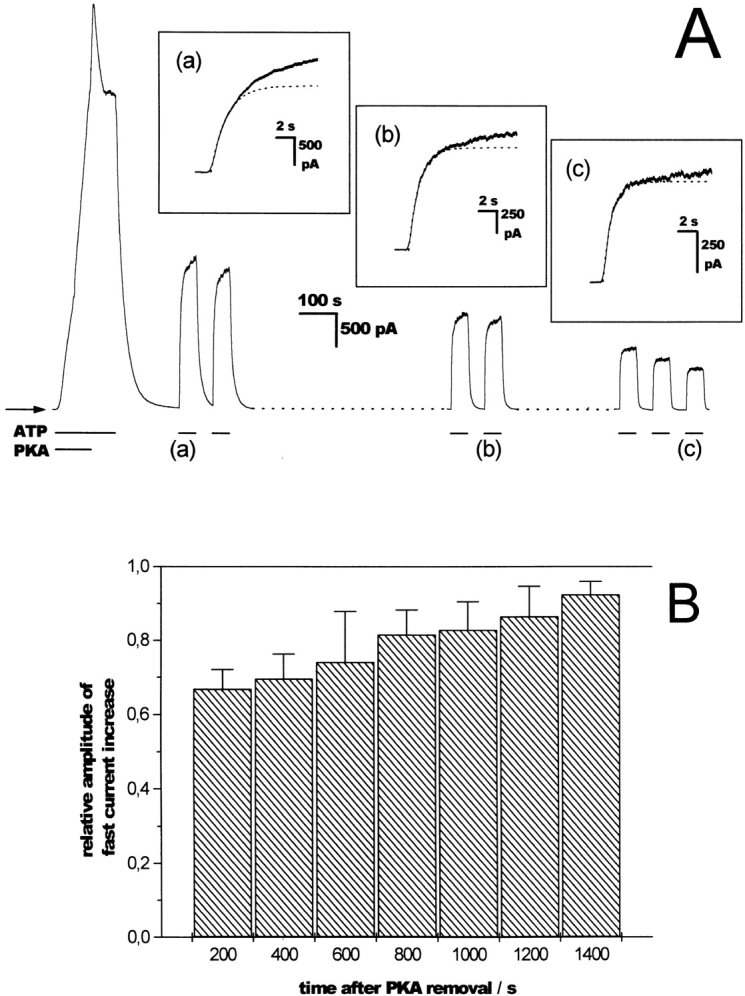
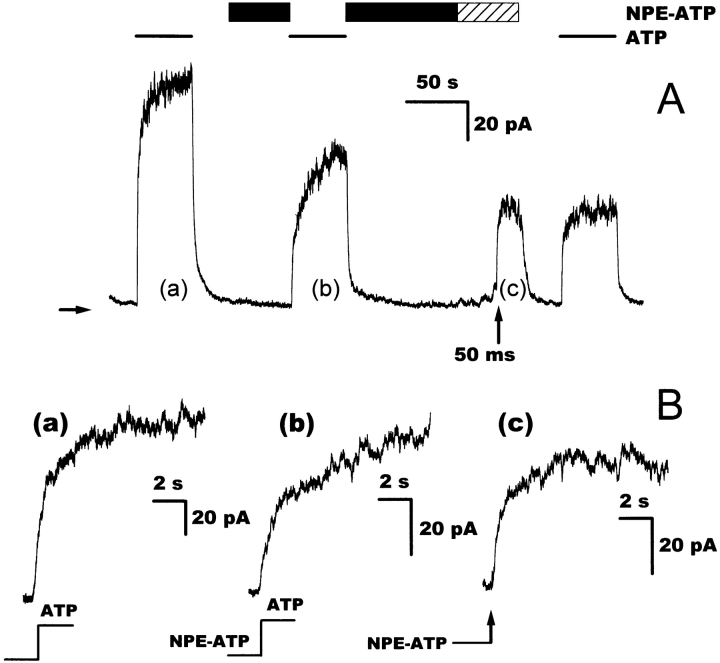
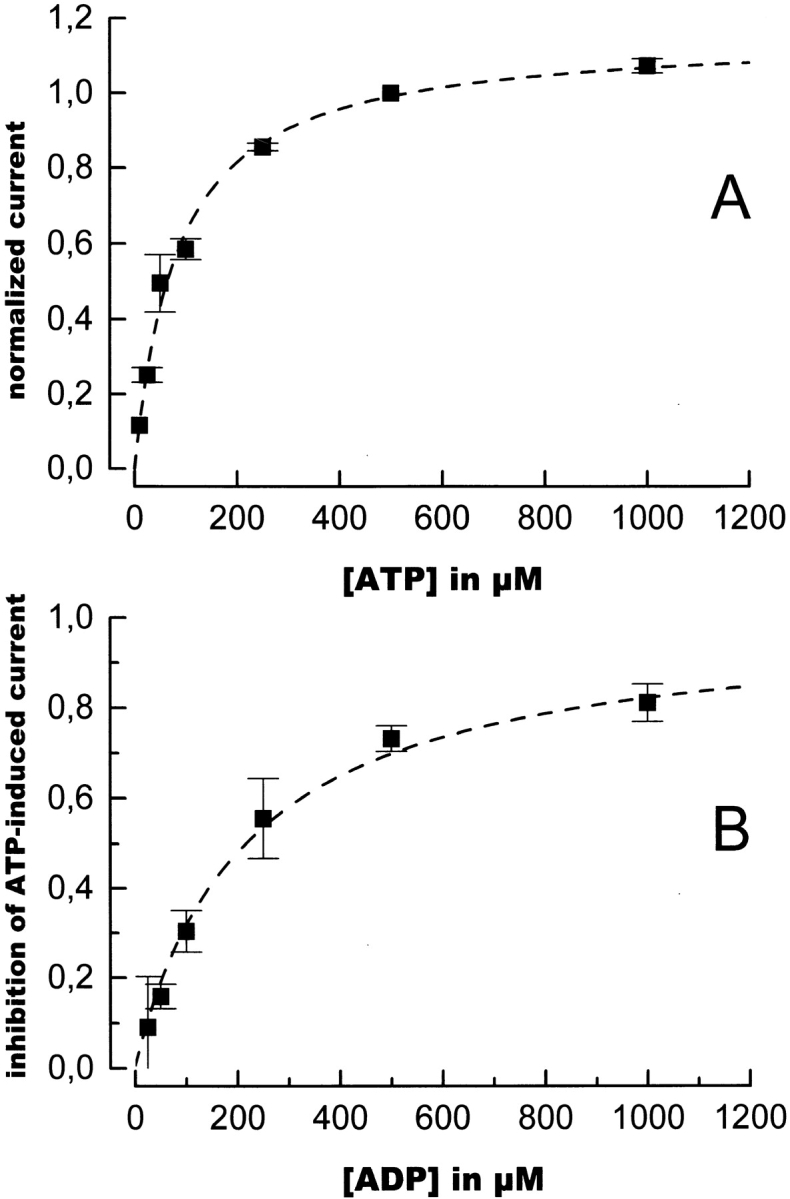
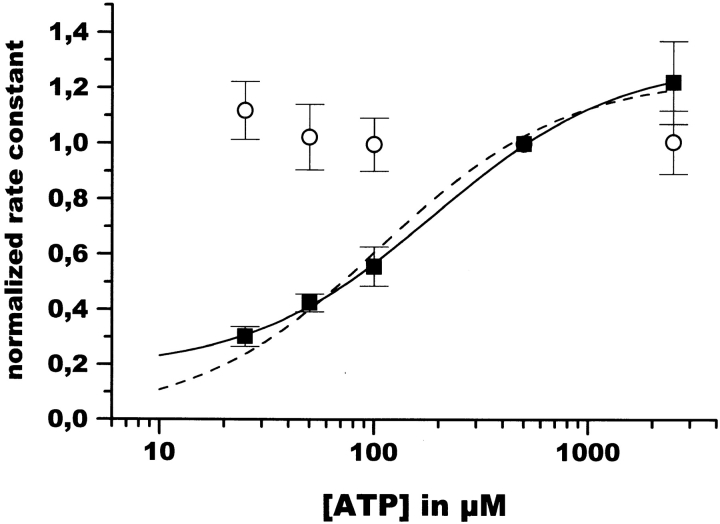
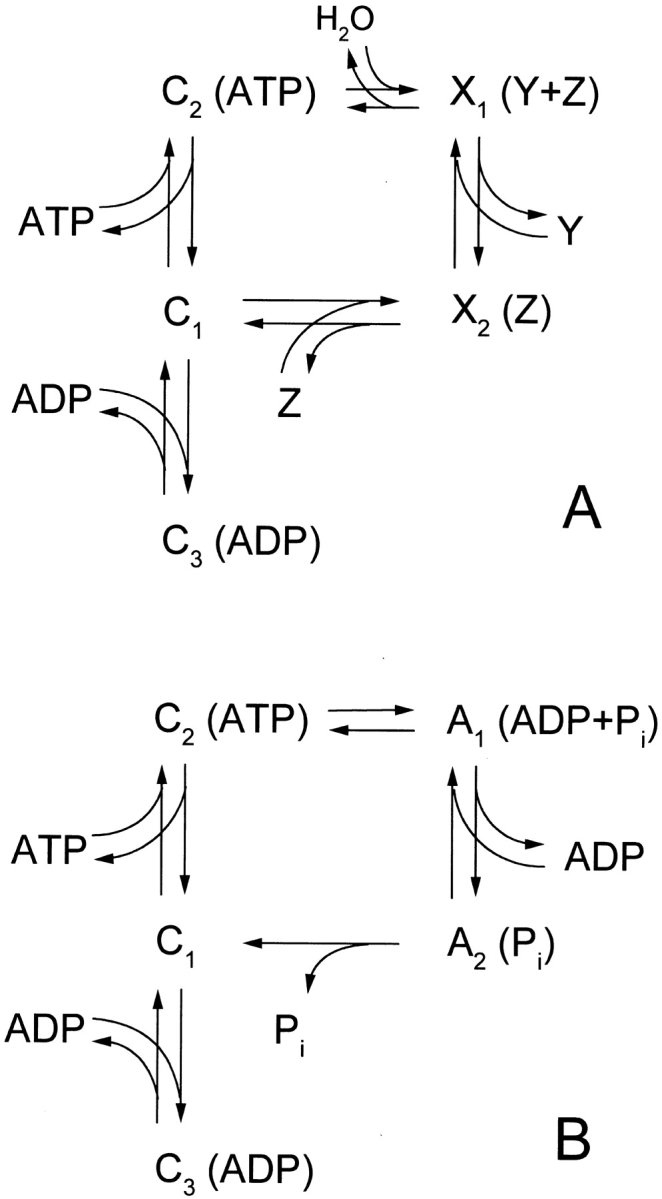
The CFTR chloride channel is regulated by phosphorylation by protein kinases, especially PKA, and by nucleotides interacting with the two nucleotide binding domains, NBD-A and NBD-B. Giant excised inside-out membrane patches from Xenopus oocytes expressing human epithelial cystic fibrosis transmembrane conductance regulator (CFTR) were tested for their chloride conductance in response to the application of PKA and nucleotides. Rapid changes in the concentration of ATP, its nonhydrolyzable analogue adenylylimidodiphosphate (AMP-PNP), its photolabile derivative ATP-P3-[1-(2-nitrophenyl)ethyl]ester, or ADP led to changes in chloride conductance with characteristic time constants, which reflected interaction of CFTR with these nucleotides. The conductance changes of strongly phosphorylated channels were slower than those of partially phosphorylated CFTR. AMP-PNP decelerated relaxations of conductance increase and decay, whereas ATP-P3-[1-(2-nitrophenyl)ethyl]ester only decelerated the conductance increase upon ATP addition. ADP decelerated the conductance increase upon ATP addition and accelerated the conductance decay upon ATP withdrawal. The results present the first direct evidence that AMP-PNP binds to two sites on the CFTR. The effects of ADP also suggest two different binding sites because of the two different modes of inhibition observed: it competes with ATP for binding (to NBD-A) on the closed channel, but it also binds to channels opened by ATP, which might either reflect binding to NBD-A (i.e., product inhibition in the hydrolysis cycle) or allosteric binding to NBD-B, which accelerates the hydrolysis cycle at NBD-A.
囊性纤维化跨膜传导调节因子(CFTR)氯离子通道受蛋白激酶(尤其是蛋白激酶A,PKA)磷酸化以及与两个核苷酸结合结构域(NBD-A和NBD-B)相互作用的核苷酸调控。对表达人上皮性囊性纤维化跨膜传导调节因子(CFTR)的非洲爪蟾卵母细胞的巨大内翻膜片进行测试,以检测其在施加PKA和核苷酸时的氯离子传导情况。ATP、其不可水解类似物腺苷酰亚胺二磷酸(AMP-PNP)、其光不稳定衍生物ATP-P3-[1-(2-硝基苯基)乙基]酯或ADP浓度的快速变化会导致氯离子传导发生变化,且具有特征性时间常数,这反映了CFTR与这些核苷酸的相互作用。高度磷酸化通道的传导变化比部分磷酸化的CFTR慢。AMP-PNP减缓了传导增加和衰减的弛豫过程,而ATP-P3-[1-(2-硝基苯基)乙基]酯仅在添加ATP时减缓传导增加。添加ATP时ADP减缓传导增加,去除ATP时ADP加速传导衰减。这些结果首次直接证明AMP-PNP与CFTR上的两个位点结合。ADP的作用也表明存在两个不同的结合位点,因为观察到两种不同的抑制模式:它在关闭通道时与ATP竞争结合(至NBD-A),但它也与由ATP打开的通道结合,这可能反映其与NBD-A的结合(即水解循环中的产物抑制)或与NBD-B的变构结合,从而加速NBD-A处的水解循环。