Rothberg B S, Magleby K L
Department of Physiology and Biophysics, University of Miami School of Medicine, Miami, Florida 33101-6430, USA.
J Gen Physiol. 2000 Jul 1;116(1):75-99. doi: 10.1085/jgp.116.1.75.
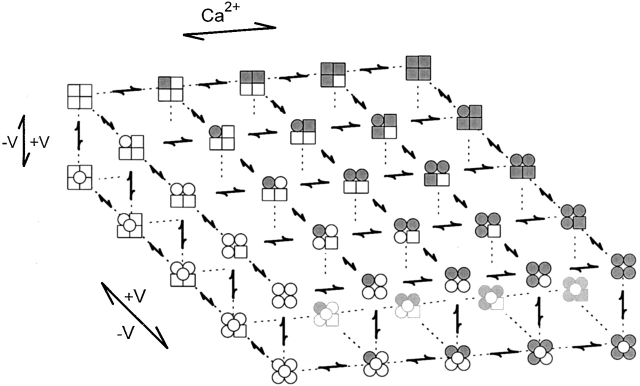
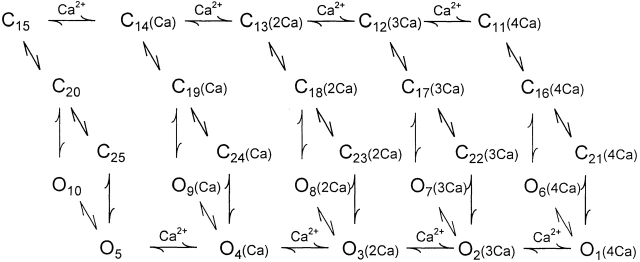
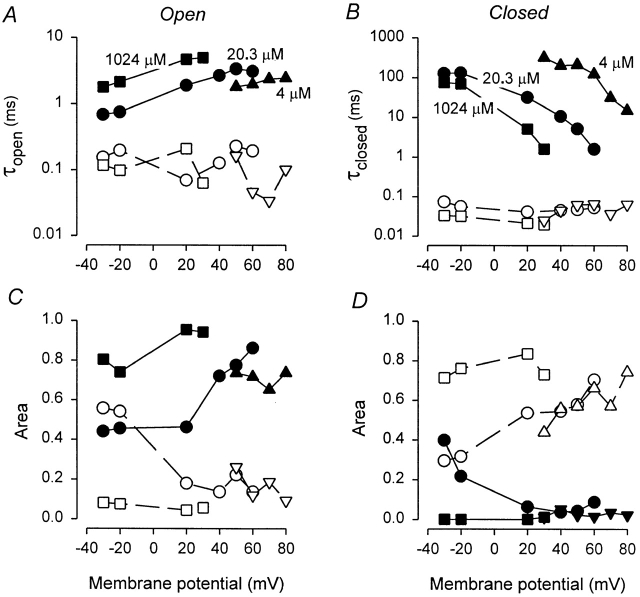
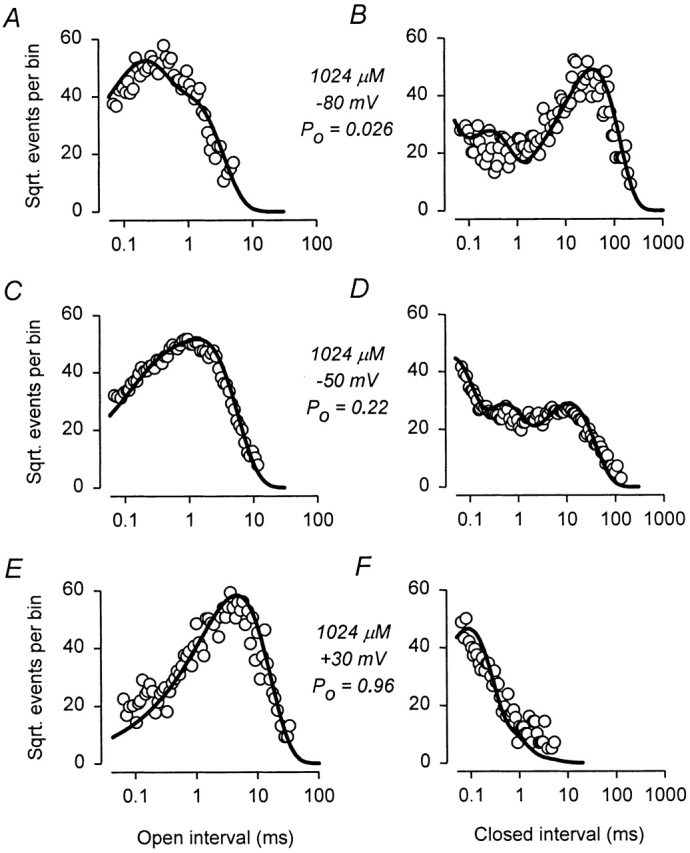
The voltage- and Ca2+-dependent gating mechanism of large-conductance Ca2+-activated K+ (BK) channels from cultured rat skeletal muscle was studied using single-channel analysis. Channel open probability (Po) increased with depolarization, as determined by limiting slope measurements (11 mV per e-fold change in Po; effective gating charge, q(eff), of 2.3 +/- 0.6 e(o)). Estimates of q(eff) were little changed for intracellular Ca2+ (Ca2+(i)) ranging from 0.0003 to 1,024 microM. Increasing Ca2+(i) from 0.03 to 1,024 microM shifted the voltage for half maximal activation (V(1/2)) 175 mV in the hyperpolarizing direction. V(1/2) was independent of Ca2+(i) for Ca2+(i) < or = 0.03 microM, indicating that the channel can be activated in the absence of Ca2+(i). Open and closed dwell-time distributions for data obtained at different Ca2+(i) and voltage, but at the same Po, were different, indicating that the major action of voltage is not through concentrating Ca2+ at the binding sites. The voltage dependence of Po arose from a decrease in the mean closing rate with depolarization (q(eff) = -0.5 e(o)) and an increase in the mean opening rate (q(eff) = 1.8 e(o)), consistent with voltage-dependent steps in both the activation and deactivation pathways. A 50-state two-tiered model with separate voltage- and Ca2+-dependent steps was consistent with the major features of the voltage and Ca2+ dependence of the single-channel kinetics over wide ranges of Ca2+(i) (approximately 0 through 1,024 microM), voltage (+80 to -80 mV), and Po (10(-4) to 0.96). In the model, the voltage dependence of the gating arises mainly from voltage-dependent transitions between closed (C-C) and open (O-O) states, with less voltage dependence for transitions between open and closed states (C-O), and with no voltage dependence for Ca2+-binding and unbinding. The two-tiered model can serve as a working hypothesis for the Ca2+- and voltage-dependent gating of the BK channel.
采用单通道分析方法,研究了培养的大鼠骨骼肌中大电导钙激活钾(BK)通道的电压和钙依赖性门控机制。通过极限斜率测量确定,通道开放概率(Po)随去极化而增加(Po每增加e倍变化,斜率为11 mV;有效门控电荷q(eff)为2.3±0.6 e(o))。对于细胞内钙(Ca2+(i))浓度范围从0.0003到1024 μM,q(eff)的估计变化不大。将Ca2+(i)从0.03增加到1024 μM,使半数最大激活电压(V(1/2))向超极化方向移动175 mV。当Ca2+(i)≤0.03 μM时,V(1/2)与Ca2+(i)无关,表明该通道在无Ca2+(i)时也可被激活。在不同Ca2+(i)和电压下但Po相同的数据中,开放和关闭驻留时间分布不同,这表明电压的主要作用不是通过在结合位点聚集Ca2+。Po的电压依赖性源于去极化时平均关闭速率降低(q(eff)= -0.5 e(o))和平均开放速率增加(q(eff)= 1.8 e(o)),这与激活和失活途径中的电压依赖性步骤一致。一个具有独立电压和钙依赖性步骤的50状态两层模型与在广泛的Ca2+(i)(约0至1024 μM)、电压(+80至 -80 mV)和Po(10(-4)至0.96)范围内单通道动力学的电压和钙依赖性的主要特征一致。在该模型中,门控的电压依赖性主要源于关闭(C-C)和开放(O-O)状态之间的电压依赖性转变,开放和关闭状态(C-O)之间的电压依赖性较小,而Ca2+结合和解离无电压依赖性。该两层模型可作为BK通道钙和电压依赖性门控的一个工作假设。