Rich T C, Fagan K A, Nakata H, Schaack J, Cooper D M, Karpen J W
Department of Physiology and Biophysics, University of Colorado Health Sciences Center, Denver 80262, USA.
J Gen Physiol. 2000 Aug;116(2):147-61. doi: 10.1085/jgp.116.2.147.
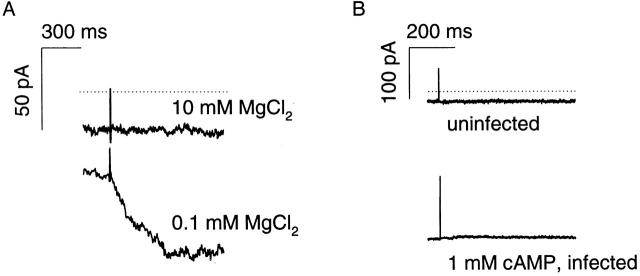
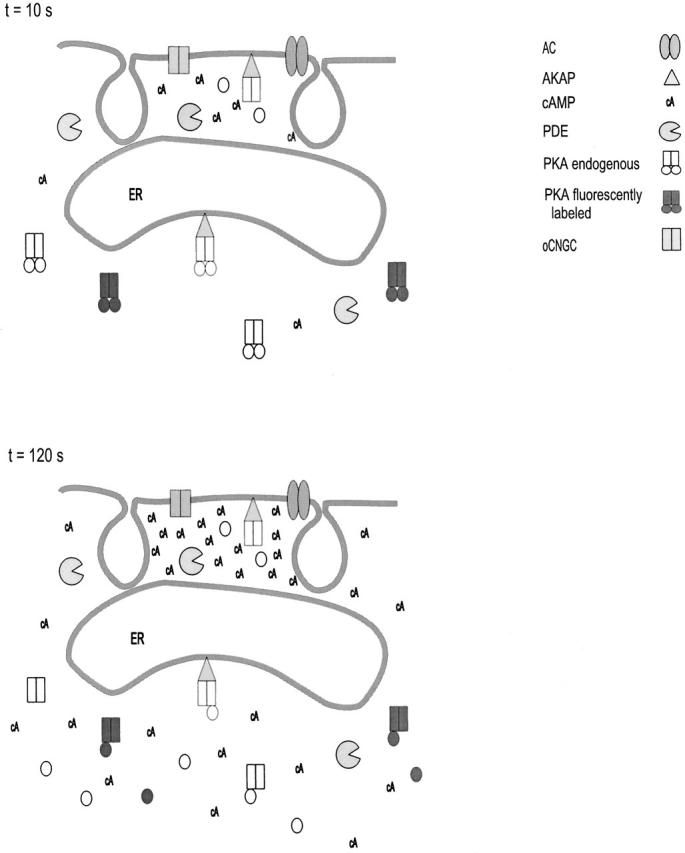
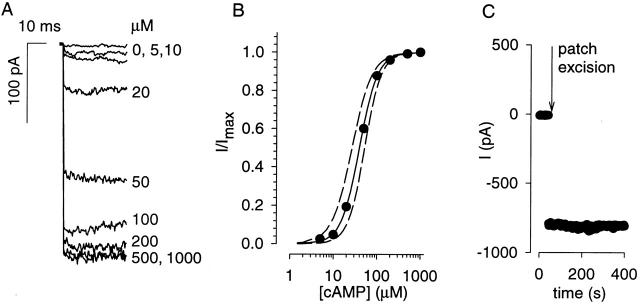
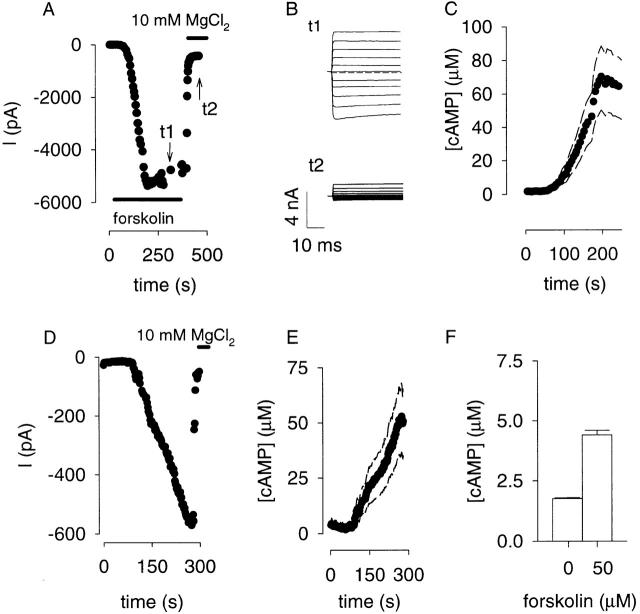
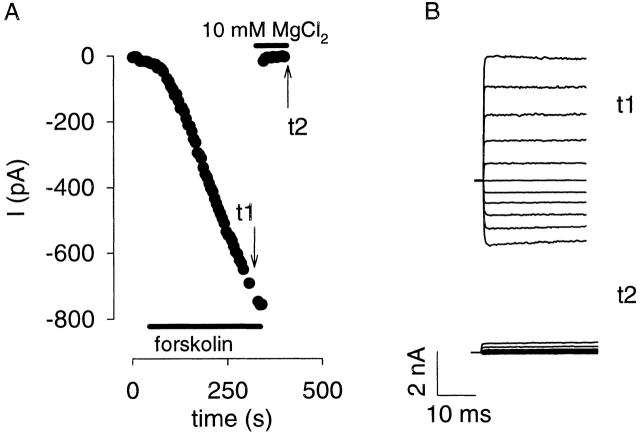
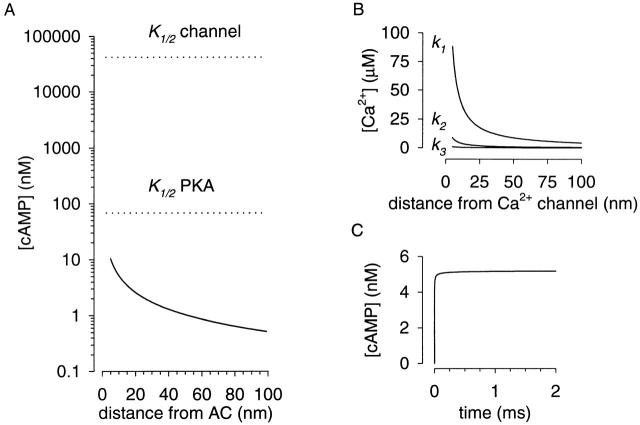
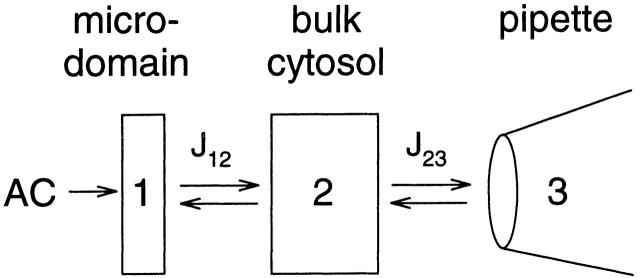
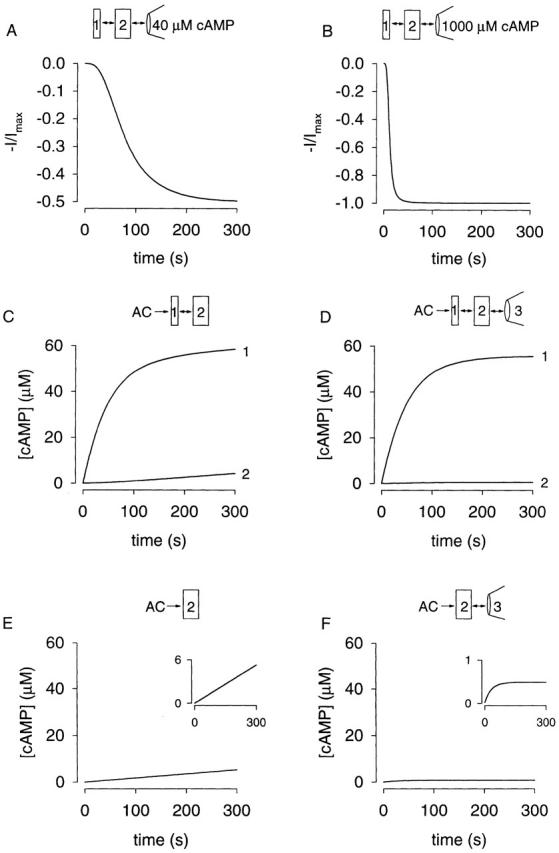
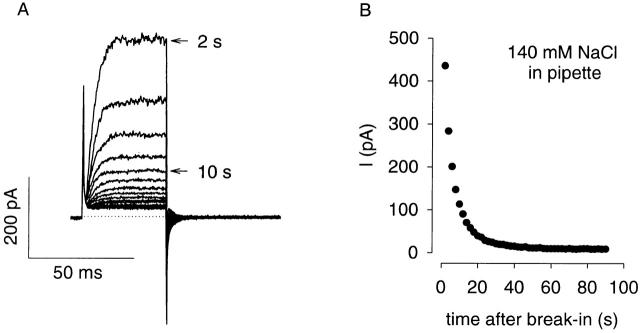
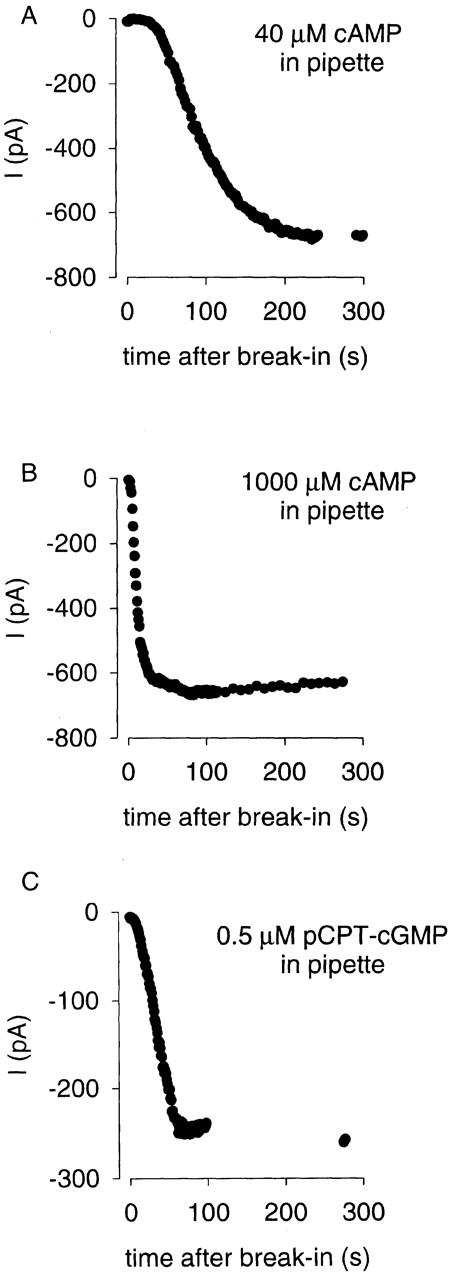
Cyclic AMP is a ubiquitous second messenger that coordinates diverse cellular functions. Current methods for measuring cAMP lack both temporal and spatial resolution, leading to the pervasive notion that, unlike Ca(2+), cAMP signals are simple and contain little information. Here we show the development of adenovirus-expressed cyclic nucleotide-gated channels as sensors for cAMP. Homomultimeric channels composed of the olfactory alpha subunit responded rapidly to jumps in cAMP concentration, and their cAMP sensitivity was measured to calibrate the sensor for intracellular measurements. We used these channels to detect cAMP, produced by either heterologously expressed or endogenous adenylyl cyclase, in both single cells and cell populations. After forskolin stimulation, the endogenous adenylyl cyclase in C6-2B glioma cells produced high concentrations of cAMP near the channels, yet the global cAMP concentration remained low. We found that rapid exchange of the bulk cytoplasm in whole-cell patch clamp experiments did not prevent the buildup of significant levels of cAMP near the channels in human embryonic kidney 293 (HEK-293) cells expressing an exogenous adenylyl cyclase. These results can be explained quantitatively by a cell compartment model in which cyclic nucleotide-gated channels colocalize with adenylyl cyclase in microdomains, and diffusion of cAMP between these domains and the bulk cytosol is significantly hindered. In agreement with the model, we measured a slow rate of cAMP diffusion from the whole-cell patch pipette to the channels (90% exchange in 194 s, compared with 22-56 s for substances that monitor exchange with the cytosol). Without a microdomain and restricted diffusional access to the cytosol, we are unable to account for all of the results. It is worth noting that in models of unrestricted diffusion, even in extreme proximity to adenylyl cyclase, cAMP does not reach high enough concentrations to substantially activate PKA or cyclic nucleotide-gated channels, unless the entire cell fills with cAMP. Thus, the microdomains should facilitate rapid and efficient activation of both PKA and cyclic nucleotide-gated channels, and allow for local feedback control of adenylyl cyclase. Localized cAMP signals should also facilitate the differential regulation of cellular targets.
环磷酸腺苷(cAMP)是一种普遍存在的第二信使,可协调多种细胞功能。目前用于测量cAMP的方法缺乏时间和空间分辨率,导致人们普遍认为,与Ca(2+)不同,cAMP信号简单且信息含量少。在此,我们展示了腺病毒表达的环核苷酸门控通道作为cAMP传感器的开发过程。由嗅觉α亚基组成的同多聚体通道对cAMP浓度的跃升反应迅速,并且测量了它们对cAMP的敏感性,以校准用于细胞内测量的传感器。我们使用这些通道来检测在单细胞和细胞群体中由异源表达或内源性腺苷酸环化酶产生的cAMP。在用福斯可林刺激后,C6 - 2B胶质瘤细胞中的内源性腺苷酸环化酶在通道附近产生高浓度的cAMP,但整体cAMP浓度仍然很低。我们发现在全细胞膜片钳实验中,全细胞胞质的快速交换并不能阻止在表达外源性腺苷酸环化酶的人胚肾293(HEK - 293)细胞中通道附近积累显著水平的cAMP。这些结果可以通过一个细胞区室模型进行定量解释,在该模型中,环核苷酸门控通道与腺苷酸环化酶在微区中共定位,并且cAMP在这些区域与整体胞质溶胶之间的扩散受到显著阻碍。与该模型一致,我们测量了cAMP从全细胞膜片移液管扩散到通道的缓慢速率(90%交换需要194秒,而监测与胞质溶胶交换的物质则需要22 - 56秒)。如果没有微区以及对胞质溶胶的受限扩散通道,我们无法解释所有结果。值得注意的是,在无限制扩散模型中,即使在极其接近腺苷酸环化酶的情况下,cAMP也不会达到足够高的浓度来充分激活蛋白激酶A(PKA)或环核苷酸门控通道,除非整个细胞充满cAMP。因此,微区应该有助于PKA和环核苷酸门控通道的快速有效激活,并允许对腺苷酸环化酶进行局部反馈控制。局部cAMP信号也应该有助于对细胞靶点的差异调节。