Nguyen W D, Kim D H, Alam H B, Provido H S, Kirkpatrick J R
Department of Surgery, Washington Hospital Center, Washington, District of Columbia 20010, USA.
Crit Care. 1999;3(5):127-30. doi: 10.1186/cc358. Epub 1999 Sep 23.
Hepatic injury after ischemia/reperfusion is attributed to the development of oxygen free radical (OFR)-mediated lipid peroxidation--a process that can be measured through its byproducts, specifically malondialdehyde. The use of free radical scavengers can offer significant protection against OFR-induced liver injury. We hypothesize that a new potent OFR scavenger, polyethylene glycol-superoxide dismutase (PEG-SOD), can inhibit OFR-mediated lipid peroxidation in hepatic ischemia/reperfusion injury.
Twelve male Sprague-Dawley rats (300-350 g) were subjected to occlusion of the left and middle hepatic arteries and portal veins for 90 min, followed by 120 min reperfusion. PEG-SOD (5000 units/kg) was given intravenously before vascular occlusion and again immediately upon reperfusion to six rats. Normal saline was given to the remaining six rats to be used as a control group. The right hepatic lobe (used as internal control) and left hepatic lobe were harvested separately and tissue malondialdehyde was measured.
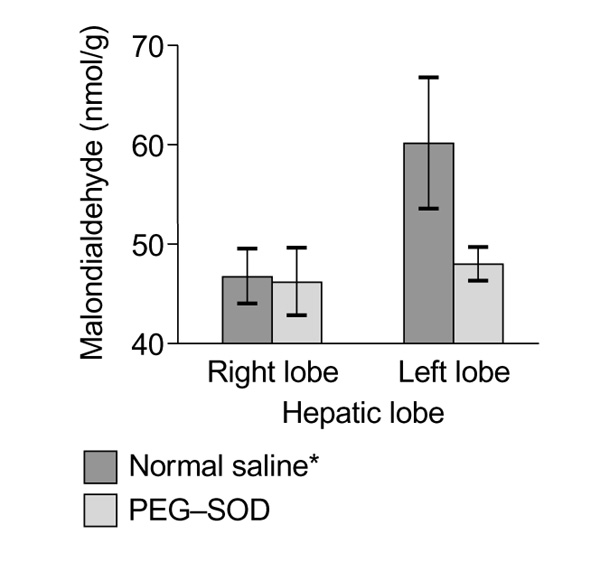
A marked increase in lipid peroxide was found in the normal saline group after 2 h reperfusion. Treatment with PEG-SOD prevented the rise in tissue malondialdehyde. The mean difference in the malondialdehyde between the left and right hepatic lobes were 13.20 +/- 6.35 and 1.70 +/- 3.65 nmol/g in the normal saline (control) and PEG-SOD groups, respectively. This difference was found to be statistically significant (P < 0.005) using Student's t-test.
PEG-SOD can effectively attenuate hepatic ischemia/reperfusion injury by inhibiting OFR-mediated lipid peroxidation.
缺血/再灌注后的肝损伤归因于氧自由基(OFR)介导的脂质过氧化作用——这一过程可通过其副产物,特别是丙二醛来测定。使用自由基清除剂可对OFR诱导的肝损伤提供显著保护。我们假设一种新型强效OFR清除剂,聚乙二醇超氧化物歧化酶(PEG-SOD),可抑制肝缺血/再灌注损伤中OFR介导的脂质过氧化作用。
将12只雄性Sprague-Dawley大鼠(300 - 350克)的左肝动脉、肝中动脉和门静脉阻断90分钟,随后再灌注120分钟。在血管阻断前静脉注射PEG-SOD(5000单位/千克),再灌注时立即对6只大鼠再次注射。给其余6只大鼠注射生理盐水作为对照组。分别采集右肝叶(用作内对照)和左肝叶,测定组织丙二醛含量。
再灌注2小时后,生理盐水组的脂质过氧化物显著增加。PEG-SOD治疗可防止组织丙二醛升高。生理盐水(对照)组和PEG-SOD组左、右肝叶丙二醛的平均差值分别为13.20±6.35和1.70±3.65纳摩尔/克。使用学生t检验发现这种差异具有统计学意义(P < 0.005)。
PEG-SOD可通过抑制OFR介导的脂质过氧化作用有效减轻肝缺血/再灌注损伤。