McInnes I B, Leung B P, Liew F Y
Centre for Rheumatic Diseases, Glasgow Royal Infirmary, University of Glasgow, Glasgow, UK.
Arthritis Res. 2000;2(5):374-8. doi: 10.1186/ar115. Epub 2000 Jul 18.
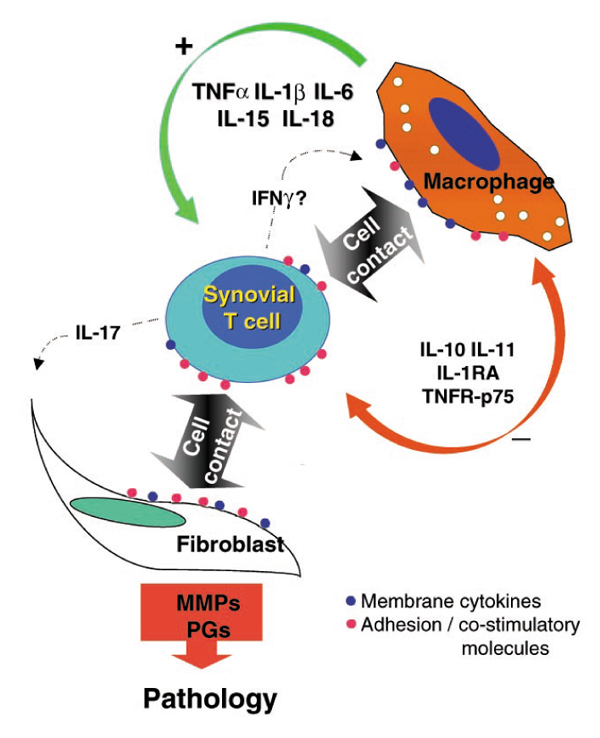
Mechanisms whereby T lymphocytes contribute to synovial inflammation in rheumatoid arthritis are poorly understood. Here we review data that indicate an important role for cell contact between synovial T cells, adjacent macrophages and fibroblast-like synoviocytes (FLS). Thus, T cells activated by cytokines, endothelial transmigration, extracellular matrix or by auto-antigens can promote cytokine, particularly TNF alpha, metalloproteinase production by macrophages and FLS through cell-membrane interactions, mediated at least through beta-integrins and membrane cytokines. Since soluble factors thus induced may in turn contribute directly to T cell activation, positive feedback loops are likely to be created. These novel pathways represent exciting potential therapeutic targets.
T淋巴细胞在类风湿性关节炎中导致滑膜炎症的机制目前还知之甚少。在此,我们回顾了一些数据,这些数据表明滑膜T细胞、相邻巨噬细胞和成纤维细胞样滑膜细胞(FLS)之间的细胞接触具有重要作用。因此,被细胞因子、内皮迁移、细胞外基质或自身抗原激活的T细胞可通过细胞膜相互作用促进巨噬细胞和FLS产生细胞因子,特别是肿瘤坏死因子α和金属蛋白酶,这种相互作用至少是通过β整合素和膜细胞因子介导的。由于由此诱导产生的可溶性因子可能反过来直接促进T细胞活化,因此可能会形成正反馈回路。这些新途径代表了令人兴奋的潜在治疗靶点。