Impagnatiello M A, Weitzer S, Gannon G, Compagni A, Cotten M, Christofori G
Research Institute of Molecular Pathology, Dr. Bohr-Gasse 7, A-1030 Vienna, Austria.
J Cell Biol. 2001 Mar 5;152(5):1087-98. doi: 10.1083/jcb.152.5.1087.
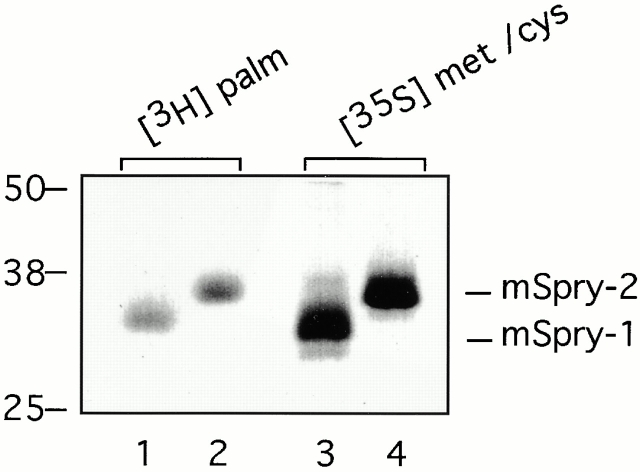
Growth factor-induced signaling by receptor tyrosine kinases (RTKs) plays a central role in embryonic development and in pathogenesis and, hence, is tightly controlled by several regulatory proteins. Recently, Sprouty, an inhibitor of Drosophila development-associated RTK signaling, has been discovered. Subsequently, four mammalian Sprouty homologues (Spry-1-4) have been identified. Here, we report the functional characterization of two of them, Spry-1 and -2, in endothelial cells. Overexpressed Spry-1 and -2 inhibit fibroblast growth factor- and vascular endothelial growth factor-induced proliferation and differentiation by repressing pathways leading to p42/44 mitogen-activating protein (MAP) kinase activation. In contrast, although epidermal growth factor-induced proliferation of endothelial cells was also inhibited by Spry-1 and -2, activation of p42/44 MAP kinase was not affected. Biochemical and immunofluorescence analysis of endogenous and overexpressed Spry-1 and -2 reveal that both Spry-1 and -2 are anchored to membranes by palmitoylation and associate with caveolin-1 in perinuclear and vesicular structures. They are phosphorylated on serine residues and, upon growth factor stimulation, a subset is recruited to the leading edge of the plasma membrane. The data indicate that mammalian Spry-1 and -2 are membrane-anchored proteins that negatively regulate angiogenesis-associated RTK signaling, possibly in a RTK-specific fashion.
受体酪氨酸激酶(RTK)介导的生长因子信号传导在胚胎发育和发病机制中起着核心作用,因此受到多种调节蛋白的严格控制。最近,发现了一种果蝇发育相关RTK信号传导的抑制剂Sprouty。随后,鉴定出了四种哺乳动物Sprouty同源物(Spry-1-4)。在此,我们报告了其中两种,即Spry-1和-2在内皮细胞中的功能特性。过表达的Spry-1和-2通过抑制导致p42/44丝裂原活化蛋白(MAP)激酶激活的途径,抑制成纤维细胞生长因子和血管内皮生长因子诱导的增殖和分化。相比之下,虽然Spry-1和-2也抑制表皮生长因子诱导的内皮细胞增殖,但p42/44 MAP激酶的激活不受影响。对内源性和过表达的Spry-1和-2进行生化和免疫荧光分析表明,Spry-1和-2都通过棕榈酰化锚定在膜上,并在核周和囊泡结构中与小窝蛋白-1结合。它们在丝氨酸残基上被磷酸化,并且在生长因子刺激后,一部分被募集到质膜的前沿。数据表明,哺乳动物Spry-1和-2是膜锚定蛋白,可能以RTK特异性方式负调节血管生成相关的RTK信号传导。