Miura Y, Misawa N, Maeda N, Inagaki Y, Tanaka Y, Ito M, Kayagaki N, Yamamoto N, Yagita H, Mizusawa H, Koyanagi Y
Department of Virology, Tohoku University Graduate School of Medicine, Sendai 980-8575, Japan.
J Exp Med. 2001 Mar 5;193(5):651-60. doi: 10.1084/jem.193.5.651.
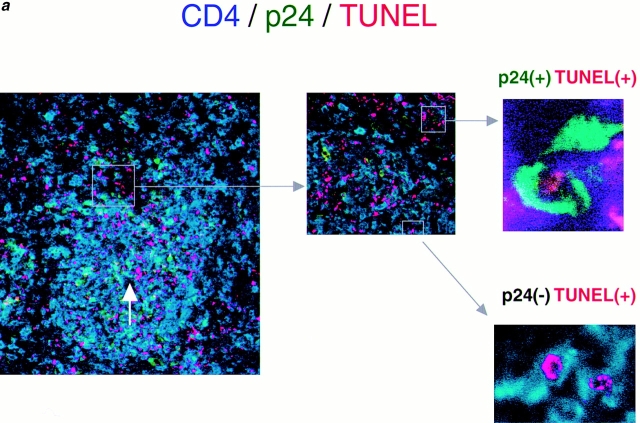
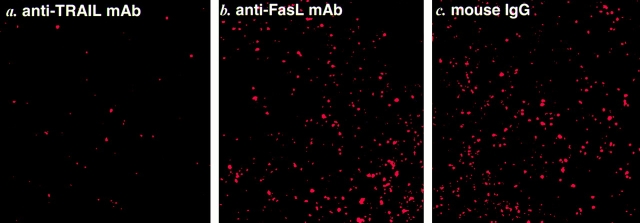
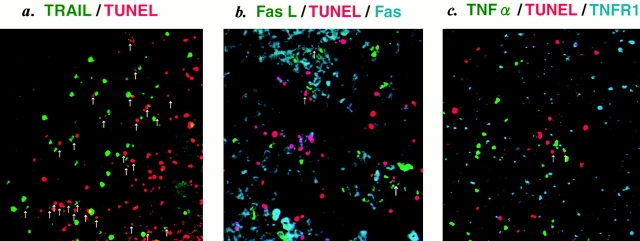
Apoptosis is a key for CD4+ T cell destruction in HIV-1-infected patients. In this study, human peripheral blood lymphocyte (PBL)-transplanted nonobese diabetic (NOD)-severe combined immunodeficient (SCID) (hu-PBL-NOD-SCID) mice were used to examine in vivo apoptosis after HIV-1 infection. As the hu-PBL-NOD-SCID mouse model allowed us to see extensive infection with HIV-1 and to analyze apoptosis in human cells in combination with immunohistological methods, we were able to quantify the number of apoptotic cells with HIV-1 infection. As demonstrated by terminal deoxynucleotidyl transferase-mediated dUTP nick-end labeling (TUNEL), massive apoptosis was predominantly observed in virus-uninfected CD4+ T cells in the spleens of HIV-1-infected mice. A combination of TUNEL and immunostaining for death-inducing tumor necrosis factor (TNF) family molecules indicated that the apoptotic cells were frequently found in conjugation with TNF-related apoptosis-inducing ligand (TRAIL)-expressing CD3+CD4+ human T cells. Administration of a neutralizing anti-TRAIL mAb in HIV-1-infected mice markedly inhibited the development of CD4+ T cell apoptosis. These results suggest that a large number of HIV-1-uninfected CD4+ T cells undergo TRAIL-mediated apoptosis in HIV-infected lymphoid organs.
细胞凋亡是HIV-1感染患者体内CD4+ T细胞破坏的关键因素。在本研究中,利用人外周血淋巴细胞(PBL)移植的非肥胖糖尿病(NOD)-重症联合免疫缺陷(SCID)(hu-PBL-NOD-SCID)小鼠来检测HIV-1感染后的体内细胞凋亡情况。由于hu-PBL-NOD-SCID小鼠模型使我们能够观察到HIV-1的广泛感染,并结合免疫组织学方法分析人细胞中的细胞凋亡,我们得以量化HIV-1感染时凋亡细胞的数量。通过末端脱氧核苷酸转移酶介导的dUTP缺口末端标记法(TUNEL)证实,在HIV-1感染小鼠脾脏中,大量细胞凋亡主要发生在未感染病毒的CD4+ T细胞中。TUNEL与死亡诱导肿瘤坏死因子(TNF)家族分子免疫染色相结合表明,凋亡细胞经常与表达肿瘤坏死因子相关凋亡诱导配体(TRAIL)的CD3+CD4+人T细胞结合出现。给HIV-1感染小鼠注射中和性抗TRAIL单克隆抗体可显著抑制CD4+ T细胞凋亡的发生。这些结果表明,在HIV感染的淋巴器官中,大量未感染HIV-1的CD4+ T细胞会发生TRAIL介导的细胞凋亡。