Li J, Xu L Z, He K L, Guo W J, Zheng Y H, Xia P, Chen Y
Xin Hua Hospital, Shanghai Second Medical University, Shanghai, China.
Breast Cancer Res. 2001;3(4):253-63. doi: 10.1186/bcr303. Epub 2001 Apr 2.
Chemotherapy is important in the systematic treatment of breast cancer. To enhance the response of tumours to chemotherapy, attention has been focused on agents to reverse multidrug resistance (MDR) and on the sensitivity of tumour cells to chemical drugs. Hundreds of reversal drugs have been found in vitro, but their clinical application has been limited because of their toxicity. The reversal activity of progestogen compounds has been demonstrated. However, classical agents such as progesterone and megestrol (MG) also have high toxicity. Nomegestrol (NOM) belongs to a new derivation of progestogens and shows very low toxicity. We studied the reversal activity of NOM and compared it with that of verapamil (VRP), droloxifene (DRO), tamoxifen (TAM) and MG, and investigated the reversal mechanism, i.e. effects on the expression of the MDR1, glutathione S-transferase Pi (GSTpi), MDR-related protein (MRP) and topoisomerase IIalpha (TopoIIalpha) genes, as well as the intracellular drug concentration and the cell cycle. The aim of the study was to examine the reversal effects of NOM on MDR in MCF7/ADR, an MCF7 breast cancer cell line resistant to adriamycin (ADR), and its mechanism of action.
MCF7/ADR cells and MCF7/WT, an MCF7 breast cancer cell line sensitive to ADR, were treated with NOM as the acetate ester. With an assay based on a tetrazolium dye [3-(4,5-dimethylthiazol-2-yl)-2,5-diphenyl-2H-tetrazolium bromide; MTT], the effects of various concentrations of NOM on MDR in MCF7/ADR cells were studied. Before and after the treatment with 5 microM NOM, the expression of the MDR-related genes MDR1, GSTpi, TopoIIalpha and MRP were assayed with a reverse transcriptase polymerase chain reaction (RT-PCR) immunocytochemistry assay. By using flow cytometry (FCM), we observed the intracellular ADR concentration and the effects of combined treatment with NOM and ADR on the cell cycle. Results collected were analysed with Student's t test.
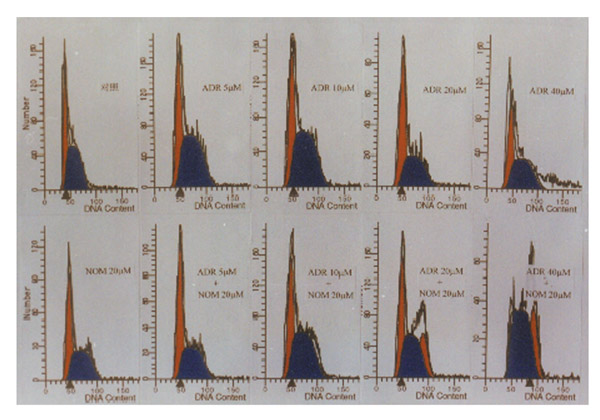
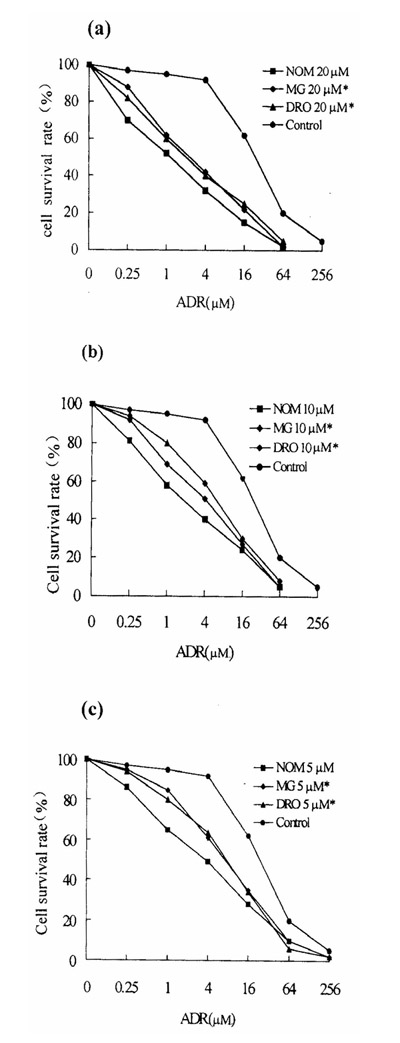
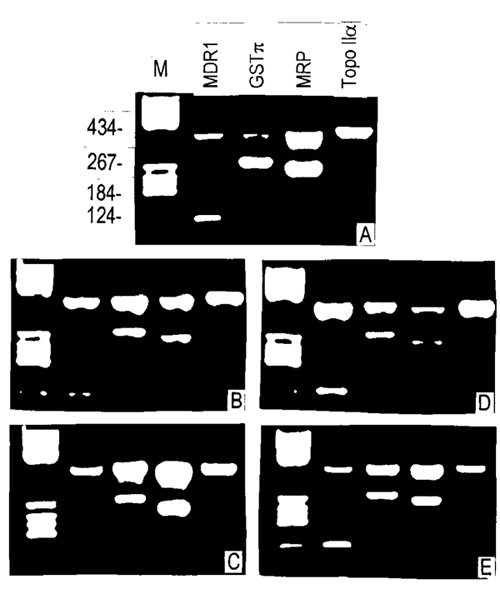
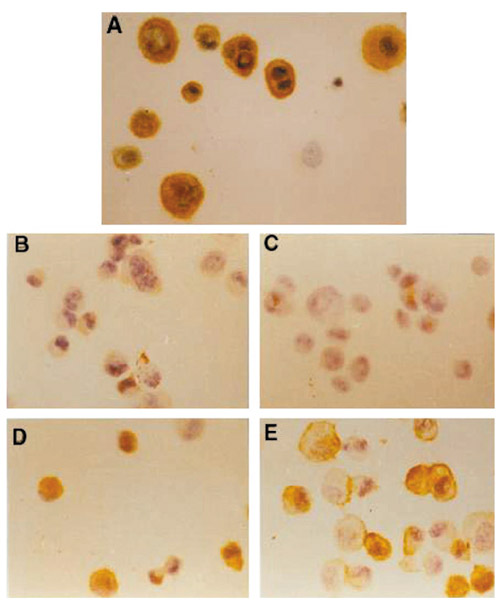
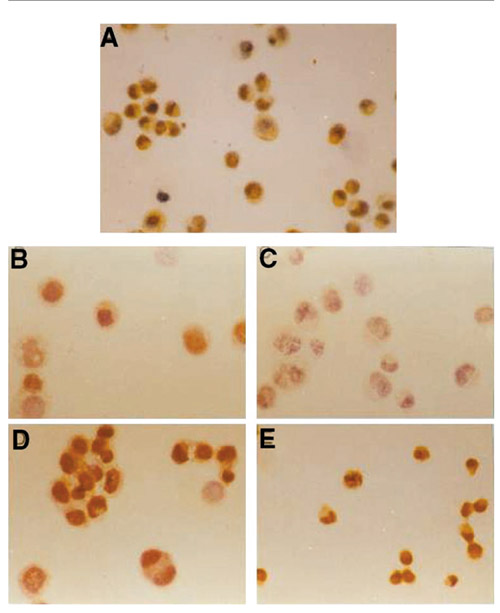
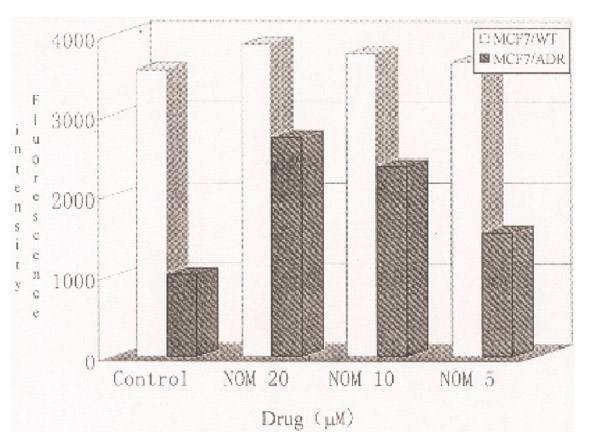
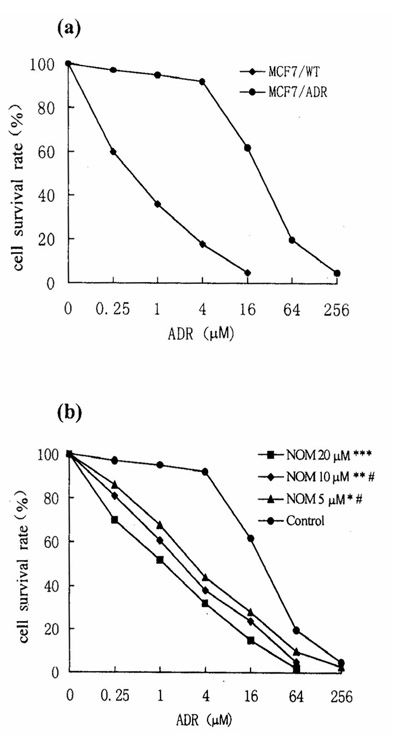
NOM significantly reversed MDR in MCF7/ADR cells. After treatment NOM at 20, 10 and 5 microM, chemosensitivity to ADR increased 21-fold, 12-fold and 8-fold, respectively. The reversal activity of NOM was stronger than that of the precursor compound MG, and comparable to that of VRP. After treatment with 5 microM NOM, the expression of both the MDR1 and the GSTpi mRNA genes began to decline on the second day (P <0.05 and P <0.01, respectively), and reached the lowest level on the third day (both P <0.01); however, on the fifth day the expression levels began to increase again (both P <0.05). The expression of MRP and TopoIIalpha had no significant changes. Changes in the expression of P-glycoprotein (P-gp) and GSTpi were similar to those of their mRNA expressions, showing early declines and late increases. Two hours after treatment with 20, 10 and 5 microM NOM, the intracellular ADR concentration increased 2.7-fold, 2.3-fold and 1.5-fold respectively. However, NOM did not increase ADR accumulation in MCF7/WT cells. FCM data showed that after 48 h of combined administration of NOM (20 microM) and ADR (from low to high concentration), MCF7/ADR cells showed a gradual arrest at the G2M phase with increasing ADR dose. The arrest effect with combined drug treatment was stronger than that with the single ADR treatment.
MDR is the major mechanism of drug resistance in malignant tumour cells. To overcome MDR and to increase chemosensitivity, many reversal agents have been found. Most progestogen compounds have been demonstrated to have reversal effects, but we found no data on NOM, a new progestogen compound. Our results show that NOM has strong reversal activity. The reversal effects were stronger than those of the precursor compound, MG, and were comparable to that of VRP. Because NOM has low toxicity, it might have good prospects in clinical application. Using RT-PCR and immunocytochemistry assays, we studied the effects of NOM on MDR-related genes. The results were that NOM could markedly downregulate the mRNA and protein expression levels of MDR1 and GSTpi. TopoIIalpha and MRP gene expression showed no significant changes. It is known that P-gp induces MDR in tumour cells mainly by decreasing the intracellular drug concentration. After treatment with NOM, the intracellular drug concentration in MCF7/ADR cells increased significantly. Combined treatment with NOM and ADR induced arrest at the G2M phase. It is worth noting that NOM caused an early decrease and a late increase in the expression of some MDR-related genes in a time-dependent manner. The phenomena raise a question for the continued administration of reversal agents in clinics that merits further study. We demonstrate that NOM has strong reversal effects on MDR in MCF7/ADR cells. The reversal is via different routes, namely downregulating the mRNA and protein expression levels of MDR1 and GSTpi, increasing intracellular drug concentration and arresting cells at the G2M phase (NOM in combination with ADR). The reversal mechanism needs further study.
化疗在乳腺癌的系统治疗中至关重要。为提高肿瘤对化疗的反应,人们将注意力集中在逆转多药耐药(MDR)的药物以及肿瘤细胞对化学药物的敏感性上。体外已发现数百种逆转药物,但由于其毒性,它们的临床应用受到限制。孕激素化合物的逆转活性已得到证实。然而,诸如孕酮和甲地孕酮(MG)等经典药物也具有高毒性。诺美孕酮(NOM)属于孕激素的新衍生物,毒性极低。我们研究了NOM的逆转活性,并将其与维拉帕米(VRP)、屈洛昔芬(DRO)、他莫昔芬(TAM)和MG进行比较,同时研究了其逆转机制,即对MDR1、谷胱甘肽S-转移酶Pi(GSTpi)、多药耐药相关蛋白(MRP)和拓扑异构酶IIα(TopoIIα)基因表达的影响,以及细胞内药物浓度和细胞周期。本研究的目的是检测NOM对阿霉素(ADR)耐药的MCF7乳腺癌细胞系MCF7/ADR中MDR的逆转作用及其作用机制。
用醋酸酯形式的NOM处理MCF7/ADR细胞和对ADR敏感的MCF7乳腺癌细胞系MCF7/WT。采用基于四氮唑盐[3-(4,5-二甲基噻唑-2-基)-2,5-二苯基-2H-四氮唑溴盐;MTT]的检测方法,研究不同浓度的NOM对MCF7/ADR细胞中MDR的影响。用5μM NOM处理前后,采用逆转录聚合酶链反应(RT-PCR)免疫细胞化学检测法检测MDR相关基因MDR1、GSTpi、TopoIIα和MRP的表达。通过流式细胞术(FCM),观察细胞内ADR浓度以及NOM与ADR联合处理对细胞周期的影响。收集的结果用Student t检验进行分析。
NOM显著逆转了MCF7/ADR细胞中的MDR。用20、10和5μM的NOM处理后,对ADR的化学敏感性分别增加了21倍、12倍和8倍。NOM的逆转活性强于前体化合物MG,与VRP相当。用5μM NOM处理后,MDR1和GSTpi mRNA基因的表达在第二天开始下降(分别为P <0.05和P <0.01),并在第三天达到最低水平(均为P <0.01);然而,在第五天表达水平又开始上升(均为P <0.05)。MRP和TopoIIα的表达没有显著变化。P-糖蛋白(P-gp)和GSTpi表达的变化与其mRNA表达的变化相似,呈现早期下降和后期上升。用20、10和5μM的NOM处理两小时后,细胞内ADR浓度分别增加了2.7倍、2.3倍和1.5倍。然而,NOM并未增加MCF7/WT细胞中ADR的蓄积。FCM数据显示,在联合给予NOM(20μM)和ADR(浓度从低到高)48小时后,MCF7/ADR细胞随着ADR剂量的增加逐渐停滞在G2M期。联合药物处理的停滞效应强于单一ADR处理。
MDR是恶性肿瘤细胞耐药的主要机制。为克服MDR并提高化学敏感性,已发现许多逆转剂。大多数孕激素化合物已被证明具有逆转作用,但我们未发现关于新孕激素化合物NOM的数据。我们的结果表明NOM具有很强的逆转活性。其逆转作用强于前体化合物MG,与VRP相当。由于NOM毒性低,其在临床应用中可能具有良好的前景。我们采用RT-PCR和免疫细胞化学检测法研究了NOM对MDR相关基因的影响。结果表明,NOM可显著下调MDR1和GSTpi的mRNA和蛋白表达水平。TopoIIα和MRP基因表达无显著变化。已知P-gp主要通过降低细胞内药物浓度诱导肿瘤细胞产生MDR。用NOM处理后,MCF7/ADR细胞内药物浓度显著增加。NOM与ADR联合处理诱导细胞停滞在G2M期。值得注意的是,NOM以时间依赖性方式导致一些MDR相关基因的表达早期下降和后期上升。这些现象为临床中逆转剂的持续给药提出了一个问题,值得进一步研究。我们证明NOM对MCF7/ADR细胞中的MDR具有很强的逆转作用。这种逆转是通过不同途径实现的,即下调MDR1和GSTpi的mRNA和蛋白表达水平、增加细胞内药物浓度以及使细胞停滞在G2M期(NOM与ADR联合)。逆转机制有待进一步研究。