LeMasurier M, Heginbotham L, Miller C
Department of Biochemistry, Howard Hughes Medical Institute, Brandeis University, Waltham, MA 02454, USA.
J Gen Physiol. 2001 Sep;118(3):303-14. doi: 10.1085/jgp.118.3.303.
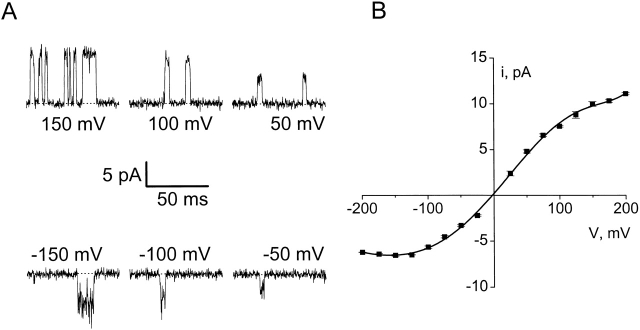
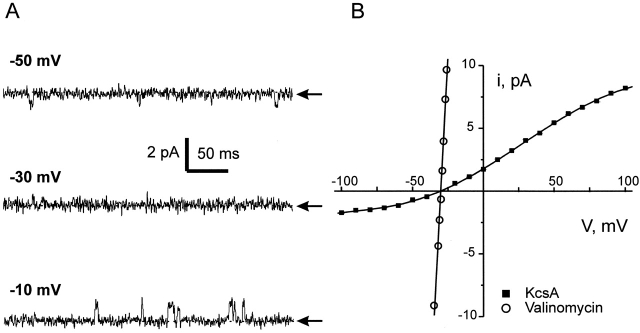
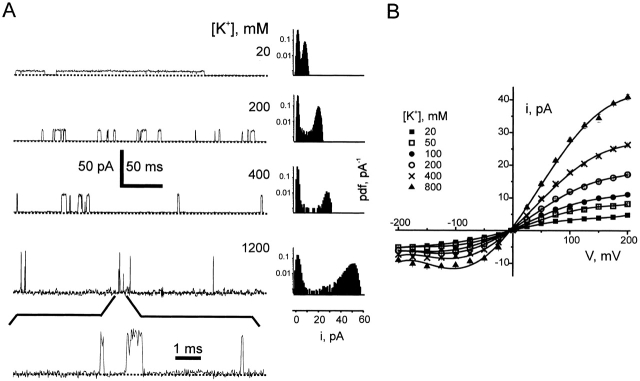
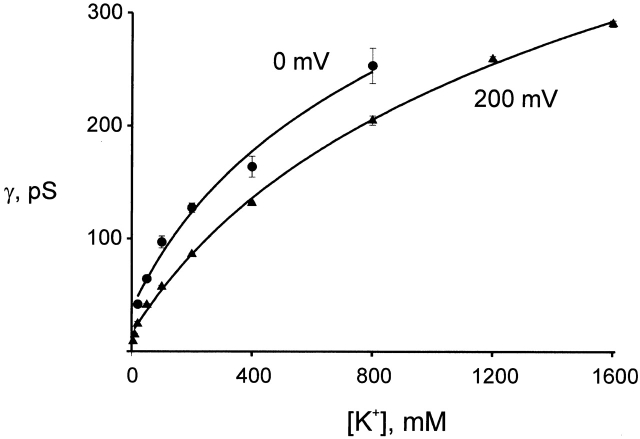
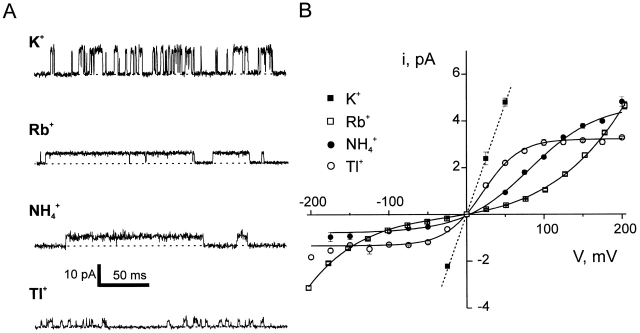
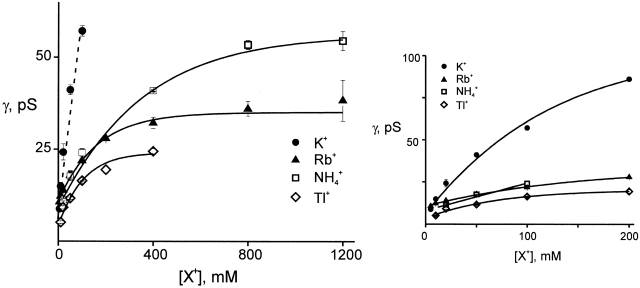
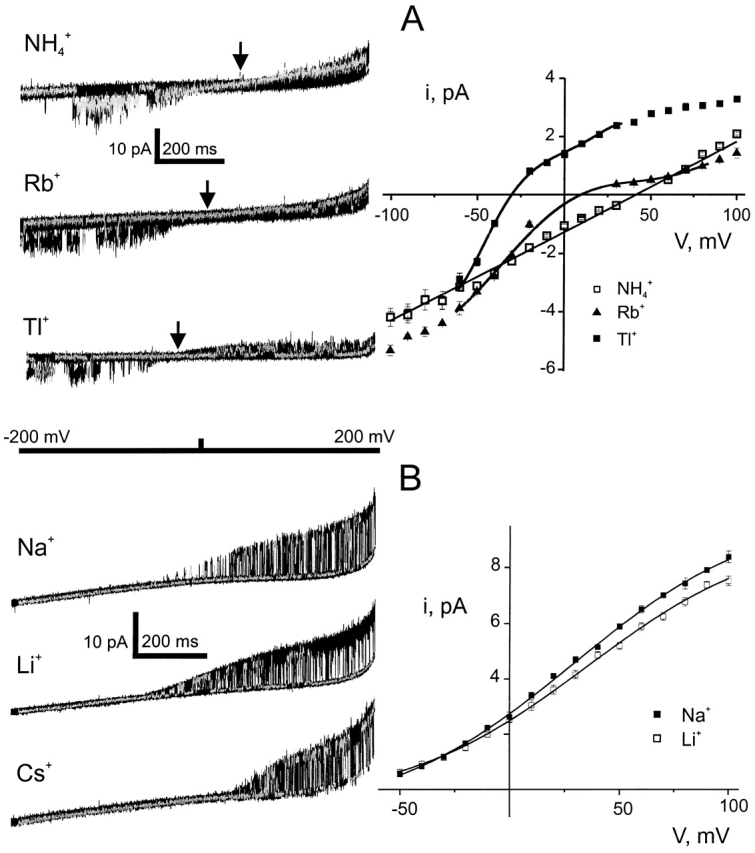
Ion conduction and selectivity properties of KcsA, a bacterial ion channel of known structure, were studied in a planar lipid bilayer system at the single-channel level. Selectivity sequences for permeant ions were determined by symmetrical solution conductance (K(+) > Rb(+), NH(4)(+), Tl(+) >> Cs(+), Na(+), Li(+)) and by reversal potentials under bi-ionic or mixed-ion conditions (Tl(+) > K(+) > Rb(+) > NH(4)(+) >> Na(+), Li(+)). Determination of reversal potentials with submillivolt accuracy shows that K(+) is over 150-fold more permeant than Na(+). Variation of conductance with concentration under symmetrical salt conditions is complex, with at least two ion-binding processes revealing themselves: a high affinity process below 20 mM and a low affinity process over the range 100-1,000 mM. These properties are analogous to those seen in many eukaryotic K(+) channels, and they establish KcsA as a faithful structural model for ion permeation in eukaryotic K(+) channels.
在平面脂质双层系统中,于单通道水平研究了已知结构的细菌离子通道KcsA的离子传导和选择性特性。通过对称溶液电导(K(+) > Rb(+), NH(4)(+), Tl(+) >> Cs(+), Na(+), Li(+))以及双离子或混合离子条件下的反转电位(Tl(+) > K(+) > Rb(+) > NH(4)(+) >> Na(+), Li(+))确定了通透离子的选择性序列。亚毫伏精度的反转电位测定表明,K(+)的通透性比Na(+)高150倍以上。在对称盐条件下,电导随浓度的变化很复杂,至少有两个离子结合过程显现出来:低于20 mM时为高亲和力过程,在100 - 1000 mM范围内为低亲和力过程。这些特性与许多真核生物K(+)通道中观察到的特性相似,并且它们将KcsA确立为真核生物K(+)通道中离子通透的可靠结构模型。