Ezzell G A, Chungbin S
Department of Radiation Oncology, Mayo Clinic Scottsdale, Scottsdale, Arizona 85259, USA.
J Appl Clin Med Phys. 2001 Summer;2(3):138-48. doi: 10.1120/jacmp.v2i3.2607.
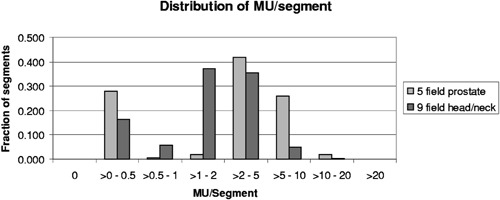
The control loop in the Varian DMLC system (V4.8) requires approximately 65 msec to monitor and halt the irradiation of a segment, causing an "overshoot" effect: the segment ends on a fractional monitor unit larger than that planned. As a result, the actual MU delivered may differ from that planned. In general, for step-and-shoot treatments, the first segment receives more, the last receives less, and intermediate segments vary. The overshoot for each segment (DeltaMU) is small, approximately 0.6 MU at 600 MU/min. Our IMRT planning system (Corvus) produces plans often having more than 20% of the segments with less than 1 MU/segment. Such segments may be skipped if the DeltaMU exceeds the segments' planned MU. Furthermore, QA filming often requires reducing the total MU by a factor of 4-6, increasing the potential for dosimetric error. This study measured DeltaMU over a range of MU/min and MU/segment. At >5 MU/segment, the DeltaMU was stable, corresponding to a delay of 62 msec. DeltaMU became larger and more variable at <1 MU/segment. The behavior was modeled in a computer program that predicted the change in delivered MU/segment and total change in delivered MU to each beamlet. Beams were analyzed for patients receiving 5 field prostate or 9 field head and neck treatments. At 400 MU/min, 28% and 16%, respectively, of the planned segments were skipped. For QA filming, up to 75% of the segments were skipped. The cumulative error averaged <0.1 MU/beamlet, but individual beamlets had errors exceeding 200%. The effect is most significant for low dose regions. Recommendations are given for deciding when to treat or do QA studies with lower MU/min. In general, treatments are not significantly affected, but QA films taken at reduced MU may be improved if irradiated at lowered MU/min.
瓦里安动态调强放疗系统(V4.8)中的控制回路监测并停止一个射野的照射大约需要65毫秒,从而产生“超调”效应:射野在大于计划的分数监测单位时结束。结果,实际输送的监测单位(MU)可能与计划的不同。一般来说,对于步进式治疗,第一段接收的更多,最后一段接收的更少,中间段则有所不同。每个射野的超调量(DeltaMU)很小,在600MU/分钟时约为0.6MU。我们的调强放疗计划系统(Corvus)生成的计划通常有超过20%的射野每段小于1MU。如果DeltaMU超过射野的计划MU,这样的射野可能会被跳过。此外,质量保证拍片通常需要将总MU降低4至6倍,增加了剂量误差的可能性。本研究在一系列MU/分钟和MU/射野范围内测量了DeltaMU。在每段大于5MU时,DeltaMU稳定,对应延迟62毫秒。在每段小于1MU时,DeltaMU变得更大且更具变化性。该行为在一个计算机程序中建模,该程序预测每段输送的MU变化以及每个子野输送的MU的总变化。对接受5野前列腺或9野头颈部治疗的患者的射束进行了分析。在400MU/分钟时,分别有28%和16%的计划射野被跳过。对于质量保证拍片,高达75%的射野被跳过。累积误差平均每子野小于0.1MU,但个别子野的误差超过200%。这种效应在低剂量区域最为显著。给出了关于何时以较低的MU/分钟进行治疗或质量保证研究的建议。一般来说,治疗不会受到显著影响,但如果以较低的MU/分钟进行照射,在降低MU时拍摄的质量保证片可能会得到改善。