Nakaji S, Shimoyama T, Umeda T, Sakamoto J, Katsura S, Sugawara K, Baxter D
Department of Hygiene, Hirosaki University School of Medicine Zaifu-cho 5, Hirosaki, 036-8562 Japan.
BMC Cancer. 2001;1:14. doi: 10.1186/1471-2407-1-14. Epub 2001 Oct 29.
Since Fuchs' report in 1999, the reported protective effect of dietary fiber from colorectal carcinogenesis has led many researchers to question its real benefit. The aim of this study is to evaluate the association between diet, especially dietary fiber and fat and colorectal cancer in Japan.
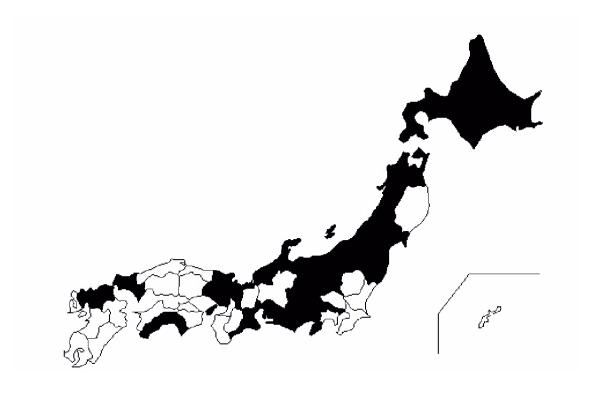
A multiple regression analysis (using the stepwise variable selection method) was performed using the standardized mortality ratios (SMRs) of colon and rectal cancer in 23 Japanese prefectures as objective variables and dietary fiber, nutrients and food groups as explanatory variables.
As for colon cancer, the standardized partial correlation coefficients were positively significant for fat (1,13, P = 0.000), seaweeds (0.41, P = 0.026) and beans (0.45, P = 0.017) and were negatively significant for vitamin A (-0.63, P = 0.003), vitamin C (-0.42, P = 0.019) and yellow-green vegetables (-0.37, P = 0.046). For rectal cancer, the standardized partial correlation coefficient in fat (0.60, P = 0.002) was positively significant. Dietary fiber was not found to have a significant relationship with either colon or rectal cancers.
This study failed to show any protective effect of dietary fiber in subjects with a low fat intake (Japanese) in this analysis, which supports Fuchs' findings in subjects with a high fat intake (US Americans).
自1999年富克斯的报告以来,膳食纤维对结直肠癌的保护作用引发了许多研究人员对其实际益处的质疑。本研究旨在评估日本饮食,尤其是膳食纤维和脂肪与结直肠癌之间的关联。
以日本23个都道府县的结肠癌和直肠癌标准化死亡比(SMR)为目标变量,膳食纤维、营养素和食物组为解释变量,进行多元回归分析(采用逐步变量选择法)。
对于结肠癌,脂肪(1.13,P = 0.000)、海藻(0.41,P = 0.026)和豆类(0.45,P = 0.017)的标准化偏相关系数呈显著正相关,而维生素A(-0.63,P = 0.003)、维生素C(-0.42,P = 0.019)和黄绿色蔬菜(-0.37,P = 0.046)呈显著负相关。对于直肠癌,脂肪的标准化偏相关系数(0.60,P = 0.002)呈显著正相关。未发现膳食纤维与结肠癌或直肠癌有显著关系。
本研究未能在低脂摄入人群(日本人)中显示膳食纤维的任何保护作用,这支持了富克斯在高脂摄入人群(美国美国人)中的研究结果。