Jiang L, Phillips T E, Hamm C A, Drozdowicz Y M, Rea P A, Maeshima M, Rogers S W, Rogers J C
Department of Biology, The Chinese University of Hong Kong, Shatin, New Territories, Hong Kong, China.
J Cell Biol. 2001 Dec 10;155(6):991-1002. doi: 10.1083/jcb.200107012.
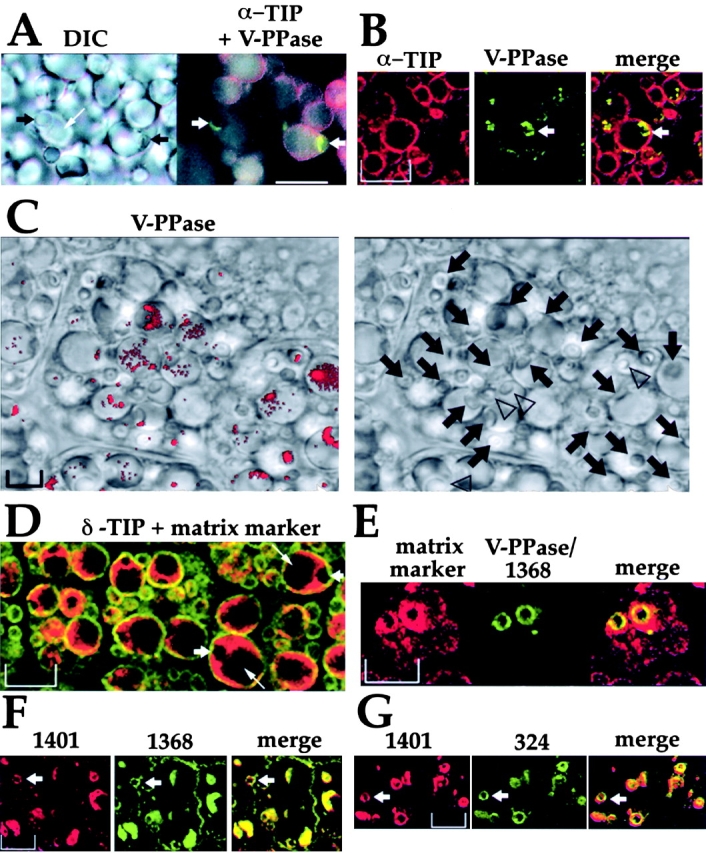
Storage proteins are deposited into protein storage vacuoles (PSVs) during plant seed development and maturation and stably accumulate to high levels; subsequently, during germination the storage proteins are rapidly degraded to provide nutrients for use by the embryo. Here, we show that a PSV has within it a membrane-bound compartment containing crystals of phytic acid and proteins that are characteristic of a lytic vacuole. This compound organization, a vacuole within a vacuole whereby storage functions are separated from lytic functions, has not been described previously for organelles within the secretory pathway of eukaryotic cells. The partitioning of storage and lytic functions within the same vacuole may reflect the need to keep the functions separate during seed development and maturation and yet provide a ready source of digestive enzymes to initiate degradative processes early in germination.
在植物种子发育和成熟过程中,储存蛋白被沉积到蛋白储存液泡(PSV)中,并稳定积累至高含量;随后,在种子萌发期间,储存蛋白迅速降解,为胚提供营养以供其利用。在此,我们表明,一个PSV内部有一个膜结合区室,其中含有植酸晶体和具有液泡溶解特性的蛋白质。这种复合结构,即一个液泡内含有另一个液泡,从而将储存功能与溶解功能分开,此前在真核细胞分泌途径中的细胞器中尚未有过描述。同一液泡内储存功能和溶解功能的分隔可能反映了在种子发育和成熟过程中保持功能分离的必要性,同时又能提供现成的消化酶来源,以便在萌发早期启动降解过程。