Bokemeyer C, Kollmannsberger C, Oechsle K, Dohmen B M, Pfannenberg A, Claussen C D, Bares R, Kanz L
Department of Hematology/Oncology, University of Tuebingen Medical Center, Otfried-Mueller-Str 10, 72076 Tuebingen, Germany.
Br J Cancer. 2002 Feb 12;86(4):506-11. doi: 10.1038/sj.bjc.6600122.
To assess the ability of [(18)F]fluorodeoxyglucose positron emission tomography for the early prediction of response in patients with relapsed metastatic germ cell tumours undergoing salvage high-dose chemotherapy. The role of positron emission tomography was compared with established means of tumour response assessment such as CT scans/MRI and serum tumour marker changes. In addition, positron emission tomography was compared with a current prognostic score which differentiates three prognostic groups with failure-free survival rates ranging from 5-50%. [(18)F]fluorodeoxyglucose uptake of metastases from germ cell tumours as well as CT scans and serum tumour marker were acquired after 2-3 cycles of induction chemotherapy but before the start of high-dose chemotherapy and CT scans/serum tumour marker were compared with the baseline examinations in 23 patients with relapsed germ cell tumours. To evaluate the validity of early response prediction by positron emission tomography, radiological monitoring and serum tumour marker decline, histopathologic response after resection of residual masses and/or the clinical course over 6 months after the end of treatment (relapse vs freedom of progression) were used. Overall, 10 patients (43%) achieved a marker-negative partial remission, three (13%) a marker-positive partial remission, five (22%) a disease stabilization and five (22%) progressed during treatment. Nine patients (39%) remained progression-free over 6 months following treatment, whereas 14 (61%) progressed. The outcome of high-dose chemotherapy was correctly predicted by positron emission tomography/CT scan/serum tumour marker in 91/59/48%. Eight patients with a favourably predicted outcome by CT scans plus serum tumour marker but a positive positron emission tomography prior to high-dose chemotherapy, failed treatment. This results in the following sensitivities/specificities for the prediction of failure of high-dose chemotherapy: positron emission tomography 100/78%; radiological monitoring 43/78%; serum tumour marker 15/100%. The positive and negative predictive values of positron emission tomography were 88 and 100%, respectively. As compared with the prognostic score, positron emission tomography was correctly positive in all patients of the three risk groups who failed treatment. In addition, a negative positron emission tomography correctly predicted a favourable outcome in the good and intermediate group. [(18)F]fluorodeoxyglucose positron emission tomography imaging can be used to assess response to chemotherapy in patients with relapsed germ cell tumours early in the course of treatment and may help to identify patients most likely to achieve a favourable response to subsequent high-dose chemotherapy. In patients with response to induction chemotherapy according to CT scans or serum tumour marker evaluation, positron emission tomography seems to add information to detect patients with an overall unfavourable outcome. It may also be a valuable addition to the prognostic model particularly in the good and intermediate group for further selection of patients who will profit from high-dose chemotherapy.
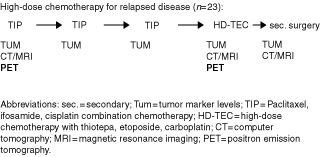
评估[¹⁸F]氟脱氧葡萄糖正电子发射断层扫描在接受挽救性大剂量化疗的复发性转移性生殖细胞肿瘤患者中早期预测反应的能力。将正电子发射断层扫描的作用与已确立的肿瘤反应评估方法(如CT扫描/MRI和血清肿瘤标志物变化)进行比较。此外,将正电子发射断层扫描与当前的预后评分进行比较,该评分区分了三个预后组,无病生存率为5%-50%。在诱导化疗2-3个周期后、大剂量化疗开始前,获取生殖细胞肿瘤转移灶的[¹⁸F]氟脱氧葡萄糖摄取情况以及CT扫描和血清肿瘤标志物,并将23例复发性生殖细胞肿瘤患者的CT扫描/血清肿瘤标志物与基线检查进行比较。为了评估正电子发射断层扫描、放射学监测和血清肿瘤标志物下降对早期反应预测的有效性,采用了切除残留肿块后的组织病理学反应和/或治疗结束后6个月的临床病程(复发与无进展)。总体而言,10例患者(43%)实现了标志物阴性部分缓解,3例(13%)实现了标志物阳性部分缓解,5例(22%)病情稳定,5例(22%)在治疗期间进展。9例患者(39%)在治疗后6个月内无进展,而14例(61%)进展。正电子发射断层扫描/CT扫描/血清肿瘤标志物对大剂量化疗结果的正确预测率分别为91%/59%/48%。8例患者经CT扫描加血清肿瘤标志物预测结果良好,但在大剂量化疗前正电子发射断层扫描为阳性,治疗失败。这导致正电子发射断层扫描、放射学监测、血清肿瘤标志物对大剂量化疗失败预测的敏感性/特异性如下:正电子发射断层扫描100%/78%;放射学监测43%/78%;血清肿瘤标志物15%/100%。正电子发射断层扫描的阳性和阴性预测值分别为88%和100%。与预后评分相比,正电子发射断层扫描在所有治疗失败的三个风险组患者中均正确呈阳性。此外,正电子发射断层扫描阴性正确预测了良好和中等组的良好预后。[¹⁸F]氟脱氧葡萄糖正电子发射断层扫描成像可用于在治疗过程早期评估复发性生殖细胞肿瘤患者对化疗的反应,并可能有助于识别最有可能对后续大剂量化疗产生良好反应的患者。在根据CT扫描或血清肿瘤标志物评估对诱导化疗有反应的患者中,正电子发射断层扫描似乎能提供额外信息以检测总体预后不良的患者。它也可能是预后模型的有价值补充,特别是在良好和中等组中,用于进一步选择将从大剂量化疗中获益的患者。
