Whitehead R H, Hughes L E
Br J Cancer. 1975 Oct;32(4):512-8. doi: 10.1038/bjc.1975.254.
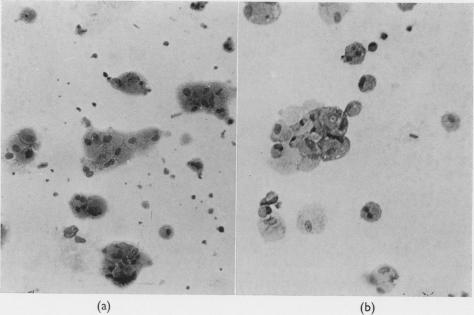
This study reports attempts to culture tumour cells from 51 malignant effusions using standard tissue culture techniques. Cultures proliferating for more than one month were derived from 42 effusions including 24/32 from breast cancer patients and 5/6 from colon carcinomata. The morphology of these cells and their culture characteristics were compared with that of cells derived from a benign effusion. A common cell type--believed to be of mesothelial origin--was found in all cultures. In addition, fibroblastic cells were common and smaller pleomorphic cells, possibly tumour cells, were found in many effusions. The mesothelial cells were often multinucleated and grew for long periods. Although the tumour cells grew in conjunction with the mesothelial cells, all attempts at separation have failed. These studies indicate that cells derived from malignant effusions may be largely of mesothelial origin although tumour cells may also be present. The use of short-term cultures of malignant effusions as the source of cells for use as target cells in cytotoxicity tests and in chemotherapy assays is disscussed.
本研究报告了使用标准组织培养技术从51例恶性积液中培养肿瘤细胞的尝试。从42例积液中获得了增殖超过一个月的培养物,其中包括32例乳腺癌患者中的24例以及6例结肠癌患者中的5例。将这些细胞的形态及其培养特征与来自良性积液的细胞进行了比较。在所有培养物中均发现了一种常见的细胞类型——据信源自间皮。此外,成纤维细胞很常见,并且在许多积液中发现了较小的多形性细胞,可能是肿瘤细胞。间皮细胞通常为多核,且能长时间生长。尽管肿瘤细胞与间皮细胞一起生长,但所有分离尝试均告失败。这些研究表明,源自恶性积液的细胞可能在很大程度上源自间皮,尽管也可能存在肿瘤细胞。本文讨论了将恶性积液的短期培养物用作细胞毒性试验和化疗测定中靶细胞来源的用途。