Hingorani Manju M, Coman Maria Magdalena
Wesleyan University, Molecular Biology and Biochemistry Department, Middletown, Connecticut 06459, USA.
J Biol Chem. 2002 Dec 6;277(49):47213-24. doi: 10.1074/jbc.M206764200. Epub 2002 Oct 4.
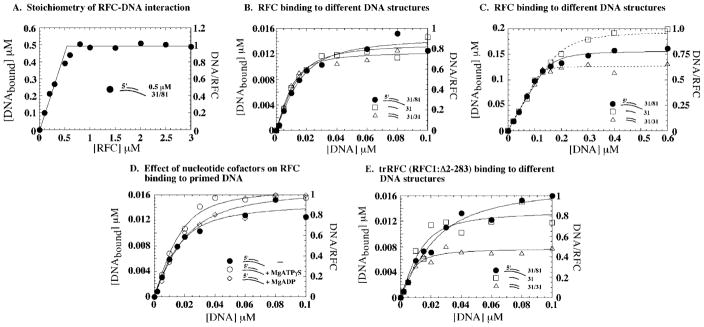
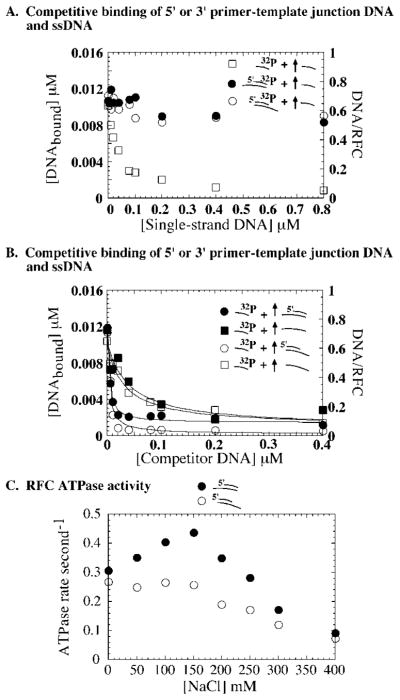
Replication factor C (RFC) catalyzes assembly of circular proliferating cell nuclear antigen clamps around primed DNA, enabling processive synthesis by DNA polymerase during DNA replication and repair. In order to perform this function efficiently, RFC must rapidly recognize primed DNA as the substrate for clamp assembly, particularly during lagging strand synthesis. Earlier reports as well as quantitative DNA binding experiments from this study indicate, however, that RFC interacts with primer-template as well as single- and double-stranded DNA (ssDNA and dsDNA, respectively) with similar high affinity (apparent K(d) approximately 10 nm). How then can RFC distinguish primed DNA sites from excess ssDNA and dsDNA at the replication fork? Further analysis reveals that despite its high affinity for various DNA structures, RFC selects primer-template DNA even in the presence of a 50-fold excess of ssDNA and dsDNA. The interaction between ssDNA or dsDNA and RFC is far less stable than between primed DNA and RFC (k(off) > 0.2 s(-1) versus 0.025 s(-1), respectively). We propose that the ability to rapidly bind and release single- and double-stranded DNA coupled with selective, stable binding to primer-template DNA allows RFC to scan DNA efficiently for primed sites where it can pause to initiate clamp assembly.
复制因子C(RFC)催化在引发的DNA周围组装环状增殖细胞核抗原夹子,从而在DNA复制和修复过程中使DNA聚合酶能够进行持续合成。为了高效执行此功能,RFC必须迅速将引发的DNA识别为夹子组装的底物,尤其是在滞后链合成期间。然而,早期报告以及本研究的定量DNA结合实验表明,RFC与引物模板以及单链和双链DNA(分别为ssDNA和dsDNA)以相似的高亲和力相互作用(表观K(d)约为10 nM)。那么,RFC如何在复制叉处将引发的DNA位点与过量的ssDNA和dsDNA区分开来呢?进一步分析表明,尽管RFC对各种DNA结构具有高亲和力,但即使在存在50倍过量的ssDNA和dsDNA的情况下,RFC仍会选择引物模板DNA。ssDNA或dsDNA与RFC之间的相互作用远不如引发的DNA与RFC之间稳定(分别为k(off) > 0.2 s(-1) 与0.025 s(-1))。我们提出快速结合和释放单链和双链DNA的能力,再加上对引物模板DNA的选择性、稳定结合,使RFC能够有效地扫描DNA以寻找引发位点,在这些位点它可以暂停以启动夹子组装。