Fletcher Emma E, Jones Morgan L, Yeeles Joseph T P
MRC Laboratory of Molecular Biology, Cambridge, UK.
EMBO J. 2025 Apr;44(8):2298-2322. doi: 10.1038/s44318-025-00386-4. Epub 2025 Feb 28.
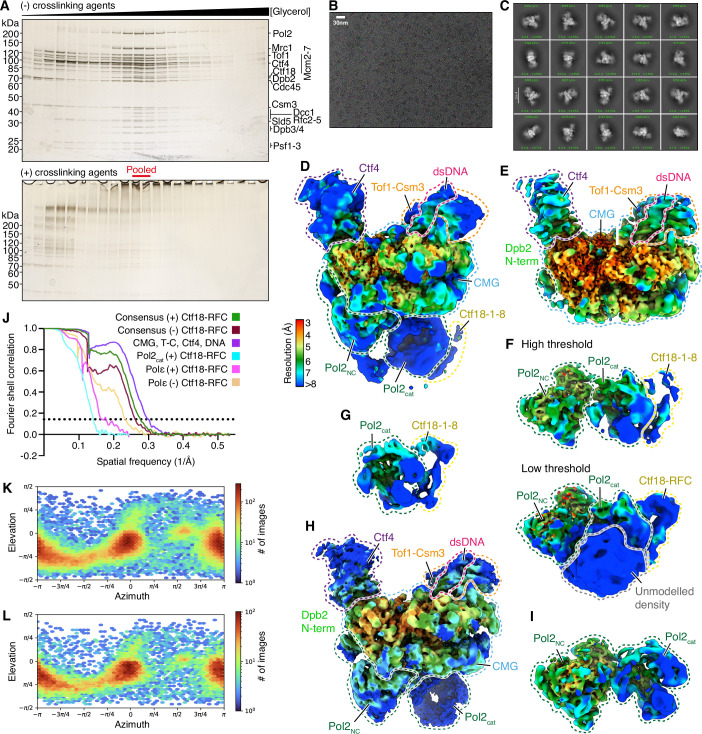
During DNA replication, the DNA polymerases Pol δ and Pol ε utilise the ring-shaped sliding clamp PCNA to enhance their processivity. PCNA loading onto DNA is accomplished by the clamp loaders RFC and Ctf18-RFC, which function primarily on the lagging and the leading strand, respectively. RFC activity is essential for lagging-strand replication by Pol δ, but it is unclear why Ctf18-RFC is required for leading-strand PCNA loading and why RFC cannot fulfil this function. Here, we show that RFC cannot load PCNA once Pol ε has been incorporated into the budding yeast replisome and commenced leading-strand synthesis, and this state is maintained during replisome progression. By contrast, we find that Ctf18-RFC is uniquely equipped to load PCNA onto the leading strand and show that this activity requires a direct interaction between Ctf18 and the CMG (Cdc45-MCM-GINS) helicase. Our work uncovers a mechanistic basis for why replisomes require a dedicated leading-strand clamp loader.
在DNA复制过程中,DNA聚合酶Pol δ和Pol ε利用环形滑动夹增殖细胞核抗原(PCNA)来提高它们的持续合成能力。PCNA加载到DNA上是由夹加载器复制因子C(RFC)和Ctf18-RFC完成的,它们分别主要在滞后链和前导链上发挥作用。RFC活性对于Pol δ进行滞后链复制至关重要,但目前尚不清楚为什么前导链PCNA加载需要Ctf18-RFC,以及为什么RFC不能履行这一功能。在这里,我们表明,一旦Pol ε被纳入出芽酵母复制体并开始前导链合成,RFC就无法加载PCNA,并且这种状态在复制体前进过程中得以维持。相比之下,我们发现Ctf18-RFC具有独特的能力将PCNA加载到前导链上,并表明这种活性需要Ctf18与CMG(Cdc45-微小染色体维持蛋白-GINS)解旋酶之间的直接相互作用。我们的工作揭示了复制体为何需要专门的前导链夹加载器的机制基础。