Bettermann Henrik, Cysarz Dirk, Van Leeuwen Peter
Department of Clinical Research, Gemeinschaftskrankenhaus, 58313 Herdecke, Germany.
BMC Physiol. 2002 Dec 4;2:18. doi: 10.1186/1472-6793-2-18.
The objective was to evaluate and to compare two completely different detection algorithms of intermittent (short-term) cardiorespiratory coordination during night sleep. The first method is based on a combination of respiratory flow and electrocardiogram recordings and determines the relative phases of R waves between successive onsets of inspiration. Intermittent phase coordination is defined as phase recurrence with accuracy alpha over at least k heartbeats. The second, recently introduced method utilizes only binary coded variations of heart rate (acceleration = 1, deceleration = 0) and identifies binary pattern classes which can be assigned to respiratory sinus arrhythmia (RSA). It is hypothesized that RSA pattern class recurrence over at least k heartbeats is strongly related with the intermittent phase coordination defined above.
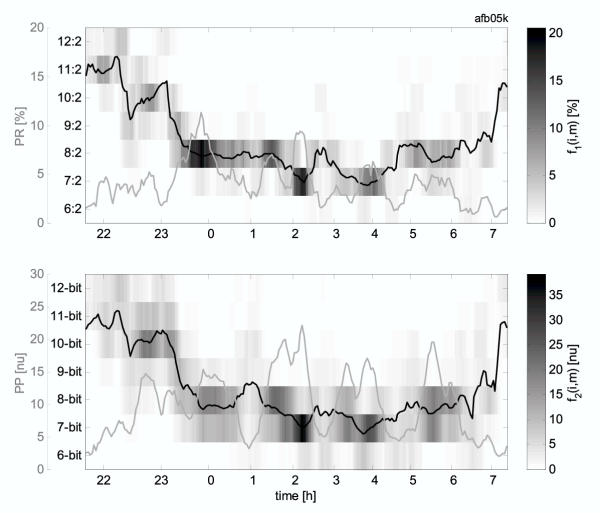
Both methods were applied to night time recordings of 20 healthy subjects. In subjects <45 yrs and setting k = 3 and alpha = 0.03, the phase and RSA pattern recurrence were highly correlated. Furthermore, in most subjects the pattern predominance (PP) showed a pronounced oscillation which is most likely linked with the dynamics of sleep stages. However, the analysis of bivariate variation and the use of surrogate data suggest that short-term phase coordination mainly resulted from central adjustment of heart rate and respiratory rate rather than from real phase synchronization due to physiological interaction.
Binary pattern analysis provides essential information on short-term phase recurrence and reflects nighttime sleep architecture, but is only weakly linked with true phase synchronization which is rare in physiological processes of man.
目的是评估和比较两种完全不同的夜间睡眠期间间歇性(短期)心肺协调检测算法。第一种方法基于呼吸流量和心电图记录的组合,并确定连续吸气起始之间R波的相对相位。间歇性相位协调被定义为在至少k次心跳中具有精度α的相位重现。第二种最近引入的方法仅利用心率的二进制编码变化(加速=1,减速=0),并识别可分配给呼吸性窦性心律不齐(RSA)的二进制模式类别。据推测,至少k次心跳的RSA模式类别重现与上述间歇性相位协调密切相关。
两种方法都应用于20名健康受试者的夜间记录。在年龄<45岁的受试者中,设置k = 3且α = 0.03时,相位和RSA模式重现高度相关。此外,在大多数受试者中,模式优势(PP)显示出明显的振荡,这很可能与睡眠阶段的动态有关。然而,双变量变化分析和替代数据的使用表明,短期相位协调主要是由心率和呼吸率的中枢调节引起的,而不是由于生理相互作用导致的真正相位同步。
二进制模式分析提供了关于短期相位重现的重要信息,并反映了夜间睡眠结构,但与真正的相位同步联系较弱,而真正的相位同步在人类生理过程中很少见。