Leung Sherri K., Ohh Michael
J Biomed Biotechnol. 2002;2(3):131-135. doi: 10.1155/S1110724302205057.
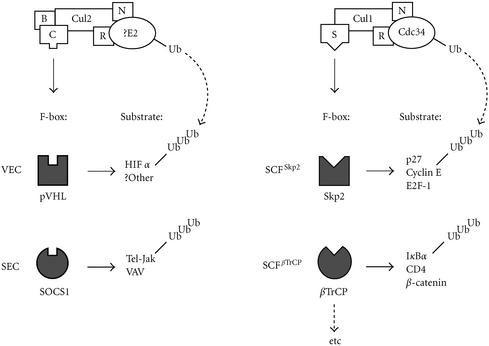
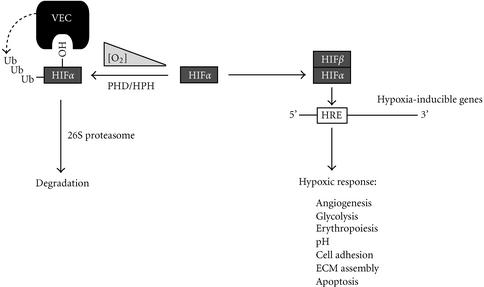
Inactivation of the von Hippel-Lindau (VHL) tumour suppressor gene product pVHL is the cause of inherited VHL disease and is associated with sporadic kidney cancer. pVHL is found in a multiprotein complex with elongins B/C, Cul2, and Rbx1 forming an E3 ubiquitin ligase complex called VEC. This modular enzyme targets the alpha subunits of hypoxia-inducible factor (HIF) for ubiquitin-mediated destruction. Consequently, tumour cells lacking functional pVHL overproduce the products of HIF-target genes such as vascular endothelial growth factor (VEGF), which promotes angiogenesis. This likely accounts for the hypervascular nature of VHL-associated neoplasms. Although pVHL has been linked to the cell-cycle, differentiation, and the regulation of extracellular matrix assembly, microenvironment pH, and tissue invasiveness, this review will focus on the recent insights into the molecular mechanisms governing the E3 ubiquitin ligase function of VEC.
冯·希佩尔-林道(VHL)肿瘤抑制基因产物pVHL的失活是遗传性VHL病的病因,且与散发性肾癌相关。pVHL存在于一个多蛋白复合物中,该复合物与延伸蛋白B/C、Cul2和Rbx1共同形成一个名为VEC的E3泛素连接酶复合物。这种模块化酶将缺氧诱导因子(HIF)的α亚基作为靶点,进行泛素介导的降解。因此,缺乏功能性pVHL的肿瘤细胞会过度产生HIF靶基因的产物,如促进血管生成的血管内皮生长因子(VEGF)。这可能解释了VHL相关肿瘤的高血管化特性。尽管pVHL与细胞周期、分化以及细胞外基质组装、微环境pH值和组织侵袭性的调节有关,但本综述将聚焦于对VEC的E3泛素连接酶功能调控分子机制的最新见解。